

Ah, Grantleigh Manor, talk about 1980s nostalgia writ large. Margaret Thatcher was Prime Minister, fox hunting was legal, and the words “Little England” suggested nothing more than small-town life amongst the rolling pastures of Britain's idyllic countryside – exactly the subject matter, in fact, of this classic sitcom, as noted by the Daily Telegraph in a 2007 cast reunion.
I just spent the better part of 16 hours over the weekend, watching this blast from the past on You Tube. For the unacquainted, above is the very first episode from the Fall of 1979, now enjoying its 30th anniversary. You can watch part 2 here and part 3 here. The sitcom was aired on BBC for three seasons between 1979 and 1981.
To the Manor Born is a British comedy about the life of Audrey fforbes-Hamilton, a woman of some means and no small reputation. Set in the heart of the English countryside, Grantleigh Manor is the focal point of Audrey fforbes-Hamiltons life, but when her husband dies she is horrified to discover that she is bankrupt and must sell her beloved Grantleigh Manor to Richard DeVere, a London businessman. Her reduced circumstances find her moving into the Manor's lodge, where she can keep an eye on DeVere's activities at the Manor while she schemes to reclaim her ancestral home.
The aristocratically-minded Audrey fforbes Hamilton is played brilliantly by British actress, Penelope Keith.
- Elizabeth our Prince -

Long to Reign Over Us our Christian Prince
- Queen Elizabeth the Second (1952 -)
- Churchill our Patron -

Patron of the English-Speaking Peoples
- Sir Winston Churchill, K.G. (1874-1965)
- Burke our Patriarch -
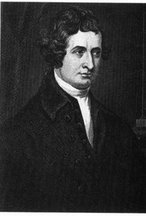
Patriarch of the Permanent Things
- Rt. Hon. Edmund Burke (1729-1797)
- Kipling our Poet -

Poet Laureate of the British Empire
- Rudyard Kipling (1865-1936)
- Salisbury our Prime Minister -
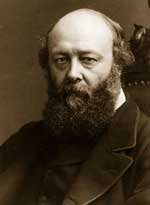
Icon of Traditional, Aristocratic Conservatism
- Lord Robert Cecil Salisbury (1830-1903)
The Daily Bayonet
The Daily Telegraph
Restore the Honour
The Salisbury Review
 Father Raymond De Souza
Lord Tebbit of Chingford
Lord Black of Crossharbour
Gerald Warner
Daniel Hannan, MEP
Andrew Cusack
 Mark Steyn
Brits at their Best
Royalty Monarchy *
The Young Fogey
Throne, Alter, Liberty
Sunlit Uplands
David Flint
Admiral Cod
Young Fogey Down Under
David Warren
Peter Hitchens
The Kiwi Examiner
Taki's Magazine
Archbishop Cranmer
The Skeptical Doctor
 Commonwealth Conversation
Your Freedom and Ours
Gods of the Copybook Headings
A Letter To The Times
Curated Secrets
"Reading The Monarchist is like entering an Edwardian Gentlemen's Club during the era of Swinging London. The hippie rabble bangs at the door demanding entrance; the members simply order the cellist to play forte and continue with the debate and the port." - The Gods of the Copybook Headings

Evelyn Waugh (1903 - 1966)
No good ever came from a public cause, only a private cause of the spirit. - Evelyn Waugh
The Counter Revolution
God Save the Queen!
Maintain Personal Union!
Call the Commonwealth British!
Save the Imperial Standard!
Restore the Hereditary Lords!
I Believe in the Elite for All!
The Radical Tory Manifesto!
Bring Back the Stiff Upper Lip!
Revive Sirs and Knighthoods!
Bring Back the RCN/RCAF!
Tobacco is Good for the Soul!
For Liberty and Livelihood!
Save the Scottish Regiments!
N.Z. Restores Knighthoods!
Gurkha Justice Campaign!
Zero Tolerance for Dust Jackets!
Keep the Gentleman's Necktie!
Repeal the Foxhunting Ban!
Abolish the "HR" Commissions!
I Want a Referendum.Com!
Bring Back Pipe Smoking!
Modern Art is Rubbish!
The Sir Keith Park Memorial!
Unite the Kingdoms!
Better Off Out!
I am a Conservative to preserve all that is good in our constitution, a Radical to remove all that is bad. I seek to preserve property and to respect order, and I equally decry the appeal to the passions of the many or the prejudices of the few. - Benjamin Disraeli
- KING AND COUNTRY -

Let us therefore brace ourselves to our duty, and so bear ourselves... - W.S. Churchill
Imperial Loyalists
Imperial State Crown
Imperial Society of Knights
The Empire Club of Canada
Commonwealth War Graves
For King and Empire
British Peoples League
American Loyalist Institute
Land Forces of the Empire
Royal Over-Seas League
Imperium et Libertas
United Empire Loyalists

Ex-Services League
Red Ensign Society of Canada
Imperial War Museum
Daughters of Empire
Empire on the Bay
British Empire Museum
Royal Commonwealth Society
The Victorian Peeper
British East India Co.
The British North America Blog
Order of the British Empire
Imperial Bank of Commerce
Dominion of British West Florida
The Victoria League
United Commonwealth Society
Hudson Bay Company
Empire State Building
Victorian Station
The North West Company
Imperial Glory
British Club Worldwide
The Emperor's Club
The Imperial Mail
Proud to be British Aussies
Taylor Empire Airways
British Expats
...if the British Empire and Commonwealth should last a thousand years, men will still say this was their finest hour.
- Prime Minister Winston Churchill
Anglo Monarchists
THE QUEEN
The Royalist
The Loyalist
Anglican Rose
Tory Heaven
 An Irish Tory
Australian Spirit
Classic Canadian
Altar and Throne
Radical Royalist
Tea at Trianon
NO REPUBLIC!
Throne and Altar
The Young Fogey
Queen and Country
The American Monarchist
Australian Young Fogey
Let Britannia Rise
God Save The Queen
New Zealand Monarchy
The Oxford Monarchists
Royal Representative
Canadian Monarchist Online
The Mad Monarchist...NEW!
Aussie Republic Unplugged
The Commonwealth Monarchist
There is nothing in the world more stubborn than a corpse: you can hit it, you can knock it to pieces, but you cannot convince it.
- Alexander Herzen
Gentlemen Royalists
Richard Stone
Gerald Warner
Timothy Belmont
Andrew Cusack
Robert Finch
Dr. David Flint
Taki Theodoracopulos
Guy Stair Sainty
Rafal Heydel-Mankoo *
Jim Frecklington, OAM
Theodore Harvey *
Richard Toporoski
Peter Hitchens
Holden Royalist
The Realm of J.J.
 J.K. Baltzersen
Philip Benwell, MBE
Dr. Roy Eappen
 Neil Welton
Charles Coulombe, KCStS
Alexander Stoddart
Padre Benton
Dr. Noel Cox
Joseph Crisp
Alan Goudman
Jeremy Paxman
Matt Bondy
On the quality of magnificence, a gentleman does not count the cost. - Aristotle
Queen and Church
 The Supreme Governor
Apostle to the English
Saint Augustine of Canterbury
Archbishop of Canterbury
Westminster Abbey
Anglican Communion
Anglican Church of Canada
Anglican Church of Australia
Anglican Church New Zealand
Anglican Catholic Church
Episcopal Church in the USA
Scottish Episcopal Church
Church of Scotland
Church of Ireland
 Church in Wales
 Church of Rome
Canterbury Cathedral
Church of Rome
Canterbury Cathedral
Archbishop of York
York Minster Cathedral
Dean of Westminster
St. George's Chapel, Windsor
Dean of Windsor
St. Giles' Cathedral
St. Paul's Cathedral
English Clergy Association
Anglicans in Africa
Catholic Church in England
Orthodox Presbyterian Church
Presbyterian Church Canada
Presbyterian Church Australia
Presbyterian Church (USA)
Presbyterian Church of NZ
Presbyterian Church America
Scottish Christian.com
Anglicans Online
King Charles the Martyr
There is nothing an English country lord loves, so much as his good English church.
- Thomas Babbington Macaulay
Saint George
ST. GEORGE'S CHAPEL
Royal Society of St. George
St. George's Society New York
St. George's Society Toronto
St. George Melbourne
St. George Greater Vancouver
St. George Birmingham
Alberta St. George of England
The St. Andrew's Society
New York Caledonian Club
St. Andrew's of Toronto
Royal Caledonian South Oz
St. Andrew's of Montreal
Royal Caledonian Melbourne
Saint David
St.David Society of Toronto
St. David Society of Baltimore
St. David's Society of Montreal
St. David's Cathedral
Victoria Welsh Society
St. Patrick's New York
St. Patrick's of Montreal
The St. Patrick Centre
The Ulster Society
Ulster Loyal
St. Patrick's Day
St. Patrick's Basilica, Ottawa
SAINT NICHOLAS
The game's afoot: Follow your spirit; and upon this charge Cry 'God for Harry, England, and Saint George!'
- William Shakespeare, Henry V
- THE QUEEN'S ENGLISH -

Self-love, my liege, is not so vile a sin, as self neglecting. - William Shakespeare
English Literature
QUEEN'S ENGLISH SOCIETY
Anthology of English Literature
The New Chaucer Society
Christopher Marlowe Society
William Shakespeare Society
John Milton Reading Room
Samuel Johnson Society
Johnson Society of London
Jonathan Swift Blog
Lord Byron Society
Edmund Burke Society
The Jane Austen Society
Discovering Dickens
Charles Dickens Page
The Lord Tennyson Page
The G.A. Henty Society
The Kipling Society
Sir Arthur Conan Doyle
The Oscar Wilde Society
Gilbert and Sullivan Archive
Sir Edward Elgar Society
G.K. Chesterton Society
Hilaire Belloc, Wiki
George Orwell's Works
The Churchill Society
T.S. Eliot Society
The Mythopoeic Society
The Tolkien Society
Dorothy L. Sayers Society
C.S. Lewis Foundation
C.S. Lewis: Into the Wardrobe
P.G. Wodehouse (1881-1975)
Evelyn Waugh (1903-1966)
Robertson Davies (1913-1995)
Robert Frost Society
Mordecai Richler, Wiki
Norman Mailer Society *
To every man upon this earth, death cometh soon or late. And how can man die better than facing fearful odds, for the ashes of his fathers, and the temples of his gods.
- Thomas Babbington Macaulay
Poets Laureate
POET LAUREATE
Cavalier Poets
The Bard of Avon
The Bard of Scotland
Parliamentary Poet Laureate
Poet Laureate Consultant
The Edinburgh Makar
Ben Jonson (1572-1637)
William Davenant (1606-1668)
John Dryden (1631-1700)
Thomas Shadwell (1642-1692)
Robert Burns (1759-1796)
Will Wordsworth (1770-1850)
Sir Walter Scott (1771-1832)
Robert Southey (1774-1843)
Lord Byron (1788-1824)
Alfred Tennyson (1809-1892)
Alfred Austin (1835-1913)
Rudyard Kipling (1860-1936)
Robert Service (1874-1958)
Robert Bridges (1844-1930)
Robert Frost (1874-1963)
John Masefield (1878-1967)
What weight of ancient witness can prevail, if private judgement hold the public scale?
- John Dryden.
- CONSTITUTION OF LIBERTY -

The right to be consulted; The right to advise; The right to warn. - Walter Bagehot
English Constitution
Charter of Liberties (1100)
Constitution Clarendon (1164)
Assize of Clarendon (1166)
Assize of Arms (1181)
Magna Carta (1215)
Model Parliament (1265)
Right of Common Law (1297)
Acts of Supremacy (1534-59)
Petition of Right (1628)
The Levellers (1642)
Levellers' Manifesto (1649)
Habeas Corpus (1679)
"Glorious Revolution" (1688)
English Bill of Rights (1689)
Act of Settlement (1701)
Treaty (Acts) of Union (1707)
Decl. of Independence (1776)
U.S. Constitution (1789)
U.S. Bill of Rights (1791)
Act of Union (1800)
Reform Act (1832)
Treaty of Waitangi (1844)
B.N.A. Act (1867)
The English Constitution (1867)
Australian Constitution (1900)
Balfour Declaration (1926)
Statute of Westminster (1931)
Constitution Act (1982)
Charter of Rights (1982)
Const. of New Zealand (1986)
Constitution of the U.K.
What weight of ancient witness can prevail, if private judgement hold the public scale?
- John Dryden.
- LANDED GENTRY -

To horse and away To the heart of the fray! Fling care to the Devil for one merry day!
- W.H. Ogilvie
Liberty and Livelihood!
Fox Hunting
Countryside Alliance
Scottish Countryside Alliance
Countryside Alliance Ireland
Masters of Foxhounds U.K.
Masters of Foxhounds N.A.
Masters of Harriers and Beagles
The Montreal Hunt Club (*)
Hunting and Conservation
Guards Polo Club
 Calcutta Polo Club
The Hurlingham Club
Calcutta Polo Club
The Hurlingham Club
Hurlingham Polo Association
 Prince of Wales Stakes
Queen's Plate
ROYAL ASCOT
Henley Royal Regatta
THE BOAT RACE
Oxford and Cambridge Cup
Henley Boat Races
The English country gentleman galloping after a fox — the unspeakable in full pursuit of the uneatable. - Oscar Wilde
English Pubs
The Royal Standard
The Queen Victoria
Old King's Head
The King's Arms
The Rose and Crown
The George and Dragon
James Joyce Pub
THE RED LION
O'Neills Irish Pub
The Marquis of Granby
The Duke of Cambridge
The Duke of Richmond
The Duke of Wellington
The Brunswick Inn
The Earl of Derby
The Elephant and Castle
The Bull and Bush
Dew Drop Inn ("do drop in")
The Goat and Compass
The Cat and Fiddle
The Cock and Bull
The Bag o'Nails
The Anglesea Arms
The Fox and Hounds
The Innholders' Company
The Moon Under Water
Up and down the King's Highway, In and out the Eagle, That’s the way the money goes, Pop! goes the weasel.
- LORD OF THE BLOG -

I can make a lord, but only God can make a gentleman. - King James I
Peers of the Realm
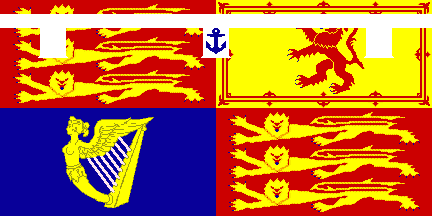 Duke of York (1986)
 Duke of Edinburgh (1947)
 Duke of Kent (1934)
Duke of Gloucester (1928)
Duke of Kent (1934)
Duke of Gloucester (1928)
Duke of Fife (1900)
Duke of Argyll (1892)
Duke of Gordon (1876)
Duke of Westminster (1874)
Duke of Abercorn (1868)
Duke of Sutherland (1833)
Duke of Wellington (1814)
Duke of Leinster (1766)
Duke of Northumberland (1766)
Duke of Manchester (1719)
Duke of Brandon (1711)
Duke of Montrose (1707)
Duke of Roxburghe (1707)
Duke of Atholl (1703)
Duke of Rutland (1703)
Duke of Marlborough (1702)
Duke of Argyll (1701)
Duke of Bedford (1694)
Duke of Devonshire (1694)
Duke of St Albans (1684)
Duke of Queensberry (1684)
Duke of Beaufort (1682)
Duke of Richmond (1675)
Duke of Grafton (1675)
Duke of Buccleuch (1663)
Duke of Hamilton (1643)
Duke of Lennox (1581)
Duke of Somerset (1547)
Duke of Norfolk (1483)
Duke of Rothesay (1398)
Duke of Cornwall (1337)
Nobility is a graceful ornament to the civil order. It is the Corinthian capital of polished society. - Edmund Burke
Barons of the Press
ROYAL INSIGHT
Majesty Magazine
The Salisbury Review
The New Criterion
The Scotsman
The Times
The Australian
The Telegraph...Blogs
National Review...Corner
The Spectator...CoffeeHouse
The Chap Magazine NEW!
Savile Row Style
Arts & Letters Daily
Burke's Peerage and Gentry
The American Conservative
New English Review
Kingston Whig-Standard
Victoria Times Colonist
Chronicles Magazine
Punch
Baronage
The Herald
Marlborough Express
Western Standard RIP
Taki's Magazine
The Brussels Journal
VDARE.COM
Globe and Mail
STUFF.CO.NZ
New York Sun RIP
Dominion Post
National Post
Quadrant Magazine
Macleans Magazine
Nelson Mail
Defence News
Gilbert Magazine
The subject who is truly loyal to the Chief Magistrate will neither advise nor submit to arbitrary measures. - Junius
(motto of the Globe and Mail)
Blogs of the Order
An Englishman's Castle
Albion's Seedlings
The Blogging Tories
Tory Diary
Kiwi Blog
A Pint of Unionist Lite
Irish Elk
Tory Heaven
Bring Back The British Empire
The Daily Bayonet
The Dominion Institute Blog
Adam Smith Institute Blog
The Witanagemot Club
Very British Subjects
Occam's Carbuncle
The Liberty Papers
The Commonwealth Realm
The Prince of Darkness
Kiwi Examiner
Our Kingdom
England Expects
Captain's Quarters
Tory Historian
Lord Kitchener's Own
The English Crusade
The British North America Blog
In the name of God, go!
100 Years Ago Today
The Anglo Saxon Chronicle
Wilson Revolution Unplugged
The Salisbury Pages
The Lord Protector
Canterbury Tales
Geoffrey Chaucer Hath a Blog
Sir Robert Bond Papers
Kiwi Pundit
My Flanders Fields
Veritas
Brit Blog
The Crusader
Burkean Canuck
Arthur's Seat
Chesterton and Friends
Lord Feverstone
Freedom and Whisky
Old Whig's Brain Dump
The Torch
Officer's Club
Guy Fawkes' Blog
Armavirumque
Mild Colonial Boy
Tommy English
Kingdom of Chaos
Alfred the OK
Postmodern Conservative
This royal throne of kings, this sceptr'd isle/This earth of majesty, this seat of Mars/This other Eden, demi-paradise...This blessed plot, this earth, this realm, this England... - William Shakespeare
Lords of the Manor
BUCKINGHAM PALACE
England's Windsor Castle
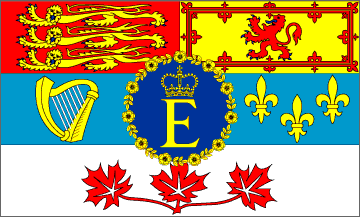 Canada's Rideau Hall
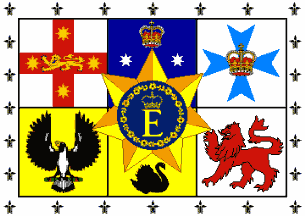 Australia's Yarralumla
Scotland's Holyroodhouse
Sandringham House
Frogmore House
Kensington Palace
Clarence House
St. James's Palace
 Balmoral Castle
COUNTRY HOUSE
Guild of Professional Butlers
The National Trust
The National Trust for Scotland
Arundel Castle (Norfolk)
Edinburgh Castle
Hatley Castle (Dunsmuir)
Harewood House
Inveraray Castle (Argyll)
Castle Howard
CASA LOMA
Chatsworth House (Devonshire)
Glamis Castle (Strathmore)
Blenheim Palace (Marlborough)
Leeds Castle (Tudor)
Spencer House
Dundurn Castle
Longleat House (Bath)
Wollaton Hall
Hardwick Hall (Devonshire)
Hatfield House (Salisbury)
Burghley House
Craigdarroch Castle
Woburn Abbey
Warwick Castle
Wilton House
Beaulieu Abbey
Bowood House
Chiswick House
Holkham Hall
Lost Heritage
A man's home is his castle.
- Sir Edward Coke, 1581
- THE GENTLEMAN -

By the by, if the English race had done nothing else, yet if they left the world the notion of a gentleman, they would have done a great service to mankind. - Gerard Hopkins
Gentlemen Clubs
White's/Brooks's/Boodle's
 Royal Air Force Club
The Caledonian Club
 Naval and Military Club
Naval and Military Club
Cavalry and Guards Club
Metropolitan Club
The Rideau Club
The Travellers Club
Oxford and Cambridge Club
Leander Rowing Club
Yale Club of New York
Harvard Club of New York
Princeton Club of New York
The Garrick Club
The Australian Club
Athenaeum Club
The National Club
The Carlton Club
The Commonwealth Club
The Bullingdon Club
Conservative Monday Club
The Albany Club
Union Jack Club
Victory Services Club
The Union Club
The Commonwealth Club
The Savage Club
The California Club
The Weld Club
The Reform Club
Royal Military Colleges Club
The Handlebar Club
The Pipe Club of London
Boisdale Jazz & Cigar Club
It would be better that ten unobjectionable men be excluded than one terrible bore be admitted. - Garrick Club's motto
Gentlemen Spirits
 BRANDY AND PORT:
 French Cognac
Thomas Hine Cognac
Hennessy Cognac
French Cognac
Thomas Hine Cognac
Hennessy Cognac
 Jerez Sherry Xeres
Porto Port Oporto
Grand Marnier
Jerez Sherry Xeres
Porto Port Oporto
Grand Marnier
Drambuie Scotch Liqueur
Armagnac
Anyone for Pimm's?
CHAMPAGNE:
Dom Pérignon
Moët et Chandon
Pol Roger Champagne
Lanson Pére et Fils
Armand de Brignac
Laurent Perrier
Korbel California
Louis Roederer
 Sovetskoye Shampanskoye
Krug Champagne
Sovetskoye Shampanskoye
Krug Champagne
LONDON DRY GIN:
Gin & Tonic
Ready to Tanqueray?
Bombay Sapphire
Boodle's British Gin
Gordon's Dry Gin
New Amsterdam Straight Gin
Hendrick's Gin
Broker's Gin
Juniper Green Organic Gin
London Beefeater Gin
Bulldog
SCOTCH & WHISKY:
Johnnie Walker
Crown Royal
"Gentleman Jack"
The Famous Grouse
Glenfiddich Single Malt
Canadian Club ...Queen Vicky's
Balvenie Single Malt
Wiser's Canadian Whisky
Chivas Regal Blended
Jim Beam Kentucky Bourbon
Cutty Sark Blended
Jack Daniel's Tennessee Whiskey
Drambuie Scotch Liqueur
John Dewar & Sons
I have taken more out of alcohol than alcohol has taken out of me. - Winston Churchill
Gentlemen-at-Arms
Gerald Warner
Roger Scruton
Mark Steyn
Daniel Larison
Simon Heffer
Andrew Bolt
Andrew Roberts
Kevin Myers
Daniel Hannan, M.E.P.
Lew Rockwell
John Derbyshire
John Fox
Peter Brimelow
Andrew Cusack
Kathy Shaidle
Peggy Noonan
John O'Sullivan
David Flint
Theodore Dalrymple
David Warren
Boris Johnson, Lord Mayor
Taki Theodoracopulos
Michael Gove, M.P.
Tim Blair
Nigel Farage, M.E.P.
Rex Murphy
George Will
Jim Hopkins
Peter Hitchens
Andrew Coyne
Tim Worstall
George Jonas
William Rees-Mogg
Tom Utley son of Peter Utley
William Gairdner
Keith Windschuttle
Roger Kimball
Iain Dale
James Bowman
Colby Cosh
John Redwood, M.P.
There is a natural aristocracy among men. The grounds of this are virtue and talents.
- Thomas Jefferson
- RICHARD THE THIRD -

Richard III Societies
Richard III Society
The Wars of the Roses
Richard III Foundation
Richard III Society Canada
Richard III New Zealand
Richard III New South Wales
Richard III Yorkshire
Richard III Western Australia
Richard III Worcestershire
Richard III America
Richard III Society of Friends
Richard III Queensland
RICHARDIII.ORG
England's Medieval Festival
Honourary Patron of the English-Speaking Peoples

Brave Old Lion, British Prime Minister, Statesman, Soldier and Author, Knight of the Most Noble Order of the Garter, Stalwart Defender of the Sacred Crown, Heroic Leader of the Free World, Honourary Citizen of the United States, Magnanimous Victor of the English-Speaking Peoples, so on and so forth.
Gentlemen-at-Arms
Sir Winston Churchill
Churchill Online
Churchill Great Republic
THE CHURCHILL CENTRE
Churchill for Democracy
The Churchill Society, London
English-Speaking Peoples
International Churchill Society
International Churchill Society
Battle of Britain Society
Last Romantic Zionist Gentile
USS Winston S. Churchill
Their Finest Hour
The Last of the Few
Sunlit Uplands
Churchill Books
Society of British Columbia
Chartwell House
Chartwell and Churchill
 Romeo Y Julieta
Blenheim Palace
The Duke of Marlborough
Cuvée Sir Winston Churchill
Churchill College, Cambridge
Churchill Archives Centre
Churchill Memorial Trust
Buried in Bladon
He mobilised the English language, and sent it into battle. - John F. Kennedy
Burke: The Father of Anglo-American Conservatism

Manners are of more importance than laws
- Edmund Burke (1729-1797)
Anglos of the Sphere
Conservative Home
Conservative Central
Conservative Union
Edmund Burke Society
Samuel Johnson Society
Johnson Society of London
Sir Walter Scott Club
Sir Robert Peel
Baldwin and Lafontaine
MacDonald and Cartier
Benjamin Disraeli
Christopher Dawson Archives
The Salisbury Review
Marquess of Salisbury
Taki's Magazine
The Freedom Association
Sir Robert Menzies
The Churchill Society
T.S. Eliot Society
George Grant
Russell Kirk Center
 Erik von Kuehnelt-Leddihn
Alexander Solzhenitsyn
Erik von Kuehnelt-Leddihn
Alexander Solzhenitsyn
William F. Buckley, RIP
Roger Scruton Page
Right Reason
CIVITAS
Samuel Francis Index
Malcolm Muggeridge Society
Michael Oakshott Association
G.K. Chesterton Society
Why I became a conservative
The Conservative Mind
The Meaning of Conservatism
Liberty or Equality
Reflections on French Revolution
Good order is the foundation of all things.
- Edmund Burke, 1790
The only thing necessary for the triumph of evil is for good men to do nothing.
- Edmund Burke
Anglos of the Sphere
Anglos of the Sphere
The Rhodes Trust
The Oxford Union
English Heritage
 The Anglosphere
An Anglosphere Primer
The 3rd Anglosphere Century
Anglo-Australian
The Churchill Centre
Splendid Isolation
English-Speaking Peoples
The Anglosphere Institute
Adam Smith Institute
The Manhattan Institute
The Dominion Institute
The Maxim Institute
The Acton Institute
The Claremont Institute
Ludwig von Mises Institute
The Round Table
Arts & Letters Daily
MOTHER ENGLAND
Anthem 4 England
Albion's Seedlings
Kingdom of England
Britain and America
Margaret Thatcher Foundation
Free Dominion
Silent Running
The Anglosphere Challenge
What England Means to Me
The Atlantic Bridge
Anglosphere Union Now!
England Your England
There is a forgotten, nay almost forbidden word, which means more to me than any other. That word is ENGLAND.
- Sir Winston Churchill
- ROYAL STANDARDS -
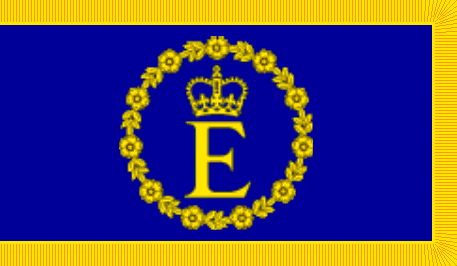
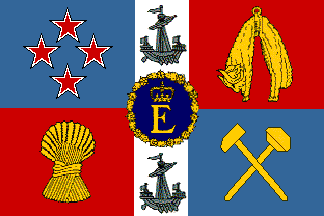
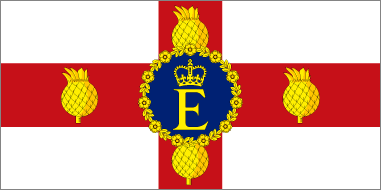
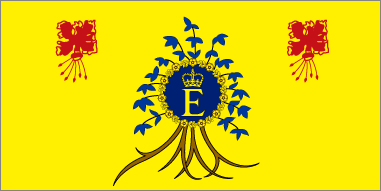
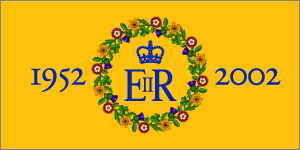


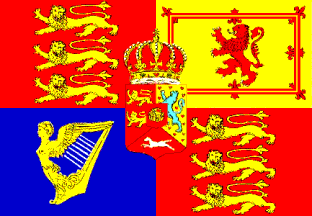
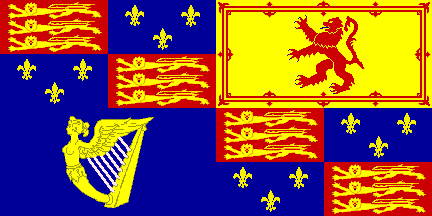
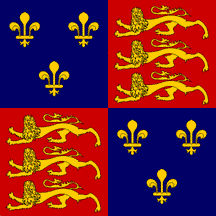
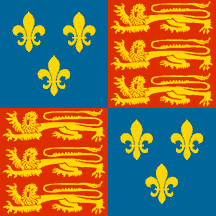
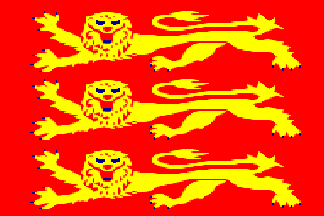
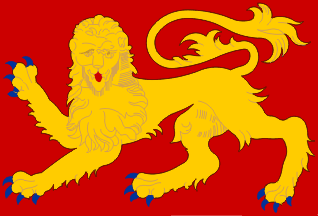
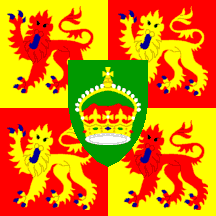
- ROYAL FAMILY -
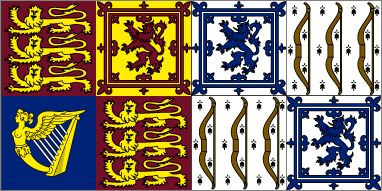
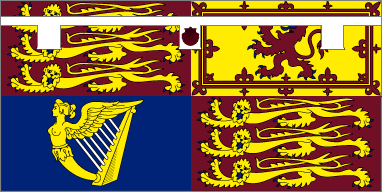
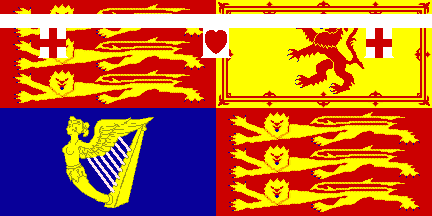
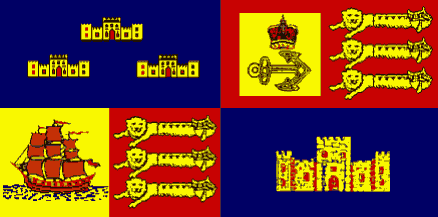
FREE MOVEMENT BETWEEN THE REALMS?
 COMMONWEALTH FREE MOVEMENT: SIGN THE PETITION!
British Borders Bill: Common Entry For Her Majesty's Realms
ROYAL SUCCESSION: The Succession to the Crown Bill
Gloriana for our times: A Diamond Jubilee Tribute
Queen's Message: The Queen's Diamond Jubilee Message
The Queen's Accession: The Accession Feb 6 - 8, 1952
Monarchy at its Finest: The Queen prospered in her role
Majestic Success: In an age of turmoil
Elizabeth-the-Dutiful: A Vintage Year for the Royal Family
Reign Maker: Restoring the Power of the Monarchy
YES MA'AM How the Queen defined her role
ROYALSALUTE.CA Fall In! The RCN & RCAF have been restored!
Now on Twitter! Defending the Crown one tweet at a time
Fade Britannia: Vichy Tories commit treason in HM's docks
Anglo-Irish Visit?: Will the Queen go to Ireland?
Crown & Country: The Royal Republic of Britain?
Royal Portraits: David Starkey reveals the power of portrait
New Vice-Regal: David Johnston takes reins as GG of Canada
Loyal Opposition: The Marxist brothers take over UK opposition
On Democracy and Kings: Why I am a monarchist.
Queen and Pope: A Glorious Day for Scotland
Kingdom of Bhutan: The Greatest Nation on Earth
Tuesday, September 29, 2009
To the Manor Born

Sunday, September 27, 2009
The Lord's Day

I will arise and go to my father, and will say unto him, Father, I have sinned against heaven, and before thee, and am no more worthy to be called thy son.
Luke 15.18,19
If we say that we have no sin, we deceive ourselves, and the truth is not in us: but if we confess our sins, he is faithful and just to forgive us our sins, and to cleanse us from all unrighteousness.
1 John 1.8,9
Dearly beloved brethren, the Scripture moveth us in sundry places to acknowledge and confess our manifold sins and wickedness; and that we should not dissemble nor cloak them before the face of almighty God our heavenly Father; but confess them with an humble, lowly, penitent and obedient heart; to the end that we may obtain forgiveness of the same by his infinite goodness and mercy.
— From The Order for Evening Prayer, BCP, 1662
Read More »»
Thine Be The Glory
Labels: Classical Music, George Frideric HandelThine Be the Glory is a popular Christian hymn set to the tune of the chorus "See, the Conqu'ring hero comes" from the Handel oratorio Judas Maccabaeus. It was written in 1884 by the Swiss writer Edmond Budry (1854-1932).
The political context of the British chorus "See, the Conqu'ring hero comes" is the Jacobite Rising of 1745. Handel, an obviously devout Hanoverian, hastily composed the oratorio in 1746 for the encouragement of the English. After the success of the British forces at the Battle of Culloden, he started a work in honour of the victorious Prince William Augustus, Duke of Cumberland, addressed as a "Truly Wise, Valiant, and Virtuous Commander".
The first performance took place on April 1, 1747 at Covent Garden, and Judas Maccabaeus became one of Handel's most popular oratorios with frequent reprises, second only to his masterpiece, Messiah. The chorus "See, the Conqu'ring hero comes" became well-known later as the music was invariably played by brass bands at the opening of new railway lines and stations in Britain during the 19th century. It is also one of the movements in Fantasia on British Sea Songs, a medly of sea songs arranged in 1905 by the legendary BBC Proms conductor, Sir Henry Wood, to mark the centenary of the Battle of Trafalgar.
Saturday, September 26, 2009
The Coronation Anthems
The four Coronation Anthems that Handel composed for the coronation of George II of Great Britain in 1727 have been sung at every subsequent British coronation service since. Although they have been part of the traditional content of English coronations since that of King Edgar at Bath Abbey in 973, the texts for all four anthems were picked by Handel himself — much to the consternation of the participating clergy.
My Heart Is Inditing (HWV 259)
The King Shall Rejoice (HWV 260)
Let Thy Hand Be Strengthened (HWV 261)
Thursday, September 24, 2009
Handel's Water Music
Legend has it that Handel composed Water Music to regain the favour of King George I. Handel had been employed by the future king before he succeeded to the British throne when he was Elector of Hanover. The composer supposedly fell out of favour for moving to London in the reign of Queen Anne. This story was first related by Handel's early biographer John Mainwaring; although it may have some foundation in fact, the tale as told by Mainwaring has been doubted by some Handel scholars.
Wednesday, September 23, 2009
Concert on the River Thames
The Water Music is a collection of orchestral movements composed by George Frideric Handel that premiered in the summer on July 17, 1717 when King George I requested a concert on the River Thames. The concert was performed by 50 musicians playing on a barge close to the royal barge from which the King listened with some close friends. George I was said to have loved it so much that he ordered the exhausted musicians to play the suites three times on the trip.
For God and the Empire
Labels: Order of the British Empire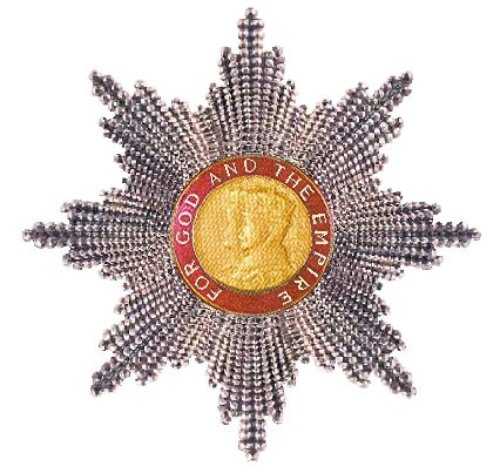
Grand Cross's star of the Order of the British Empire
The Most Excellent Order of the British Empire was established on 4 June 1917 by King George V. The Order's motto is For God and the Empire. It is the most junior of the British (Commonwealth) orders of chivalry, and the largest, with over 100,000 living members worldwide. Read More »»
Tuesday, September 22, 2009
All Whig and no Tory
 The basic philosophical problem with the otherwise impressive Daniel Hannan, is that he has no discernible reverence for ancient Christian monarchy and reserves his greatest jubilation for history's triumphs over kings.
There are four places in the world which I never visit without a sense of reverence, almost of pilgrimage. Three are in Britain: Stratford, where the greatest mind produced by our species was shaped; Runnymede, where the idea that governments should be answerable to their peoples was encoded; and Naseby, where the victory of constitutional parliamentary authority was secured. The fourth is the old courthouse in Philadelphia where the US Declaration of Independence was signed and where, later, the Constitution was drafted.To be sure there's much to like here, but while we all love Shakespeare, we shouldn't be surprised if Hannan's favourite tragic play is MacBeth's regicide of King Duncan. All Whig and no Tory, Roundhead values with no Cavalier tastes. So foul and fair a day I have not seen.
The problem with this milquetoast monarchist is that all his heroes are republican, from John Milton to Thomas Jefferson. Yes he looks up to Burke, but probably only the most Whiggish aspects of the man. Aren't the truly great men in history those who managed to fuse their classical liberalism with traditional conservative values - liberal conservative thinkers and principled floor crossers like Burke, Churchill, Russell Kirk and Erik von Kuehnelt-Leddihn?
I mean, what prospect of future progress is there in championing the one-dimensional fact that people wrestled away power from their kings long ago? Yes they did, and yes it was good up to a point, but what, pray, has been happening over the last hundred years or so? Are we okay with the fact that government of the people has grown from taking 10% of our earnings to more than 50% today? Do we really enjoy greater liberty today than we did under the influence of the king's men? Is there any real prospect of ever wrestling power away from politicians and putting it back in the hands of the individual where it belongs? No, not under the current system, the spoils of government are just too enticing for ambition to ignore, politicians prefer the corruption of Walpole over the patriotism of Bolingbroke.
My issue with Daniel Hannan is that while he rails splendidly against the former, he is at best a limp, halfhearted and perfunctory torch-bearer for the latter. Read More »»
Monday, September 21, 2009
Where's the Steel and Arsenic?
William Shawcross is out with a new glowing book about the Queen Mother. The Queen Mother was once described as having "a touch of arsenic in the marshmallow". While there is reportedly much that is new in this official biography of our late Empress, Shawcross's portrait is apparently almost entirely marshmallow and no arsenic. I have not read it, only sought out the toughest review I could find and came up with this lovely little critique, which, while much tougher on the Queen Mum, did even more to elevate my respect.

Sunday, September 20, 2009
The Lord's Day

Repentance is always difficult, and the difficulty grows still greater by delay. But let those who have hitherto neglected this great duty, remember, that it is yet in their power, and that they cannot perish everlastingly but by their own choice! Let them therefore endeavour to redeem the time lost, and repair their negligence by vigilance and ardour! 'Let the wicked forsake his way, and the unrighteous man his thoughts; and let him return unto the Lord, and he will have mercy upon him, and to our God, for he will abundantly pardon.'— Samuel Johnson, Sermons Read More »»
St. Paul's Cathedral Choir
Labels: Church of England, Sunday Psalms, The Lord's DayThe Queen's Golden Jubilee in 2002. The text for this anthem "I Was Glad" is Psalm 122, which has been chanted or sung as the Sovereign processes up the aisle at the beginning of every Coronation since, at least, the Coronation of Richard II in the 13th Century as recorded in the Liber Regalis.
The arrangement in this video dates from the Coronation of Edward VII in 1902. It has been sung at every Coronation since, and like Handel's anthems, seems now a permanent feature to this glorious ritual.
Saturday, September 19, 2009
Sweeter than Roses
You can't mention the Great Handel, without recalling his great mentor, Henry Purcell.
The Arrival of the Queen of Sheba
Labels: Classical Music, George Frideric HandelHandel was the greatest composer that ever lived. I would uncover my head, and kneel before his tomb — Ludwig van Beethoven
Friday, September 18, 2009
Divine Reason
What to say about the good doctor Samuel Johnson on his 300th birthday? It would be almost mundane and cliché to repeat his quotes here, to harp that he was a Tory royalist and devout Anglican who wrote a dictionary on the English language, and whose life was made famous by Boswell's biography of him: The Life of Samuel Johnson. So we won't.
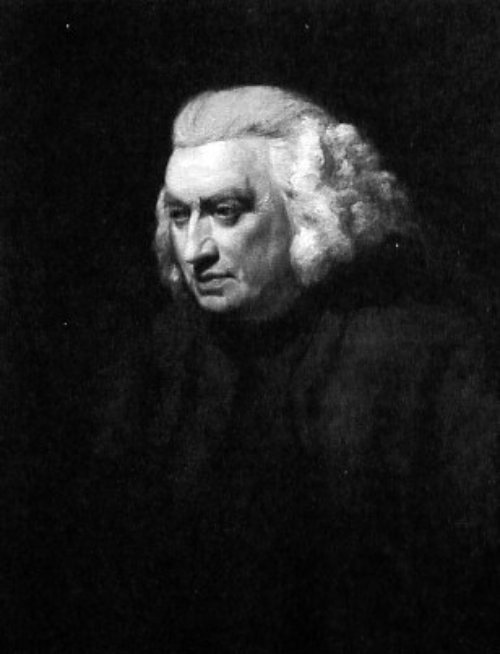
A photographic portrait of Samuel Johnson. Artist unknown
Dr. Johnson was a critic of the Enlightenment. He lived through the first period in modern history we might think of as secular in spirit, that was skeptical in matters of knowledge, questioning of authority, rationalistic towards the existence of ancient institutions, devoted to the idea of justice and an unquestioning belief in the goodness of human nature.
The crude reductionism of imparting abstract legitimacy in the hands of an Ideal People may have been alive and well in France, but with memories still fresh from the experience of the English Civil War, writers in England leading up to this time were largely Tory in spirit: distrustful of human nature and devoted to the cause of public order. In England, the distinctive spirit of the age might too be called the Enlightenment, but it was a critical one - constantly testing through irony, purging with satire, and finding conviction in the poise of an exact antithesis to the slowly settling Whig orthodoxies of that era. This is the genuine greatness of men like Johnson and Burke - they stood against the whole tendency of their epoch - not necessarily hostile to the ideas of the Enlightenment, but intensely critical of them.
Despite his deeply held religious views, Johnson was a rationalist and believed that rational thought was vital to morality. In his review of Soame Jenyns's A Free Enquiry into the Nature and Origin of Evil and its argument that those "born to poverty" should not be educated so they could enjoy the "opiate of ignorance", Johnson wrote, "To entail irreversible poverty upon generation after generation only because the ancestor happened to be poor, is, in itself, cruel, if not unjust". The hereditary principle, even that as understood by a staunch Tory, had its clear limits. When Jenyns claimed that madness was a way God ensured that the poor would be content with life, Johnson responded:
On the happiness of madmen, as the case is not very frequent, it is not necessary to raise a disquisition, but I cannot forbear to observe that I never yet knew disorders of mind increase felicity; every madman is either arrogant and irascible, or gloomy and suspicious, or possessed by some passion or notion destructive to his quiet. He has always discontent in his look, and malignity in his bosom. And, if we had the power of choice, he would soon repent who should resign his reason to secure his peace.Although Johnson believed that "All change is of itself an evil, which ought not to be hazarded but for evident advantage", he could not accept such a belief when it came to slavery. At Oxford, according to Boswell, Johnson gave a toast and said, "Here's to the next insurrection of the Negroes in the West Indies".
Samuel Johnson's life, like Burke's, is sandwhiched between the Jacobite and Jacobin periods. As hereditary monarchists, both men - Tory and Whig - in their earlier life had difficulty with the consequences unleashed by the 'Glorious Revolution', most acutely with the destruction of the divine principle in the human soul immortalized in Johnson's quip that "the first Whig was the devil". But by the time of George III, both men had come around to the Hanoverian Succession. Burke in particular criticized the "old fanatics of single arbitrary power" who had "dogmatized as if hereditary royalty was the only lawful government in the world, just as our new fanatics of popular arbitrary power, maintain that a popular election is the sole lawful source of authority." Burke was talking of France of course, but he could easily have been talking of the way democracy is idolized today.
Both Johnson and Burke as critics of the Enlightenment gave credence to revealed religion, and perceived well that pure reason had its frontiers. They understood that to deny the existence of realms beyond those borders was puerile, and therefore possessed a belief in a transcendent order, and an affection for the "variety and mystery" of human existence. Read More »»
The Siege of Toulon
Labels: British Battles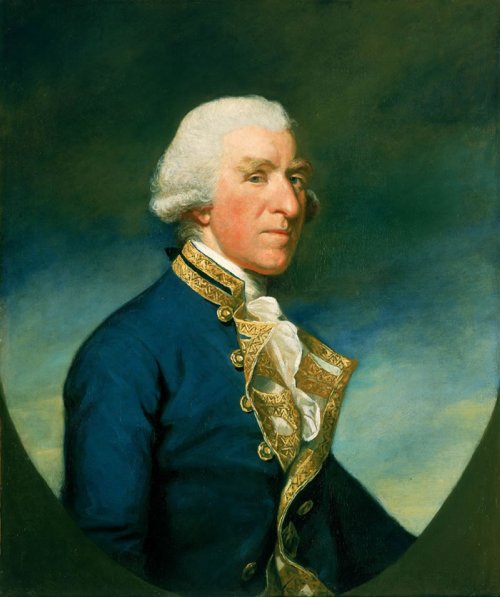
Admiral Samuel Hood
Admiral Samuel Hood, later the first Viscount Hood, who had also served in the American War of Independence for His Britannic Majesty, commanded the forces of the Royal Navy in the Siege of Toulon, teaming up with French royalists against the revolutionary republic.
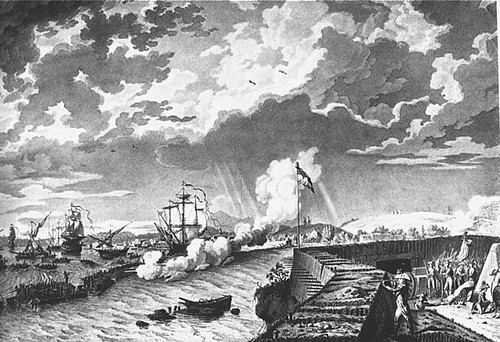
The Royal Navy bombards Toulon
The Kingdom of France had contributed largely to the fall of monarchic rule in what was now those United States of America, but apparently His Britannic Majesty was the bigger man. The Royal Navy was employed against the revolutionary republic, and the Siege of Toulon – from September 18, 1793 to December 18, 1793 – was one such employment.
Those were indeed other days than when the British Empire under the leadership of the likes of Herbert Henry Asquith and David Lloyd George teamed up with the revolutionary republic – and also later the former rebels across the pond – in the quest to “make the world safe for democracy.” Read More »»
Wednesday, September 16, 2009
The King in Colour

A rare colour image of King Edward VII taking a breather during a stroll through a Scottish estate in full Highland costume in the autumn of 1909. Recently discovered in the home of the banker Lionel de Rothschild, who took the photo, the image of the King was taken on one of the banker's regular trips to Scotland for the autumn grouse season, at Tulchan in Strathspey, 15 miles from Balmoral. Rothschild was an enthusiastic amateur photographer who experimented in taking colour pictures, called autochromes, and went about perfecting the new process. Eight months after it was taken, Edward died and George V
Tuesday, September 15, 2009
Monday, September 14, 2009
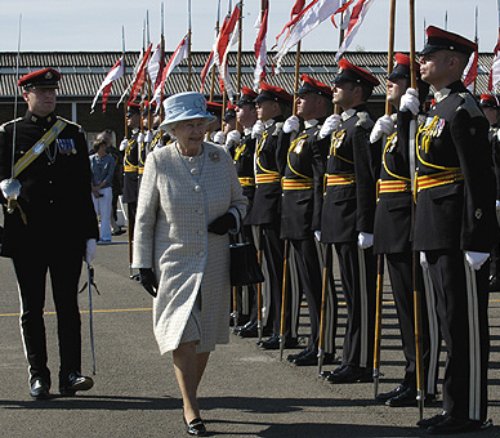
The Queen's Royal Lancers
The Queen's Royal Lancers is a cavalry regiment of the British Army, which can trace its lineage back 250 years to the death of General Wolfe. The Queen's visit marked the 250th anniversary of the raising of the 17th Light Dragoons. The 17th Lancers (Duke of Cambridge's Own) was a cavalry regiment most famous for its participation in the Charge of the Light Brigade in the Crimean War.
In 1759 Colonel John Hale of the 47th Foot was ordered home by General James Wolfe just prior to the General's death, with the final dispatches and news of Wolfe's victory in the Battle of Quebec. For bringing news of the victory, Hale was rewarded with land in Canada and permission to raise a regiment of light dragoons.
The new regiment was known as the 17th Regiment of (Light) Dragoons and was also known as Hale's Light Horse after its founder. The admiration of his men for General Wolfe was evident in the cap badge Colonel Hale chose for the regiment: the Death's Head with the motto "Or Glory". Death or Glory is the motto of the regiment to this day.
Various amalgamations have resulted in its absorption into the Queen's Royal Lancers (which also incorporates the 5th Lancers, 16th Lancers and 21st Lancers). Read More »»
Sunday, September 13, 2009
Wolfe and Montcalm
Je me souviens reads the National Assembly of Quebec just below two life-size statutes of General Wolfe and the General Montcalm, who were both killed on the Plains of Abraham at the Battle of Quebec 250 years ago today. That both of these men, not just Montcalm, are given central place above the main doors of the Assembly is telling.
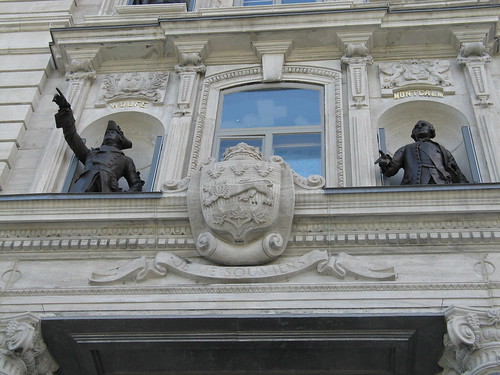
Despite the hotheaded comments of some Quebec nationalists, the anniversary passed respectfully enough and went by calme comme Montcalm. Whilst most Quebeckers naturally don't view Wolfe as "the hero of Quebec", they do respect him probably as much, if not more, than English-speaking Canadians, who can't even be bothered to remember much of their nation's own history.
The Wolfe Montcalm story has always been central theatre to the identity and vision of French-speaking Quebec inside Canada, the idea that the country was really founded by two European peoples - British and French. It's a vision frustrated by political and historical reality, however, for constitutionally speaking, Canada is a confederation of ten provinces, not two peoples. The initial union between Lower and Upper Canada in the 1840s lent some credence to this historical vision, but then two became four in 1867, and by 1949 four had become ten with the inclusion of Newfoundland. Quebec's relative power has diminished over time, it never aspired to be a mere province in the first place, and does not really accept the notion that Canada is a nation or a people - a state, yes, but not a nation.
There is considerable merit to this belief, for the embryonic British nation set in motion in North America by General Wolfe 250 years ago has largely wiped away the old heraldry. The Maple Leaf flag is remarkable for its boldness, cleanliness and distinctiveness, for its deliberate excising of the past. There is no Je Me Souviens in Canada. Read More »»
Westminster Cathedral Choir
Labels: Sunday Psalms, The Lord's DayNot to be confused with Westminster Abbey and the Church of England. Whatever. Anglican or Catholic, we are chastened by the Lord, and entreat Him to turn His anger away from us. Psalm 38
The Plains of Abraham
Labels: British BattlesWell, here we are gentlemen. 250 years to the day. Enjoy.
Saturday, September 12, 2009
The Hero of Québec
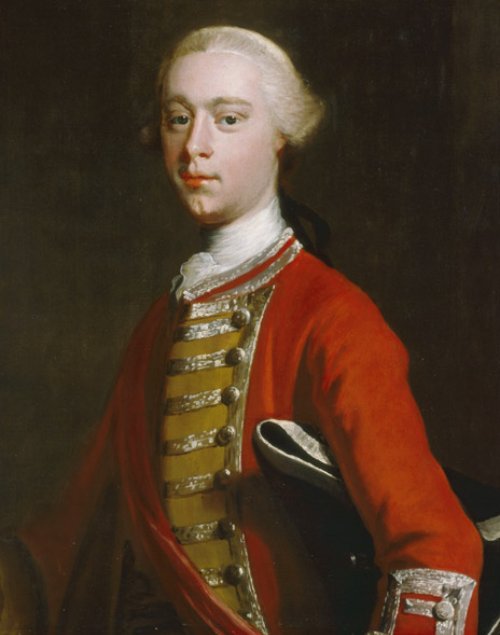
Major General Wolfe.
Who, at the Expence of his Life, purchas'd immortal Honour for his Country,
and planted, with his own Hand, the British Laurel, in the inhospitable Wilds of North America, By the Reduction of Quebec, Septr. 13th. 1759.
Friday, September 11, 2009
Here Died Wolfe Victorious
Apropos "Kipling's" post below, the inscription on the obelisk at Quebec City, erected to commemorate the battle on the Plains of Abraham no longer reads: "Here Died Wolfe Victorious." Now it simply reads: "Here Died Wolfe."
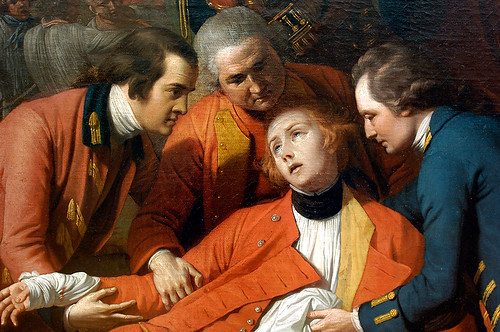
The Death of General Wolfe by Benjamin West. Oil on canvas, 1770.
The site where Wolfe purportedly fell is marked by a column surmounted by a helmet and sword. An inscription at its base now reads, in French and English, "Here died Wolfe - September 13th, 1759." It replaces a large stone which had been placed there by British troops to mark the spot.
Wolfe's defeat of the French led to the British capture of New France, and his "hero's death" made the Wolfe name a legend. The Wolfe legend led to the famous painting above and the opening line of the patriotic Canadian anthem, "The Maple Leaf Forever", it too all but wiped from English Canadian memory to accommodate (appease) French Canadians insided a united Canada.
Historian Francis Parkman described the death of Wolfe this way:
They asked him [Wolfe] if he would have a surgeon; but he shook his head, and answered that all was over with him. His eyes closed with the torpor of approaching death, and those around sustained his fainting form. Yet they could not withhold their gaze from the wild turmoil before them, and the charging ranks of their companions rushing though the line of sire and smoke.Read More »»
"See how they run." one of the officers exclaimed, as the French fled in confusion before the leveled bayonets.
"Who run?" demanded Wolfe, opening his eyes like a man aroused from sleep.
"The enemy, sire," was the reply; "they give way everywhere."
"Then," said the dying general, "tell Colonel River, to cut off their retreat from the bridge. Now, God be praised, I die contented," he murmured; and, turning on his side, he calmly breathed his last breath.
Thursday, September 10, 2009
Paths of Canadians
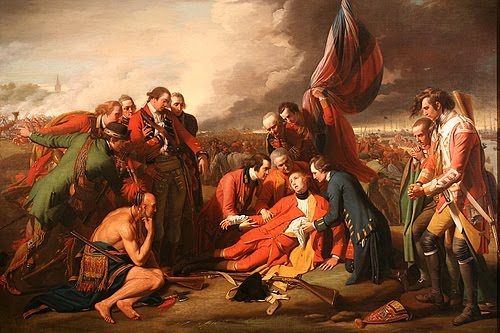
The Death of General Wolfe by Benjamin West. Oil on canvas, 1770.
The CBC shocks us all.
Canada's national broadcaster will mark the 250th anniversary of the Battle of the Plains of Abraham with a documentary on the decisive British-French conflict, months after threats from hardline separatists forced the cancellation of a planned re-enactment in Quebec City.The Canadian Broadcasting Corporation, like a broken clock. To our American readers, let me put this in perspective. Imagine if a bunch Southerners demanded that a re-enactment of the Battle of Gettysburg be cancelled, because the battle recalled painful memories of defeat, and you begin to understand the absurdity of the protests of Quebecois nationalists. One can take two perspectives about landmark events like Gettysburg and the Plains of Abraham. It's big history that deserves to be remembered, regardless of the respective merits of each side. The other approach is honouring the values the respective sides were fighting to uphold. On both counts Gettysburg and Quebec were major events whose outcomes changed their respective nations for the better. While there is no moral comparison between New France and the Confederacy, slavery was a peripheral issue in Canada though it did exist, 1759 was ultimately a lucky break for les Canadiens.
The one-hour documentary, set to air during prime time next Thursday, is already ruffling the feathers of those who opposed the real-life re-enactment
The New France of the mid-eighteenth century was much like old France, quasi-feudal and dominated by a Catholic Church far enough away from grasping the need for the separation of church and state. While the Enlightenment was in full swing in the salons and coffee shops of Paris, its values and attitudes had yet to trickle down to the average Frenchmen in the fields. Only a tiny landed elite along the St. Lawrence would have begun to come to grips with the implications of figures like Voltaire and Diderot. For the generation of Quebec nationalists who emerged after the Quiet Revolution, 1759 was both humiliation and lost opportunity. Had French colonial rule lasted Quebec might have become a modern independent liberal nation, just as Canada and the United States had.
The narrative implies that English speaking Canada helped prop up Quebec's ancien regime. Having about one quarter of the population of Canada stuck in the seventeenth century, for the first hundred years after Confederation, was a significant encumbrance. Something polite opinion has steadily ignored for decades. Quebec was strategically vital to the existence of Canada, yet its basic values were more statist and collectivist than those of the ROC ("Rest of Canada"). For all the celebration of the coureur des bois, the state and clergy preferred les habitant to stay on the farm. The province's educational system famously churned out priests and lawyers, just as schools in English speaking North America were beginning to turn out business graduates and engineers.
The hope that Quebec might have modernized sooner had it remained within France's orbit, omits the bloody history of the metropole after 1789. Five republics, two Empires, three major military defeats and a near coup as late as 1962, modern France modernized slowly and often by force. The France of the 1950s might have been nominally more secular that contemporary Quebec, yet it suffered from many of the same structural setbacks. What Quebec had enjoyed was two centuries of peace, security and relatively more freedom than his French counterpart. The Battle of Quebec was the inception of Canada. For the Quebecois it was the moment they came into the orbit of a liberal and modern government. That alone should be enough to commemorate. Read More »»
Sunday, September 6, 2009
The King's College Chapel Choir
I have for you a very special treat on this glorious Sunday morning. The world-famous Choir of King's College, Cambridge is one of today's most accomplished and renowned representatives of the great British choral tradition. It was created by King Henry VI, who founded King's College, Cambridge in 1441, to provide daily singing in his Chapel, which remains the main task of the choir to this day.
The above is a sublime performance of Psalm 51, which is frequently used in various liturgical traditions because of its beautiful spirit of humility and repentance. It begins: Have mercy on me, O God.
Saturday, September 5, 2009
100 Years Young
The Girl Guides
The BBC reports: "Thousands of people across the United Kingdom are now gathering to celebrate the centenary of The Girl Guiding Movement. More than half a million girls and their guests are taking part in parties, Girlguiding UK said. About 8,000 Guides, Brownies and Rainbows were today gathering at this event in Manchester's Heaton Park. Some 7,000 were due at London's Crystal Palace, where a group of young girls asked Lord Robert Baden-Powell for their own movement at a Scout Rally in 1909. A century after the youngsters urged him to offer "something for the girls", Girlguiding UK said it is still going strong. One in four eight-year-old girls in the United Kingdom is a Brownie and almost half of all British women have been involved at some stage in their lives. It has about 45,000 girls waiting to join." Details about the celebrations: 1, 2, 3, 4, 5.
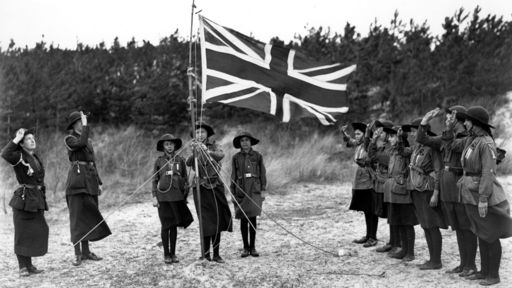
The 1909 Rally
"The very first Scout Rally, held in 1909 at The Crystal Palace in London, attracted 11,000 boys and a number of girls. Scouting developed largely spontaneously in response to 'Scouting For Boys' but the 1909 Rally led to a more formal organization under the leadership of its founder. Robert Baden-Powell called for a Rally in London at the suggestion of King Edward VII." More.
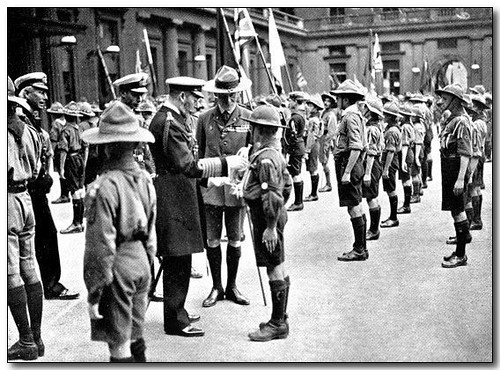
The Sea Scouts
"In 1909, two years after The Scout Movement was founded, the idea of sea scouting was talked about at a campfire where Robert Baden-Powell voiced the hope that older Scouts would be interested in learning about boat management and seamanship. He stressed the need for young men to prepare themselves for service on their countries ships. 'Sea Scouting' was introduced by Robert Baden-Powell and brother Warington Baden-Powell - sailor and canoe sailing investor."
"Robert Baden-Powell personally held a Scout Camp at Buckler's Hard on The Beaulieu River in Hampshire in August 1909 which marked the start of The Sea Scouts, although Sea Scouts were not officially named as such until 1912. In celebration of the 100 years of Sea Scouts, a special Jamboree was held at The National Water Sports Centre in Nottingham. The Jamboree was run over one week in August which coincided with the original camp, 100 years ago." More. Read More »»
Friday, September 4, 2009
Queensland or Saxon Land
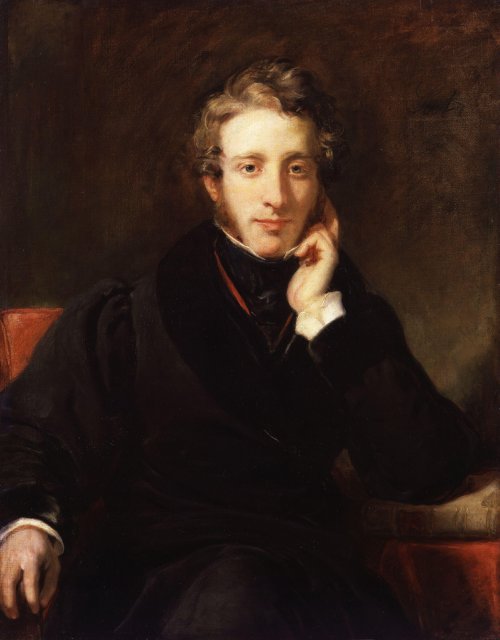
ROYAL LETTERS: Edward Bulwer Lytton involved in naming of Queensland.
The Courier Mail in Australia reports: "A British historian says Queensland might have been called Saxon Land or Clarence - and Queen Victoria didn't seem to take any interest in the State's naming. Saxon Land, Clarence and Queen's Land were options suggested by The Colonial Secretary, Sir Edward Bulwer Lytton, according to Professor Ged Martin from The University of Edinburgh."
"Professor Martin reveals his findings in letters to his friend John Dawson, a former Queensland Agent General in London, now retired in Brisbane. Professor Martin said letters held in The Royal Archives at Windsor Castle show Lord Lytton's own correspondence to Her Majesty Queen Victoria in 1859."
"When the options were narrowed to Saxon Land and Queen's Land, Lord Lytton wrote a letter. He said "both the names which have occurred to Your Majesty are excellent", adding, "the Colonists would find particular pride" in Queen's Land. So it came to be. But the naming of Queensland seems to have been an afterthought with letters showing Victoria more interested in the naming of British Columbia and its capital, Victoria." Celebrate Saxonland (sorry, Queensland) here and here. Read More »»
Thursday, September 3, 2009
A State of War
His soft, lilting voice called the Empire to war. In a three minute radio speech on September 3rd, 1939 Neville Chamberlain announced the declaration of war on Germany. In fulfilling his guarantee of Polish sovereignty, ten months after having betrayed the Czechs to Hitler, Chamberlain did so with all the enthusiasm of a doomed man. His language was pleading that Britain had no other choice, that he had tried his very best but that war couldn't be helped. In the popular imagination the time between Poland's conquest and the invasion of the Low Countries and Norway are the "Phony War." Chamberlain vanishes from the scene during this period. A spent force - in every sense, he would die in late 1940 - the full consequences of his years of inaction would only be fully realized by the British public in the frantic days of Dunkirk.
This war was not like the last war. The slow grinding war of attrition was replaced by Blitzkrieg. The little known irony was that this German word had partly British origins. The military theorists J. F. C. Fuller and Basil Lidell Hart had envisioned a new kind of warfare in the dying days of the last war. The Hundred Days of 1918 had seen Australian, Canadian and British troops spearhead the destruction the Kaiser's Army using Blitzkrieg like tactics.
The first two years of the new war showed, very bloodily and painfully, how horribly unprepared the Allies were for it. The Wehrmacht utterly outclassed anything in the world at the time, and arguably since. The legendary German officer corp, its origins going back to the birth of the Prussian state more than two centuries before, granted German forces a remarkable skill for improvisation. All of this was placed at the disposal of a psychotic with a gift for oratory. The strange and sordid tale by which one of the world's leading nations fell into the hands of Nazism is beyond the scope of this post. An object lesson not simply of evil but how otherwise decent and respectable people fall under its sway.
Good men doing nothing. In Germany and in Britain. Chamberlain's name has become a epithet in the seven decades since the beginning of the Second World War. In his defence it has been said that appeasement was simply a skillful stalling for time, allowing Britain to rearm. His protestations of seeking peace a blind for preparations for war. Certainly after Munich British spending on arms rose dramatically. The theory, however, imparts a level of cynicism and skill that Chamberlain is not known to have had. A more likely explanation is pragmatism. Seeking peace, while preparing for war, was a strategy to appease factions within his own party and the country.
Parliament and the nation turned to Churchill as a last resort. A loose cannon whose name was still associated with the disaster of Gallipoli and his "ratting" from Tories to the Liberals and back again. His wilderness years had begun not because of his opposition to appeasement, but his refusal to support a measure to grant India greater self-rule and his support for free trade. Excluded from Ramsey Macdonald's National Government of 1931, Churchill spent much of the early 1930s writing histories and biographies. In the 1934 he gave his famous The Threat of War speech. It was only in early September of 1939 that he was recalled to his old post as First Lord of the Admiralty. "Winston is Back" went the signal to the fleet.
Read More »»
In search of living ideals
I was not planning on posting again today, but the exchange between Our Learned Proprietor and Neil Welton on the World War Two remembrance post interested me so much, I think I will.
Brevity is a virtue I have never mastered.
In any case, here it is, excerpted below:
Neil Welton said:
My grandfather would say it is time to move on. For as you point out - this is 2009, not 1939.Trouble with monarchists and, to a point The Royal Family, is this permanent "ration books mentality". We appear increasingly retarded as every year goes by. No wonder republicanism is getting popular - we have yet to get past 1955.
To which The Monarchist replied:
Yes, Remembrance should be about Forgetting. Seventy years ago, 70 million people (or some other obscene number) lost their lives (or were soon to lose it) in the ugliest episode to ravage the four corners of the planet. Nothing to see here, nothing to remember. Time to move on...
To be entirely frank (and frankness is one virtue Dr. Swift does have) I have some sympathy with both points of view. I have no wish to intrude on the conversations of my betters, but it appears to me hugely important that someone makes the point I am about to.
Remembrance is a virtue in itself - I am with The Monarchist on that, for the reasons he outlines. But on the other hand, Neil Welton is right too - that is, we cannot continue talking as if virtue died in 1955, or expired (to adapt Philip Larkin) when sex began in 1968.
My generation is too young to remember the 1960's. We have imbibed much poison from that wretched decade, but have no Baby Boomer excitement which comes from throwing off The Man.
What we do have (and I speak for myself primarily), I think, is what Papa Benedict calls "a crisis of hope"--that is, we are utterly desperate to see that the values testified to by the Greatest Generation in the War (honour, duty, responsibility, selflessness, compassion, justice, sacrifice, service etc.) are not extinct--that they are possible, and relevant.
Of course, those virtues are eternal--they are expressed in every age, and every place, even when the wider culture may not value them. To pick several examples at random:
Here by the young Dominicans
Here by new cops on the beat.
Here combatting alcohol and drug abuse
Here teaching duty and service.
And, of course, here:
What we need is not simply remembrance of ideals, as if they were dead (although that helps), but commitment to them, in new and modern contexts, demonstration that they work, and the courage to defend them. Her Majesty put it this way, in 1957--Take it away, Ma'am:
Today, we need a special kind of courage. Not the kind needed in battle, but the kind that makes us stand up for everything we know is right. Everything that is true and honest. We need the kind of courage that can withstand the subtle corruption of the cynics, so that we can show the world that we are not afraid of the future.
What she said.
The King Declares War
Labels: RemembranceIt is notified that a State of War exists between His Majesty and Germany as from 11 o’clock A.M. to-day the 3rd September, 1939. — King George VI
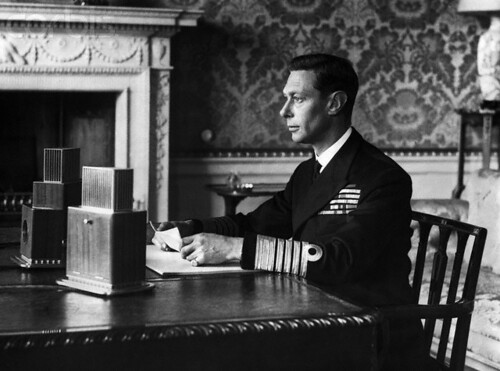
War! 3rd September 2009 sees the 70th anniversary of Britain’s entry into the conflict that was to become known as the Second World War. King George VI declared war against Germany at 11am on that day because of the refusal by Hitler's Government to give assurances that it would withdraw from Poland. The war was to last six long, hard and world-changing years.
Speaking to the Nation from 10 Downing Street at 11.15 am, Prime Minister Neville Chamberlain explained how Britain had requested an undertaking from the German Government that it would immediately prepare to withdraw from Poland and if there was no word by 11am, Britain would be at war. He went on to say, “I have to tell you now that no such undertaking has been received and that consequently this country is at war with Germany”.
The King confirmed the Nation’s slide into a state of conflict through an announcement in a supplement to the London Gazette newspaper, distributed on that evening, which said "It is notified that a State of War exists between His Majesty and Germany as from 11 o’clock A.M. to-day the 3rd September, 1939".
France also joined Great Britain by sending a message to Berlin at 12.30pm asking for assurances that Germany would immediately start plans to withdraw from Poland with a deadline of 5pm. No assurances were received, as with Britain’s ultimatum, so from that deadline on the same day, 1939, France too was at war.
Also declaring war against Germany on the 3rd was Australia’s Prime Minister, Mr Menzies, on behalf of his country. Hot on the heels of the Australian announcement came one from New Zealand. India showed its support and also declared war. South Africa’s declaration of war came on September 5th.
Canada offered support initially giving the rationale – "when Britain is at war, Canada is at war", then made its official declaration on September 10th following Parliament's formal approval. It is the first time that Canadians make their own declaration of war as a sovereign nation. The previous week, a solemn King took to the airwaves with an address called "Canada at the side of Britain.", even though Canada remained neutral until Sept. 10. King George VI declared war on Germany in the name of Canada the same day.
The day after Parliament's decision, the Globe and Mail described Canada's entry into the war as follows: "This peaceful country, 3,000 miles distant from the scene of the conflict, which desires to live on terms of amity with the whole world, has spoken in it own right for human justice and equity, prepared to defend with life and its full treasure principles more sacred than life or material welfare."
"The solemn decision reached was the echo of a nation's soul," the Globe and Mail continued, "torn by wholesale murder and brigandage on land and sea and tyranny which it could not in silence see imposed on others wishing to live undisturbed like itself." While keeping up a front of patriotic fervour, the Globe did take a swipe at Prime Minister MacKenzie King and Parliament for not immediately committing to the war effort.
Over the next six years, King George VI, following in his father's footsteps, visited troops, munitions factories, supply docks and bomb-damaged areas to support the war effort. As the Nazi's bombed London, the royal family remained at Buckingham Palace; George went so far as to practice firing his revolver, vowing that he would defend Buckingham to the death. Fortunately, such defense was never necessary. The actions of the King and Queen during the war years greatly added to the prestige of the monarchy. Read More »»
Civics?
The so-called "republic debate" in New Zealand is an odd thing. Here's the Cliff Notes, setting out how it's usually handled--at least, when it's handled at all.
1. The Poll War.
Every now and then, someone will do a Poll on the Monarchy. It usually (but not always) reveals a majority in favour of the Queen--personally--who doesn't like Her Majesty? And crashing indifference about Constitutional arrangements in general. Insert lots of "But when we have Prince Charles, will the Crown continue?" breathlessness. To be honest, I think the Poll War is pointless, for reasons I shall outline.
2. The National Identity issue
A republic is a sign of national growth. Gratitude, even. Place in the sun, mature country, growing out of colonialism and cultural cringe, etc. When we "grow up" we leave home.
I disagree with the basic premise of this argument, but it's a good one. In the news media, it is accompanied by lots of slightly sneering old newsreel footage of people bowing and snivelling to various Royal figures, and implications it's time we grew up. Vide John Campbell's A Queen's Tour.
3. But young people/ordinary people don't care.....
Royal tours, events like the Jubilee, interest in the Monarchy, etc. is ebbing--young people don't care about it, and old people are dying. See 2. It's this argument I'm interested in for this post.
Suppose I grant it (I don't think I do, but suppose I did). Here's my question. Are "young people" uninterested in the Monarchy, or simply uneducated about it? Is the indifference to the Monarchy a sign of wider indifference to, and disconnection from, civic life in general?
How many young people vote?
How many vote in local bodies?
How many join service clubs, or political ones?
How many know their neighbours?
How many are educated enough about civic life, history, and constitutional issues to even make an informed decision, for or against the republic?
Is our generation (for Dr. Swift is young) generally remarkable for depth of public engagement? Investment in constitutional, moral and social values? (in some cases, clearly yes. But is civics one of these things?) Or is the young majority for a republic (assuming there is one, see 1.) simply making up their mind based on sloganeering, and back issues of OK! ?
Somehow, it is a bad thing for the Monarchist majority to make up their minds based on personal loyalty to the Queen, as a celebrity figure (I don't disagree with this contention).
But the level of knowledge and engagement of the republican man-in-the-street are not interrogated. Is he or she really in favour of a republic? Or simply blankly incomprehending about the Monarchy and its historical and Constitutional role? How much is disconnection from the Monarchy a sign of disconnection and distrust of institutions in general?
It's these things we should be debating. And by the way, if you want to see the republican case set out in depth and detail, skip the Cliff Notes, which do not do it justice--buy the Handbook. I intend to practice what I preach, and do just that.
Cross-posted at Kiwi Examiner.
Wednesday, September 2, 2009
The Lord Earl of Halsbury

Hardinge Stanley Giffard, 1st Earl of Halsbury PC, QC (1823-1921)
During the crisis over the bill that became the Parliament Act of 1911, Lord Halsbury was one of the principal leaders – if not the principal leader – of the rebel faction of Tory peers that resolved on all out opposition to the government's bill.
Lord Halsbury is known to have said at a meeting of Conservative peers on the 21 July 1911: "I will divide even if I am alone."
On August 8th of that year, the House of Lords resolved:
That in the opinion of this House, the advice given to His Majesty by His Majesty’s Ministers, whereby they obtained from His Majesty a pledge that a sufficient number of Peers would be created to pass The Parliament Bill in the shape in which it left the House of Commons, is a gross violation of constitutional liberty, whereby, among many other evil consequences, the people will be precluded from again pronouncing upon the policy of Home Rule.Two days later Their Lordships yielded with a dissentient, the dissentient having the following justification:
- Because it destroys the balance of the Constitution itself.
- Because it deals with the problem of Constitutional responsibility, but as a party measure.
- Because it is destructive and not constructive.
- Because it abrogates the authority of the House of Lords without substituting anything for it.
- Because it releases the House of Commons from all substantial control.
- Because it thus establishes in these realms, contrary to all the traditions of this country and the experience of all great Constitutional Powers, a Single-Chamber Government.
- Because it preserves this House in a nominal existence so as to obscure from the people of this country the absolute and unrestrained power of the House of Commons.
- Because it is avowedly brought forward as a means of carrying a further Constitutional measure of the first importance without referring that measure to the people of the United Kingdom, who have twice expressed their repugnance to it.
- Because the method of carrying it is almost as great a strain on the Constitution as the measure itself.
- Because the whole transaction tends to bring discredit on our country and its institutions.
Tuesday, September 1, 2009
Grand Dame

Vera Lynn is 92 and has just re-entered the pop-charts:
Dame Vera, who kept up the spirits of millions with her songs and personality during the darkest days of the Second World War, entered the album chart at number 20, at the age of 92.
Her album, We'll Meet Again - The Very Best of Vera Lynn, returned her to the charts almost six decades after she topped them in the 1950s.
It overtook those of comparative spring chickens U2, the Stone Roses, Green Day and Eminem.
Dame Vera said: ''I am extremely excited and delighted to be back in the charts after all these years.''
The album was released to coincide with this week's 70-year anniversary of the declaration of war, which falls this Thursday.
About which we'll have more on the 3rd. Born just before the Battle of Vimy Ridge, Dame Lynn is more than a link to the past, she's a reminder of better musical taste. The nearly seven decades that have passed since she made a hit of We'll Meet Again has seen the decline of such hum-drum things as melody and tone. Sometime in the twentieth century music acquired a best-before date. Tell me what music you listen to and a reasonable guess can be made of when you were born. This doesn't apply to literature or even movies. I know many people who have substantial collections of classic movies, yet recoil from all but a handful of classical or jazz pieces. They can quote Rick in Casablanca, or Joseph Cotton in Citizen Kane, but can't tell Handel from Beethoven. I was once speaking to a director at my firm, a woman in her late thirties. She admitted to liking the Irish Rovers but felt afraid of admitting it. "It makes me feel so old when I say that." In an era that boasts of having no barriers, of being free of petty constraints of genre and type, we run up against one insuperable barrier: time. A present tense culture requires present tense music.
Read More »»
The Glory of Old Europe
Whilst I bear no real hostility towards neoconservatives per se (while not nearly as good as traditional conservatives, they are not nearly as bad as modern liberals), they do offend me from time to time with their presumptive anti-monarchism, perennial gunboating and "pernicious doctrines of self-determination, equality and perfectability", to use the wonderful jargon of the late "Peter Simple", a fellow-in-arms neo-feudalist.

Certainly traditionalists will never forget the insult of "Old Europe" delivered by that inglorious bastard, Donald Rumsfeld, who by stint of his position managed to turn the pride of that phrase on its head, whilst inferring that "New Europe" was somehow an improvement.
I am grateful to Andrew Cusack for resurrecting Michael Wharton's old column; the fictitious Peter Simple is a pleasure to re-read. Here, for example, is what Mr. Simple had to say about Mr. Rumsfeld on 31 January 2003:
Gone for Ever
“Old Europe”: with this contemptuous phrase, Rumsfeld and his fellow eminences at the White House dismissed French and German opposition to military action against Iraq. Supremely arrogant, confident of a future world order even more repellent than the present, how should they know or care that for some of us Old Europeans the phrase can induce a mood of hopeless longing?
A hundred years ago, Old Europe ruled the world. From its colonies in every continent came tribute which daily enhanced its wealth, convenience and comfort. The old kingdoms and empires were still intact. The Kaiser ruled in Berlin, the Tsar in St Petersburg, the Emperor Franz-Joseph in Vienna, each with his splendid court whose customs and ceremonies seemed made to last for ever.
The civilisation of Europe – the greatest civilisation the world has known – still seemed secure. Its ancient cities, so varied in their beauty and splendour, still held glorious treasuries of art. Its noble landscapes were still unsullied. Its various peoples kept their own historical traditions.
But the death wish fell on Old Europe, and it collapsed in fratricidal war. The Americans arrived to hasten its ruin with their pernicious doctrines of self-determination, equality and perfectability. Mortally wounded, Old Europe staggered on, but could not recover.
Now there is talk of a New Europe. It is a matter not of emperors and kings but of technicians, accountants and businessmen. It may or may not prosper. What do we care, when Old Europe has gone for ever? Read More »»
- Dieu et mon Droit -

Britain, Canada, Australia, New Zealand, Jamaica, Barbados, Bahamas, Grenada, Papua New Guinea, Solomon Islands, Tuvalu, St.Lucia, St.Vincent & Grenadines, Antigua & Barbuda, Belize, Kitts & Nevis
DEFENDER OF THE FAITH
[+] The Lord God Almighty
[+] God Save the Queen
[+] The Sacred Crown
[+] Church of England
[+] Saint George
[+] Throne and Altar
[+] The Stone of Destiny
[+] The Divine Right of Kings
Honour all men. Love the brotherhood.
Fear God. Honour the king. - 1 Peter 2:17
 KING AND COUNTRY
[+] The Queen's English
[+] Sovereign of the Realms
[+] Fount of Justice
[+] Constitution of Liberty
[+] Crown-in-Parliament
[+] Queen's Prime Ministers
[+] Fountain of Honour
[+] Commander-in-Chief
[+] Her Majesty's Ships
[+] The Queen's Regiments
[+] Patron of the Arts
[+] Philosophy of Loyalty
[+] Head of the Commonwealth
Every subject’s duty is the king’s; but every subject’s soul is his own.
- William Shakespeare
 LORD OF THE BLOG
[+] Lords of the Blog
[+] Guild of Butlers
[+] Debrett's Online
[+] Burke's Peerage and Gentry
[+] The Duke of Edinburgh
[+] The House of Lords
[+] Peers of the Realm
[+] Barons of the Press
[+] Blogs of the Order
[+] Lord Stanley's Cup
[+] Great Officers of State
[+] Lord of the Manor
[+] Brideshead Revisited
[+] Downton Abbey
Lords are lordliest in their wine.
- John Milton
 THE WEEPING CAVALIER
[+] Sir Winston Churchill
[+] Most Noble Order of the Garter
[+] Knights of the Round Table
[+] Society of Knights Bachelor
[+] Military Knights of Windsor
[+] Orders of Chivalry
[+] In Defence of Pomp
[+] The Joy of Order
[+] Equality Be Damned
[+] The Decline of Reverence
[+] Roundhd Values, Cavalier Tastes
[+] The Decent Draperies of Life
[+] Fade Britannia
But what are kings, when regiment is gone, But perfect shadows in a sunshine day?
- Christopher Marlowe
 THE GENTLEMAN
[+] Mr. Gentleman
[+] The Chap Manifesto
[+] The Queen's Bankers
[+] The Black Tie Guide
[+] "Gentlemen's Champagne"
[+] Anyone for Pimm's?
[+] Gentlemen-at-Arms
[+] The Landed Gentry
[+] Master of Foxhounds
[+] Calcutta Polo Club
[+] Traditional Gentlemen's Club
[+] For Liberty and Livelihood!
[+] The Military Gentleman
[+] The Art of Manliness
[+] The Last Edwardian
All men are equal. All men, that is, who possess umbrellas. - E.M. Forster
 THE PROUD TOWER
[+} Defending the Crown since 2005
[+] The Monarchist on Twitter
[+] The Monarchist Interview
[+] The Monarchist Spectrum
[+] Number One on Google!
[+] One of Taki's Favorite Blogs!
[+] List with Kiwi Blogs
[+] Member, Blogging Tories
[+] Member, English Free Press
[+] The Anglosphere Consortium
[+] Enlist in the Red Ensign Brigade
[+] Monarchist Message Board
[+] Email The Monarchist

The blog that brought back the
Royal Canadian Navy (R.C.N.) and the Royal Canadian Air Force (R.C.A.F.)
The reward of a thing well done is to have done it. - Ralph Emerson
From the proud tower in town, death looks gigantically down. - Edgar Allen Poe
If I have seen further than others, it is because I have stood on the shoulders of giants. - Sir Isaac Newton
 QUEEN ELIZABETH II (1952 -)
King George VI (1936-52)
King Edward VIII (1936)
King George V (Windsor)
King Edward VII (Saxe-Coburg)
Queen Victoria (1837-1901)
King William IV (1830-37)
King George IV (1820-30)
QUEEN ELIZABETH II (1952 -)
King George VI (1936-52)
King Edward VIII (1936)
King George V (Windsor)
King Edward VII (Saxe-Coburg)
Queen Victoria (1837-1901)
King William IV (1830-37)
King George IV (1820-30)
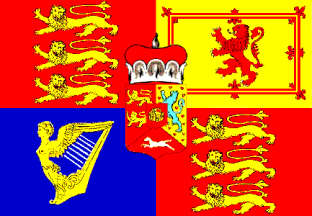 King George III (1760-1820)
King George II (1727-60)
King George I (Hanover)
Queen Anne (1702-14)
King William III (Orange)
King James II (1685-88)
King Charles II (1660-85)
King George III (1760-1820)
King George II (1727-60)
King George I (Hanover)
Queen Anne (1702-14)
King William III (Orange)
King James II (1685-88)
King Charles II (1660-85)
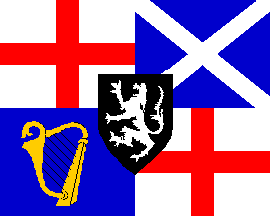 Richard Cromwell (1658-59)
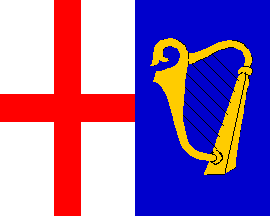 Oliver Cromwell ("Protector")
King Charles I ("Martyr")
King James I (Stuart)
Queen Elizabeth I ("Gloriana")
Queen Mary ("Bloody Mary")
Lady Jane Grey (Regent)
King Edward VI (1547-53)
King Henry VIII ("Majesty")
King Henry VII (Tudor)
King Richard III (1483-85)
King Edward V (1483)
King Edward IV (York)
King Henry VI (1422-61)
King Henry V (1413-22)
King Henry IV (Lancaster)
King Richard II (1377-99)
King Edward III (1327-77)
King Edward II (1307-27)
King Edward I ("Longshanks")
King Henry III (1216-72)
King John (Magna Carta)
King Richard I ("Lionheart")
King Henry II (Plantagenet)
King Stephen (House of Blois)
King Henry I (Charter Liberties)
King William II ("Rufus")
King William I ("Conqueror")
King Harold II (Godwinson)
King Edward ("Confessor")
Oliver Cromwell ("Protector")
King Charles I ("Martyr")
King James I (Stuart)
Queen Elizabeth I ("Gloriana")
Queen Mary ("Bloody Mary")
Lady Jane Grey (Regent)
King Edward VI (1547-53)
King Henry VIII ("Majesty")
King Henry VII (Tudor)
King Richard III (1483-85)
King Edward V (1483)
King Edward IV (York)
King Henry VI (1422-61)
King Henry V (1413-22)
King Henry IV (Lancaster)
King Richard II (1377-99)
King Edward III (1327-77)
King Edward II (1307-27)
King Edward I ("Longshanks")
King Henry III (1216-72)
King John (Magna Carta)
King Richard I ("Lionheart")
King Henry II (Plantagenet)
King Stephen (House of Blois)
King Henry I (Charter Liberties)
King William II ("Rufus")
King William I ("Conqueror")
King Harold II (Godwinson)
King Edward ("Confessor")
Monarchy can easily be debunked, but watch the faces, mark well the debunkers. These are the men whose taproot in Eden has been cut: whom no rumour of the polyphony, the dance, can reach - men to whom pebbles laid in a row are more beautiful than an arch. Yet even if they desire mere equality they cannot reach it. Where men are forbidden to honour a king they honour millionaires, athletes or film stars instead: even famous prostitutes or gangsters. For spiritual nature, like bodily nature, will be served; deny it food and it will gobble poison - C.S. Lewis
- GOD SAVE THE QUEEN -

I declare before you that my whole life, whether it be long or short, shall be devoted to your service and the service of the great Imperial Commonwealth to which we all belong. - Princess Elizabeth, 1947
British Monarchy
HER MAJESTY
Queen of Canada
Queen of Australia
Queen of New Zealand
Queen of Jamaica
Queen of Barbados
Commonwealth Realms
Style of the British Sovereign
The Prince Consort
The Prince of Wales
The Duke of York.Org
The Monarchy Today
Monarchy Media Centre
History of the Monarchy
Royal Art and Residences
Royal Society Portrait Painters
The Royal Collection
The Queen's Images
The Royal YouTube Channel
Official Royal Image Library
LOYAL PROCLAMATION
Uneasy lies the head that wears a crown.
- William Shakespeare
Royal Family
HOUSE OF WINDSOR
British Royal Family
Her Majesty The Queen
HRH The Duke of Edinburgh
HRH Prince Charles of Wales
HRH The Duchess of Cornwall
HRH Prince William of Wales
HRH Prince Henry of Wales
HRH The Princess Royal
HRH The Duke of York
HRH The Earl of Wessex
HRH The Countess of Wessex
HRH The Duke of Gloucester
HRH The Duchess of Gloucester
HRH The Duke of Kent
HRH The Duchess of Kent
HRH Prince Michael of Kent
HRH Princess Michael of Kent
HRH Princess Alexandra
Lord Mountbatten of Burma
They would never leave without me, I would never leave without the King, and the King would never leave. - Queen Mother, 1940
Monarchist Leagues
Canadian Royal Heritage Trust
Diamond Jubilee Trust Australia
British Monarchist League
Monarchist League of Canada
Australian Monarchist League
Monarchy New Zealand
British Monarchist Society
SA Monarchist Society
Monarchy Wales
American Monarchist League
Orange Lodge of Ireland
Orange Lodge of Canada
Orange Lodge of England
Orange Lodge of Australia
Loyal Orange Institution
Orange Historical Site
For Constitutional Monarchy
Junior Lodge of Ireland
Society of United Royalists
Monarchist Society of America
Royal Over-Seas League
The Victoria League
There is something behind the throne greater than the King himself.
- William Pitt the Elder
- DEFENDER OF THE FAITH -

The character of Kings is sacred; their persons are inviolable; they are the anointed of the Lord, if not with sacred oil, at least by virtue of their office. Their power is broad - based upon the Will of God, and not on the shifting sands of the people's will. They will be spoken of with becoming reverence, instead of being in public estimation fitting butts for all foul tongues. It becomes a sacrilege to violate their persons, and every indignity offered to them in word or act, becomes an indignity offered to God Himself. - Archbishop John Healy
The Sacred Crown
CROWN JEWELS
Jewel House, Tower of London
The Stone of Scone (847 A.D.)
King Edward's Chair (1296)
Crown of Scotland (1540)
St. Edward's Crown (1661)
Mary Modena's Crown (1661)
Sceptre with the Cross (1661)
Sceptre with the Dove (1661)
The Sovereign's Orb (1661)
Sword of Mercy (Curtana)
Sword of Offering (1820)
George IV State Diadem (1820)
Coronation Ring (1831)
Imperial Crown of India (1911)
Imperial State Crown (1937)
Gold Armills and Royal Robe
Colobium Sindonis
Royal Regalia
The Sleeping King
Here lies an anachronism, in the vague expectation of eternity. - 'Lord Peter'
Queen's Coronation
DIEU ET MON DROIT
The Devine Right of Kings
House of God, House of Kings
Throne and Altar
Order of Succession
Royal Line of Succession
King is Dead. Long Live the King!
The Interregnum
Accession Proclamation
QUEEN'S CORONATION:
Swearing of the Oath
Presenting of the Holy Bible
Anointing with Holy Oil
Presenting of Spurs and Sword
Investing with the Armills
Delivery of the Orb
Investiture and Crowning
"God Save the Queen!"
The Benediction
Enthroning and Homage
Holy Communion and the Recess
Archbishop: Will you solemnly promise and swear to govern the Peoples of the United Kingdom of Great Britain and Northern Ireland, Canada, Australia, New Zealand, ...and of your Possessions and other Territories to any of them belonging or pertaining, according to their respective laws and customs?
Queen: I solemnly promise so to do.
- SOVEREIGN OF REALM -

To be a king and wear a crown is more glorious to them that see it than it is a pleasure to them that bear it.
- Queen Elizabeth the First
Pomp and State
ELIZABETH REGINA
The Royal Yacht Britannia
In Defence of Pomp
Coronation of Elizabeth II
Reserve Powers of the Crown
Her Majesty's Privy Council
Queen's Privy Council
Great Officers of State
Queen's Golden Jubilee
Diamond Wedding Anniversary
Queen's Silver Jubilee
Trooping the Colour
Changing of the Guard
Sovereign's Fleet Review
Battle of Britain Memorial Flight
Accession Day (Feb 2)
Commonwealth Day (Mar 13)
Victoria Day (May 24)
Coronation Day (Jun 2)
Queen's Official B'day (Jun 6)
Remembrance Day (Nov 11)
Royal Xmas Message (Dec 25)
State Opening of Parliament
Sovereign's Ceremonial Mace
THE ROYAL TOURNAMENT
Edinburgh Military Tattoo
 Royal Nova Scotia Tattoo
Royal International Air Tattoo
Royal Nova Scotia Tattoo
Royal International Air Tattoo
Canadian Military Tattoo
Australian Federation Tattoo
Virginia International Tattoo
Birmingham Military Tattoo
 Quebec City Military Tattoo
Windsor Castle Royal Tattoo
SPEECH FROM THE THRONE
Quebec City Military Tattoo
Windsor Castle Royal Tattoo
SPEECH FROM THE THRONE
If your job is to leaven ordinary lives with elevating spectacle, be elevating or be gone. - George F. Will
- FOUNT OF JUSTICE -

And in choosing to leave the selection of their head of state to this most common denominator in the world - the accident of birth - Canadians implicitly proclaim their faith in human equality; their hope for the triumph of nature over political manoeuvre, over financial and social interest; for the victory of the human person.
- Jacques Monet
The Queen's Bench
QUEEN AND THE LAW
At Her Majesty's Pleasure
The Queen's Peace
Justices of the Peace
King's Court (Curia Regis)
Her Majesty's Courts Service
Royal Courts of Justice
Magna Carta Society
Constitution Society
English Common Law
Unwritten Constitution
The Liberty Papers
British House of Lords
Supreme Court of Canada
High Court of Australia
High Court of New Zealand
King's Bench Prison
Queen's Bench Bar Assn.
Crown Attorney
Crown Prosecutor
Tower of London
The Old Bailey
Without authority there is no liberty. Freedom is doomed to destruction at every turn, unless there is a recognized right to freedom. And if there are rights, there is an authority to which we appeal for them.
- G. K. Chesterton
King's Colleges
KING'S COLLEGE
University of Oxford (1167)
Westminster School (1179)
University of Cambridge (1209)
Winchester College (1382)
University St. Andrews (1410)
ETON COLLEGE (1440)
University of Glasgow (1451)
King's College, Aberdeen (1495)
Saint Paul's School (1509)
Shrewsbury School (1552)
Merchant Taylors' School (1561)
Rugby School (1567)
Harrow School (1572)
Trinity College, Dublin (1592)
Charterhouse School (1611)
Harvard University (1636)
College William & Mary (1693)
Yale University (1701)
Princeton University (1746)
King's College, Columbia (1754)
University King's College (1789)
McGill University (1821)
King's College, Toronto (1827)
King's College London (1829)
Upper Canada College (1829)
King's College School (1829)
Queen's University (1841)
Queensland University (1909)
Gordonstoun (1933)
KING'S SCHOLAR
Oxford gave the world marmalade and a manner, Cambridge science and a sausage
- CROWN-IN-PARLIAMENT -

Above the ebb and flow of party strife, the rise and fall of ministries, and individuals, the changes of public opinion or public fortune, the British Monarchy presides, ancient, calm and supreme within its function, over all the treasures that have been saved from the past and all the glories we write in the annals of our country. - Winston Churchill
Her Majesty's Government
"MY GOVERNMENT"
The Royal Prerogative
Her Majesty's Privy Council
Queen's Privy Council
Federal Executive Council
Executive Council of N.Z.
Her Majesty's Government
Westminster Cabinet
Rt. Hon. Prime Minister
Minister of the Crown
Her Majesty's Loyal Opposition
Her Majesty's Loyal Opposition
Order-in-Council
Chief Government Whip
Letters Patent
Petition of Right (1628)
The King-Byng Affair (1926)
The Dismissal of 1975
Dropping the Writ
The attitude of successive governments towards the monarchy is that of the urchin, secretly urinating on some shrub in the hope that it will die. - Peter Brimelow
Westminster Parliaments
QUEEN-IN-PARLIAMENT
Palace of Westminster
The Westminster System
Granting of Royal Assent
Act of Parliament
Parliamentary Privilege
Unparliamentary Language
Prorogation of Parliament
Anglo-Saxon Witenagemot (650)
The Model Parliament (1295)
U.K. Parliament (1801)
New Zealand Parliament (1852)
Parliament of Canada (1867)
Parliament of Australia (1901)
British House of Lords
Gentleman Usher of Black Rod
British House of Commons
Speaker of the House (1377)
Sergeant-at-Arms
(Let's Not) Elect The Lords
For an English Parliament
Scottish Parliament
National Assembly for Wales
As nature’s ties decay
As duty, love, and honour fail to sway,
Fictitious bonds, the bonds of wealth and law,
Still gather strength, and force unwilling awe.
- Oliver Goldsmith
Hansard Societies
 HANSARD
U.K. Hansard
CAN Hansard
AUS Hansard
NZ Hansard
Ireland Hansard
Wales Hansard
Scotland Hansard
 Northern Ireland Hansard
Isle of Man Hansard
Jersey Hansard
British Columbia Hansard
A nation of sheep will beget a government of wolves. - Edward R. Murrow


Orders of Chivalry
KNIGHTS AND CHIVALRY
Military Knights of Windsor
Noble Order of the Garter
Ancient Order of the Thistle
Illustrious Order of St. Patrick
Honourable Order of the Bath
Order of the Star of India
Order of St. Michael & St. George
The Order of Canada
The Order of Australia
The Order of New Zealand
Order of the Crown of India
The Order of Merit
New Zealand Order of Merit
Order of Military Merit
Royal Victorian Order
Order of the British Empire
Order of the Indian Empire
Order of Australia Association
Distinguished Service Order
Merit of the Police Forces
Companions of Honour
Society of Knights Bachelor
Knight Bachelor
Venerable Order of St. John
...in a nation of gallant men, in a nation of men of honour, and of cavaliers! I thought ten thousand swords must have leaped from their scabbards, to avenge even a look that threatened her with insult. But the age of chivalry is gone; that of sophisters, economists, and calculators has succeeded, and the glory of Europe is extinguished forever. - Edmund Burke
Victoria Cross
 For Valour: The Monarchist
Canadian Victoria Cross
Anzac Victoria Cross
The Victoria Cross Society
History of the Victoria Cross
Canadian Recipients of the VC
Australian Winners of the VC
New Zealand Recipients
Victoria Cross at Sea
Imperial War Museum VCs
Victoria Cross Heroes
BRITISH MEDALS
Canadian Victoria Cross
New Zealand Cross (Civilian)
George Cross (Civilian)
Cross of Valour (Civilian)
Cross of Valour (Civilian)
Conspicuous Gallantry Cross
Star of Military Valour
Distinguished Service Cross
Distinguished Service Cross
Military Cross
Distinguished Flying Cross
Star of Courage (Civilian)
Star of Courage (Civilian)
Medal of Military Valour
New Zealand Cross (Civilian)
Meritorious Service Cross
Medal of Bravery
The Sacrifice Medal
The King feels so strongly that, no matter the crime committed by anyone on whom the VC has been conferred, the decoration should not be forfeited. Even were a VC to be sentenced to be hanged for murder, he should be allowed to wear his VC on the gallows. - Lord Stamfordham, 1920
- COMMANDER-IN-CHIEF -

In war, resolution; in defeat, defiance; in victory, magnanimity; in peace, goodwill.
- Sir Winston Churchill, K.G. (1874-1965)
Queen and Armed Forces
QUEEN AND ARMED FORCES
Land Forces of the Empire
 The British Army
HM Canadian Armed Forces
The Australian Army
The New Zealand Army
Royal Armouries
The Royal Air Force
Royal Australian Air Force
Royal New Zealand Air Force
THE ROYAL NAVY
My Royal Canadian Navy
Royal Australian Navy
Royal New Zealand Navy
Her Majesty's Canadian Navy
Her Majesty's Royal Marines
Royal Canadian Mounted Police
Digger History (ANZAC)
Wellington's Dispatches
REGIMENTS.ORG
Never in the field of human conflict was so much owed by so many to so few.
- Winston Churchill
- HER MAJESTY'S SHIPS -

England expects that every man will do his duty. - Admiral Lord Horatio Nelson, 1805
The Admiralty
 LORD HIGH ADMIRAL
First Lord of the Admiralty
The First Sea Lord
LORD HIGH ADMIRAL
First Lord of the Admiralty
The First Sea Lord
The Nelson Society
Nelson's Dispatches
The 1805 Club
Vice-Admiral United Kingdom
Rear-Admiral United Kingdom
Nelson and His Navy
THE ROYAL NAVY
Royal Canadian Navy
Royal Australian Navy
Royal New Zealand Navy
The Great White Fleet
Her Majesty's Canadian Navy
Her Majesty's Royal Marines
Britannia Royal Naval College
Annapolis Naval Academy
Royal Naval College Greenwich
Royal Roads Military College
Royal Naval College Osborne
Trafalgar 200th
Admiral Cod
Nelson's Victory
Duty is the great business of a sea officer; all private considerations must give way to it, however painful it may be. - Lord Nelson
Royal Yachts
HMY BRITANNIA
Royal Yacht Squadron
The Royal Yacht Britannia
 Royal Thames Yacht Club
 Royal Canadian Yacht Club
 Royal Sydney Yacht Squadron
Royal Nova Scotia Yacht Sqn.
Royal Cork Yacht Club
Royal Perth Yacht Club
Royal Ulster Yacht Club
Royal Sydney Yacht Squadron
Royal Nova Scotia Yacht Sqn.
Royal Cork Yacht Club
Royal Perth Yacht Club
Royal Ulster Yacht Club
 The New York Yacht Club
Royal Brighton Yacht Club
Royal Irish Yacht Club
Royal Southampton Yacht Club
Royal Yacht Club of Tasmania
The New York Yacht Club
Royal Brighton Yacht Club
Royal Irish Yacht Club
Royal Southampton Yacht Club
Royal Yacht Club of Tasmania
It takes 3 years to build a ship, but 300 years to build a tradition.
- Admiral Cunningham, 1941
- QUEEN'S REGIMENTS -

The Battle of Waterloo was won on the playing fields of Eton. - Arthur Wellesley
- The Duke of Wellington, 1815
Ceremonial Guards
THE QUEEN'S GUARD
Yeomen of the Guard
Gentlemen at Arms
Royal Company of Archers
Yeomen Warders
Warden of the Cinque Ports
Royal Canadian Mounted Police
Military Knights of Windsor
HOUSEHOLD DIVISION
The King's Troops
The Life Guards
The Blues and Royals
The G-G's Horse Guards
Australia's Federation Guard
The Grenadier Guards
The Canadian Grenadier Guards
The Coldstream Guards
The Scots Guards
The Irish Guards
The Welsh Guards
The G-G's Foot Guards
We few, we happy few, we band of brothers; For he to-day that sheds his blood with me Shall be my brother; be he ne'er so vile, This day shall gentle his condition: And gentlemen in England now a-bed Shall think themselves accursed they were not here, And hold their manhoods cheap whiles any speaks That fought with us upon Saint Crispin's day. - William Shakespeare
Cavalry Regiments
HOUSEHOLD CAVALRY
The Life Guards
The Blues and Royals
The G-G's Horse Guards
DRAGOON REGIMENTS:
1st The Queen's Dragoon Guards
Royal Scots Dragoon Guards
Royal Dragoon Guards
Royal Canadian Dragoons
The British Columbia Dragoons
The Saskatchewan Dragoons
HUSSAR REGIMENTS:
Queen's Royal Hussars
Prince of Wales's Royal Lancers
King's Royal Hussars
Royal Canadian Hussars
The Light Dragoons
1st Hussars
The Sherbrooke Hussars
Princess Louise's Hussars
LANCER REGIMENTS:
The Queen's Royal Lancers
Lord Strathcona's Horse
Hunter River Lancers
Royal New South Wales Lancers
LIGHT HORSE REGIMENTS:
Queensland Mounted Infantry
Queen Alexandra's Mounted
South Australia Mounted Rifles
South Alberta Light Horse
Prince of Wales' Light Horse
The Light Horse Regiment
The Fort Garry Horse
Le Regiment blinde du Canada
TANK REGIMENTS:
1st Royal Tank Regiment
2nd Royal Tank Regiment
1st Armoured Regiment
2nd Cavalry Regiment
3rd/4th Cavalry Regiment
The Ontario Regiment
Queen's York Rangers
Prince Edward Island Regiment
Duke of Connaught's Own
King's Own Calgary Regiment
Le Regiment de Hull
The Windsor Regiment
From time to time, the tree of liberty must be watered with the blood of tyrants and patriots. - Thomas Jefferson
- REMEMBRANCE -

We are the dead. Short days ago We lived, felt dawn, saw sunset glow...If ye break faith with us who die We shall not sleep, though poppies grow In Flanders fields.
- Lt.Col. John McCrae (1872-1918)
War Veterans
REMEMBRANCE DAY
War Graves Commission
British Ex-Services League
For King and Empire
Queen's Book of the Red Cross
THE POPPY APPEAL
Royal British Legion
Royal British Legion Scotland
Royal Canadian Legion
Returned Services League
Returned Services Association
The American Legion
Land Forces of the Empire
Grand Army of the Republic
The Earl Haig Fund Scotland
Veterans Affairs Canada
Anzac Day Dawn Service
Western Front Association
Surviving WW1Veterans
They shall grow not old, as we that are left grow old. Age shall not weary them, nor the years condemn. At the going down of the sun and in the morning We will remember them.
- Laurence Binyon, For the Fallen
Lest We Forget
O VALIANT HEARTS (mp3)
Menin Gate Memorial
The Verdun Memorial
National Vimy Memorial
Thiepval War Memorial
ANZAC War Memorial
The Unknown Warrior
Tomb of the Unknown Soldier
Tomb of the Unknown Warrior
The Cenotaph at Whitehall
Arlington National Cemetary
Tyne Cot War Graves Cemetary
Scottish War Memorial
Ireland War Memorial
Canadian War Memorial
Australian War Memorial
 Nfld National War Memorial
New Zealand War Memorial
Shot at Dawn Memorial
Saint Julien Memorial
Shrine of Remembrance (*)
The Armed Forces Memorial
Douaumont Ossuary Verdun
National Memorial Arboretum
The Welsh Memorial
British Commando Memorial
Lewis War Memorial
 Old City Hall Cenotaph
Ottawa Memorial
Old City Hall Cenotaph
Ottawa Memorial
Korean War Memorial Wall
South African War Memorial
Vancouver Victory Square
The Hobart Cenotaph
 Next of Kin Memorial Avenue
Auckland War Memorial
Saskatchewan Memorial Gates
Beaumont-Hamel Memorial
Notre Dame de Lorette
The Normandy Memorial
Groesbeek War Cemetery
Garden of Remembrance
The Hong Kong Cenotaph
Juno Beach Centre
Women of World War II
Peacekeeping Monument
LAST POST ASSOCIATION
Their name liveth forevermore.
- Rudyard Kipling, from Ecclesiasticus
Commonwealth Premiers
YES, PRIME MINISTER
 David Thompson (2008-)
Kevin Rudd (2007-)
David Thompson (2008-)
Kevin Rudd (2007-)
 Bruce Golding (2007-)
Gordon Brown (2007-)
Bruce Golding (2007-)
Gordon Brown (2007-)
 Hubert Ingraham (2007-)
Stephen Harper (2006-)
P. Simpson-Miller (2006-07)
Hubert Ingraham (2007-)
Stephen Harper (2006-)
P. Simpson-Miller (2006-07)
 Michael Somare (2002-)
Perry Christie (2002-07)
Paul Martin (2003-06)
Mekere Morauta (1999-2002)
Michael Somare (2002-)
Perry Christie (2002-07)
Paul Martin (2003-06)
Mekere Morauta (1999-2002)
 Helen Clark (1999-)
Bill Skate (1997-99)
Tony Blair (1997-2007)
Jenny Shipley (1997-99)
John Howard (1996-2007)
Helen Clark (1999-)
Bill Skate (1997-99)
Tony Blair (1997-2007)
Jenny Shipley (1997-99)
John Howard (1996-2007)
 Keith Mitchell (1995-)
Julius Chan (1994-97)
Owen Arthur (1994-2008)
Jean Chretien (1993-2003)
Kim Campbell (1993)
Paias Wingti (1992-94)
Hubert Ingraham (1992-2002)
P.J. Patterson (1992-2006)
Paul Keating (1991-96)
Nicholas Brathwaite (1990-95)
Jim Bolger (1990-97)
John Major (1990-97)
Mike Moore (1990)
Geoffrey Palmer (1989-90)
Ben Jones (1989-90)
Michael Manley (1989-92)
Rabbie Namaliu (1988-92)
Paias Wingti (1985-88)
Brian Mulroney (1984-93)
Erskine Sandiford (1987-94)
Errol Barrow (1986-87)
Bernard St. John (1985-86)
David Lange (1984-89)
Herbert Blaize (1984-89)
John Turner (1984)
Nicholas Brathwaite (1983-84)
Bob Hawke (1983-91)
Michael Somare (1982-85)
Edward Seaga (1980-89)
Julius Chan (1980-82)
Pierre Trudeau (1980-84)
Margaret Thatcher (1979-90)
Joe Clark (1979-80)
Tom Adams (1976-85)
James Callaghan (1976-79)
Michael Somare (1975-80)
Robert Muldoon (1975-84)
Malcolm Fraser (1975-83)
Bill Rowling (1974-75)
Harold Wilson (1974-76)
Lynden Pindling (1973-92)
Gough Whitlam (1972-75)
Norman Kirk (1972-74)
Michael Manley (1972-80)
Jack Marshall (1972)
William McMahon (1971-72)
Edward Heath (1970-74)
John Gorton (1968-71)
Pierre Trudeau (1968-79)
Hugh Shearer (1967-72)
John McEwen (1967-68)
Errol Barrow (1966-76)
Harold Holt (1966-67)
Donald Sangster (1967)
Harold Wilson (1964-70)
Lester Pearson (1963-68)
Alec Douglas-Home (1963-64)
Alex Bustamante (1962-67)
Keith Holyoake (1957-72)
John Diefenbaker (1957-63)
Harold Macmillan (1957-63)
Walter Nash (1957-60)
Anthony Eden (1955-57)
Louis St. Laurent (1948-57)
Sidney Holland (1949-57)
Keith Mitchell (1995-)
Julius Chan (1994-97)
Owen Arthur (1994-2008)
Jean Chretien (1993-2003)
Kim Campbell (1993)
Paias Wingti (1992-94)
Hubert Ingraham (1992-2002)
P.J. Patterson (1992-2006)
Paul Keating (1991-96)
Nicholas Brathwaite (1990-95)
Jim Bolger (1990-97)
John Major (1990-97)
Mike Moore (1990)
Geoffrey Palmer (1989-90)
Ben Jones (1989-90)
Michael Manley (1989-92)
Rabbie Namaliu (1988-92)
Paias Wingti (1985-88)
Brian Mulroney (1984-93)
Erskine Sandiford (1987-94)
Errol Barrow (1986-87)
Bernard St. John (1985-86)
David Lange (1984-89)
Herbert Blaize (1984-89)
John Turner (1984)
Nicholas Brathwaite (1983-84)
Bob Hawke (1983-91)
Michael Somare (1982-85)
Edward Seaga (1980-89)
Julius Chan (1980-82)
Pierre Trudeau (1980-84)
Margaret Thatcher (1979-90)
Joe Clark (1979-80)
Tom Adams (1976-85)
James Callaghan (1976-79)
Michael Somare (1975-80)
Robert Muldoon (1975-84)
Malcolm Fraser (1975-83)
Bill Rowling (1974-75)
Harold Wilson (1974-76)
Lynden Pindling (1973-92)
Gough Whitlam (1972-75)
Norman Kirk (1972-74)
Michael Manley (1972-80)
Jack Marshall (1972)
William McMahon (1971-72)
Edward Heath (1970-74)
John Gorton (1968-71)
Pierre Trudeau (1968-79)
Hugh Shearer (1967-72)
John McEwen (1967-68)
Errol Barrow (1966-76)
Harold Holt (1966-67)
Donald Sangster (1967)
Harold Wilson (1964-70)
Lester Pearson (1963-68)
Alec Douglas-Home (1963-64)
Alex Bustamante (1962-67)
Keith Holyoake (1957-72)
John Diefenbaker (1957-63)
Harold Macmillan (1957-63)
Walter Nash (1957-60)
Anthony Eden (1955-57)
Louis St. Laurent (1948-57)
Sidney Holland (1949-57)
 Robert Menzies (1949-66)
Winston Churchill (1951-55)
Robert Menzies (1949-66)
Winston Churchill (1951-55)
Thereupon the people picked a leader nearer to their mood, Churchill, who was at any rate able to grasp that wars are not won without fighting. - George Orwell
Imperial Prime Ministers
Ben Chifley (1945-49)
Frank Forde (1945)
Clement Attlee (1945-51)
John Curtin (1941-45)
Arthur Fadden (1941)
Winston Churchill (1940-45)
Peter Fraser (1940-49)
Robert Menzies (1939-41)
Earle Page (1939)
Neville Chamberlain (1937-40)
MacKenzie King (1935-48)
Michael Savage (1935-40)
Stanley Baldwin (1935-37)
Joseph Lyons (1932-39)
Richard Bennett (1930-35)
George Forbes (1930-35)
James Scullin (1929-32)
Ramsay MacDonald (1929-35)
Joseph Ward (1928-30)
MacKenzie King (1926-30)
Arthur Meighen (1926)
Gordon Coates (1925-28)
Francis Bell (1925)
Stanley Baldwin (1924-29)
Stanley Bruce (1923-29)
MacKenzie King (1921-26)
Andrew Bonar Law (1922-23)
Arthur Meighen (1920-21)
David Lloyd George (1916-22)
Billy Hughes (1915-23)
Andrew Fisher (1914-15)
Joseph Cook (1913-14)
William Massey (1912-25)
Thomas Mackenzie (1912)
Robert Borden (1911-20)
Andrew Fisher (1910-13)
Alfred Deakin (1909-10)
Herbert Asquith (1908-16)
Andrew Fisher (1908-09)
Joseph Ward (1906-12)
William Hall-Jones (1906)
Alfred Deakin (1905-08)
Campbell-Bannerman (1905-8)
George Reid (1904-05)
Chris Watson (1904)
Alfred Deakin (1903-04)
Arthur Balfour (1902-05)
Edmund Barton (1901-03)
Wilfred Laurier (1896-1911)
Charles Tupper (1896)
Marquess of Salisbury (1895-02)
Mackenzie Bowell (1894-96)
Earl of Rosebery (1894-95)
Richard Seddon (1893-1906)
John Thompson (1892-94)
William Gladstone (1892-94)
John Ballance (1891-93)
John Caldwell Abbott (1891-92)
Marq. of Salisbury (1886-92)
William Gladstone (1886)
Marquess of Salisbury (1885-86)
Robert Stout (1884-87)
Frederick Whitaker (1882-83)
John Hall (1879-82)
John A. MacDonald (1878-91)
George Edward Grey (1877-79)
Julius Vogel (1876)
Daniel Pollen (1875-76)
William Gladstone (1880-85)
Benjamin Disraeli (1874-80)
Julius Vogel (1873-75)
Alexander Mackenzie (1873-78)
George Waterhouse (1872-73)
William Fox (1869-72)
William Gladstone (1868-74)
Benjamin Disraeli (1868)
John A. MacDonald (1867-73)
Earl of Derby (1866-68)
Edward Stafford (1865-69)
Earl Russell (1865-66)
Frederick Weld (1864-65)
Frederick Whitaker (1863-64)
Alfred Domett (1862-63)
William Fox (1861-62)
Viscount Palmerston (1859-65)
Earl of Derby (1858-59)
Edward Stafford (1856-61)
Henry Sewell (1856)
Viscount Palmerston (1855-58)
Earl of Aberdeen (1852-55)
Earl of Derby (1852)
Earl Russell (1846-52)
Robert Peel (1841-46)
Viscount Melbourne (1835-41)
Robert Peel (1834-35)
Duke of Wellington (1834)
Earl Grey (1830-34)
Duke of Wellington (1828-30)
Viscount Goderich (1827-28)
George Canning (1827)
Earl of Liverpool (1812-27)
Spencer Perceval (1809-12)
Duke of Portland (1807-09)
Lord Grenville (1806-07)
William Pitt (1804-06)
Henry Addington (1801-04)
William Pitt (1783-1801)
Duke of Portland (1783)
Earl of Shelburne (1782-83)
Marquess of Rockingham (1782)
Lord North (1770-82)
Duke of Grafton (1768-70)
Earl of Chatham (1766-68)
Marq. of Rockingham (1765-66)
George Grenville (1763-65)
Earl of Bute (1762-63)
Duke of Newcastle (1757-62)
Duke of Devonshire (1756-57)
Duke of Newcastle (1754-56)
Henry Pelham (1743-54)
Earl of Wilmington (1742-43)
Robert Walpole (1721-42)
RIGHT HONOURABLE
Primus Inter Pares. First Among Equals.