

 "Attack it immediately."
Churchill had asked for advice, he got it. The French fleet at Mers-el-Kébir was in danger of falling into German hands. On July 3rd, in an act as ruthless as it was necessary, Churchill ordered the destruction of the French Fleet. He is said to have wept on giving the order. His interlocutor was not so moved. The Minister of Aircraft Production had reasoned that the French fleet might be blackmailed by the Germans, perhaps by a threat to destroy Marseilles, into joining their weight to the Italian navy, tipping the balance against the Allies in the Mediterranean. The minister's strategic logic was sound. Churchill knew that. He had appointed him to cabinet over the howls of many members of his war-time coalition. In the vital summer of 1940 the RAF was desperately short of Spitfires and Hurricanes. Britain needed pilots and planes. The volunteers were not lacking, their tools were.
A production miracle was needed, Churchill turned to Max Aitken, 1st Baron of Beaverbrook. Max was an old friend. He was also the most powerful press baron in the Empire. His Daily Express sold 3.7 million copies, the largest circulation of any paper in the world. He also had an uncanny knack for finance, making him, his associates and investors very rich. In four months he produced 6400 aircraft for the British war effort. Quadrupling the rate of production. His critics charged he was exaggerating the number of aircraft. Probably. Max had a tendency to do that. He had cut his teeth in the business world selling bonds door to door in rural New Brunswick. The hyper-active salesman never left him. He often went too far in making promises, in saying things he shouldn't. Yet what he did deliver was nothing short of brilliant.
As part of a series of books on influential Canadians, under the guidance of former GG consort John Ralston Saul, the noted New Brunswick novelist David Adams Richards has produced a thin one volume biography of Lord Beaverbrook. Written in a chatty manner, that might be irritating to some, Richards provides what is really a longish personal essay, on arguably the most influential Canadian of the twentieth century. Another son of the Miramichi, Richards intersperses his chronological narrative with personal and family encounters with Beaverbrook. What emerges is a character somewhere between Horatio Alger and Duddy Kravitz, yet on a grand scale. A smooth operator with sharp elbows, always thinking several moves ahead of the opposition.
It was said of his contemporary, TE Lawrence, that he had a habit of backing into the limelight. So did Max, except he would usually bump into some famous personage of the day, or soon to be, as well. He ran R.B. Bennett's first election campaign, while he was not yet of voting age. He promised voters things that R.B. couldn't, or wouldn't deliver, which did not amuse the future Prime Minister. Yet when Bennett moved west, and ran for Parliament, there was Max with his impish grin and fast moving 5ft 5in frame. You could never quite stay mad at him. No matter how many times he committed adultery, or bent the facts just a wee bit too much, he usually got away with it. Because he could charm, yes. Because he was often right, even when he was wrong, yes. Above all, because people needed Max. He was smarter than they were.
He talked his way into a job with the powerful financier John F Stairs, who put the bright young lad - just in his twenties - to merging a smaller bank to Stairs' Union Bank, then to running Royal Securities. Soon Max was in Montreal, the centre of Canadian Edwardian capitalism. The venerable Sir Sanford Fleming was in distress. His interests in concrete were threatening the pioneering engineer with bankruptcy and disgrace. Lead by the President of the Bank of Montreal, and assisted by the Who's Who that was then the board of the CPR, the great and good of Canadian business asked that Max Aitken figure something out. It was a trap. The fast rising Aitken was a threat, and one with a slippery reputation. The collapse of Fleming's interests in concrete seemed ordained. Best that the blame might be placed on the pushy cad from nowhere New Brunswick. Max had the last laugh. He saved Fleming's fortune, introduced a sweeping consolidation of the Canadian concrete industry - which had been crippled in the wake of the Panic of 1907 - and made his own fortune into the bargain. Yet the whole thing has been just a bit too slick. There were rumours. Max, now a millionaire (pounds not dollars) while not yet thirty, headed for the epicentre of power and finance, London.
Arriving with his beautiful wife - daughter of a Major-General - in England, he set up in great country estate - his neighbour and new friend was Rudyard Kipling. Marital bliss was fleeting. Richards argues that Beaverbrook was chasing love most of life, in the arms of this lovely and that, in the respect of a series of father figures. Among the most influential of the latter, was a fellow Canadian, Andrew Bonar Law. A prominent Conservative, Law was engineered into the leadership of the party by Beaverbrook, a newly minted MP, in 1912. Aitken revered Law, deciding that his friend must become Prime Minister. The Liberals, under H.H. Asquith. were weak. An expected election in 1914 or 1915 would topple them. Sarajevo intervened.
Another one of Aitken's new friends, Winston Churchill, had wanted an Liberal-Tory coalition to fight the war. The Liberals refused. Yet the government's popularity waned. Asquith was to be overthrown through a parliamentary coup in late 1916, among whose leading plotters was Aitken. Law was denied the premiership, instead made number two to another new friend of Max's, David Lloyd George. Though their politics were rarely compatible, they were both in a sense actors. Lloyd George, however, was a professional and Aitken just starting. Dropping hints of a cabinet position, as Minister of Trade, Lloyd George secured Aitken's support.
In expectation of office, Aitken resigned his seat and started campaigning for re-election - as was required by British law at the time. Lloyd George, through Law, instructed Aitken not to run again, allowing the seat to go to "a Georgian" loyalist who would be made Minister of Trade. As consolation Aitken was raised to the peerage. According to legend, Kipling talked him out of becoming Lord Miramichi, on the grounds that Englishmen would be unable to pronounced it. The new Lord Beaverbrook had to console himself with PR work. First promoting the job Canadian soldiers were doing on the Western Front, then as Minister of Information in the war-time cabinet. Dreams of revenged never left him. From the end of the war in 1918 until 1922, Beaverbrook plotted again, to remove Lloyd George and replace him with Law. He succeeded only to have Law resign shortly after from throat cancer.
In the midst of the intrigues surrounding Asquith's fall, Beaverbrook had acquired control of a failing paper called the Daily Express. Lord Northcliffe had told him he would lose his fortune keeping it afloat. Instead he revolutionized the industry. He introduced the first women's section and crossword. No expense was spared on photography and layout. The modern tabloid was born. As the paper grew in importance, Beaverbrook's reputation as a pushy cad never left him. The Establishment found his enthusiasm and energy aggravating. The mixture of envy and hatred that is directed from old money to new money. From self-made men to the scions of great names. Being a colonial didn't help. The British elite were not completely averse to outsiders, the Empire would never have lasted without the ruling classes talent for co-opting rising stars. Disraeli had been Prime Minister the year Beaverbrook was born. Dizzy, however, was a witty novelist and insanely charming dinner guest. The Maritime accent, and manners, hung too closely to the backwoods baron.
They hated him, but they needed him. Nor was the hatred expressed in ordinary terms. That great worshipper of the upper classes, Evelyn Waugh, mocked his former employer as Lord Copper in Scoop. My own personal suspicion for years has been that Rex Mottram, the amoral materialist from Canada in Brideshead Revisited, was another dig at Beaverbrook. Isolated again, he sought out more women and more business ventures. The lure of politics remained. In a quixotic gesture he founded the short-lived Empire Party in 1930. Disgusted with the defeat of the Tories under Stanley Baldwin, who had succeed Law as leader and PM. Never an admirer of the famously pragmatic Baldwin, the Empire Party was a political blunt weapon to be used to take down Baldwinite Tories. The ideas was dropped, but not the party platform. Since coming to England, Beaverbrook had been a highly vocal advocate of Imperial Preference, a free trade zone within the Empire. This was a first step toward some kind of greater imperial unity, which he never defined.
Imperial Preference faded, after a brief vogue during the Ottawa Conference of 1932. Like many middle aged men, Beaverbrook's world view had frozen in his youth. Then the idea of some kind of imperial federation was widely discussed in the first decade of the twentieth century. The idea of empire, however, was fading. The colonial boy made good found himself, so to speak, being more royalist than the king. The centre had no interest in holding. If his views didn't always carry the day in the councils of state, his dominance of the press was unquestioned. He almost single handedly kept news of Edward VIII's relationship to Wallace Simpson secret - in Britain - for much of 1936. Eventually the Daily Express did break the story, once it was clear Edward was set on abdication. If he couldn't prevent a constitutional crisis in the 1930s, he could at least give a platform to his old friend, Churchill, to warn of the gathering storm. Few in late 1930s Britain were interested in what Churchill had to say. The Times and the BBC effectively banned him for long stretches of time. When war came, and in time his appointment as PM, Churchill remember Beaverbrook's aid and comfort.
The post-war world proved disappointing to Beaverbrook. He had resigned from the cabinet in 1942 when Attlee was made Deputy PM. The age of socialism and decolonization was alien to Max. He made a few attempts to resettle in New Brunswick, but England was now his home. In all this he found time to write books. Richards describes his writing style as "Beaverado."So was his life. In his last public appearance, an interviewer asked him if he was disappointed in the ultimate failure of imperial preference. The old man replied quietly: "I was unworthy." Yet again he was exaggerating. Not from hubris, but undeserved humility.
- Elizabeth our Prince -

Long to Reign Over Us our Christian Prince
- Queen Elizabeth the Second (1952 -)
- Churchill our Patron -

Patron of the English-Speaking Peoples
- Sir Winston Churchill, K.G. (1874-1965)
- Burke our Patriarch -
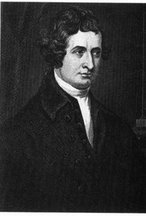
Patriarch of the Permanent Things
- Rt. Hon. Edmund Burke (1729-1797)
- Kipling our Poet -

Poet Laureate of the British Empire
- Rudyard Kipling (1865-1936)
- Salisbury our Prime Minister -
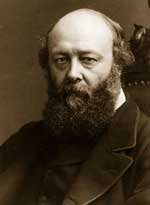
Icon of Traditional, Aristocratic Conservatism
- Lord Robert Cecil Salisbury (1830-1903)
The Daily Bayonet
The Daily Telegraph
Restore the Honour
The Salisbury Review
 Father Raymond De Souza
Lord Tebbit of Chingford
Lord Black of Crossharbour
Gerald Warner
Daniel Hannan, MEP
Andrew Cusack
 Mark Steyn
Brits at their Best
Royalty Monarchy *
The Young Fogey
Throne, Alter, Liberty
Sunlit Uplands
David Flint
Admiral Cod
Young Fogey Down Under
David Warren
Peter Hitchens
The Kiwi Examiner
Taki's Magazine
Archbishop Cranmer
The Skeptical Doctor
 Commonwealth Conversation
Your Freedom and Ours
Gods of the Copybook Headings
A Letter To The Times
Curated Secrets
"Reading The Monarchist is like entering an Edwardian Gentlemen's Club during the era of Swinging London. The hippie rabble bangs at the door demanding entrance; the members simply order the cellist to play forte and continue with the debate and the port." - The Gods of the Copybook Headings

Evelyn Waugh (1903 - 1966)
No good ever came from a public cause, only a private cause of the spirit. - Evelyn Waugh
The Counter Revolution
God Save the Queen!
Maintain Personal Union!
Call the Commonwealth British!
Save the Imperial Standard!
Restore the Hereditary Lords!
I Believe in the Elite for All!
The Radical Tory Manifesto!
Bring Back the Stiff Upper Lip!
Revive Sirs and Knighthoods!
Bring Back the RCN/RCAF!
Tobacco is Good for the Soul!
For Liberty and Livelihood!
Save the Scottish Regiments!
N.Z. Restores Knighthoods!
Gurkha Justice Campaign!
Zero Tolerance for Dust Jackets!
Keep the Gentleman's Necktie!
Repeal the Foxhunting Ban!
Abolish the "HR" Commissions!
I Want a Referendum.Com!
Bring Back Pipe Smoking!
Modern Art is Rubbish!
The Sir Keith Park Memorial!
Unite the Kingdoms!
Better Off Out!
I am a Conservative to preserve all that is good in our constitution, a Radical to remove all that is bad. I seek to preserve property and to respect order, and I equally decry the appeal to the passions of the many or the prejudices of the few. - Benjamin Disraeli
- KING AND COUNTRY -

Let us therefore brace ourselves to our duty, and so bear ourselves... - W.S. Churchill
Imperial Loyalists
Imperial State Crown
Imperial Society of Knights
The Empire Club of Canada
Commonwealth War Graves
For King and Empire
British Peoples League
American Loyalist Institute
Land Forces of the Empire
Royal Over-Seas League
Imperium et Libertas
United Empire Loyalists

Ex-Services League
Red Ensign Society of Canada
Imperial War Museum
Daughters of Empire
Empire on the Bay
British Empire Museum
Royal Commonwealth Society
The Victorian Peeper
British East India Co.
The British North America Blog
Order of the British Empire
Imperial Bank of Commerce
Dominion of British West Florida
The Victoria League
United Commonwealth Society
Hudson Bay Company
Empire State Building
Victorian Station
The North West Company
Imperial Glory
British Club Worldwide
The Emperor's Club
The Imperial Mail
Proud to be British Aussies
Taylor Empire Airways
British Expats
...if the British Empire and Commonwealth should last a thousand years, men will still say this was their finest hour.
- Prime Minister Winston Churchill
Anglo Monarchists
THE QUEEN
The Royalist
The Loyalist
Anglican Rose
Tory Heaven
 An Irish Tory
Australian Spirit
Classic Canadian
Altar and Throne
Radical Royalist
Tea at Trianon
NO REPUBLIC!
Throne and Altar
The Young Fogey
Queen and Country
The American Monarchist
Australian Young Fogey
Let Britannia Rise
God Save The Queen
New Zealand Monarchy
The Oxford Monarchists
Royal Representative
Canadian Monarchist Online
The Mad Monarchist...NEW!
Aussie Republic Unplugged
The Commonwealth Monarchist
There is nothing in the world more stubborn than a corpse: you can hit it, you can knock it to pieces, but you cannot convince it.
- Alexander Herzen
Gentlemen Royalists
Richard Stone
Gerald Warner
Timothy Belmont
Andrew Cusack
Robert Finch
Dr. David Flint
Taki Theodoracopulos
Guy Stair Sainty
Rafal Heydel-Mankoo *
Jim Frecklington, OAM
Theodore Harvey *
Richard Toporoski
Peter Hitchens
Holden Royalist
The Realm of J.J.
 J.K. Baltzersen
Philip Benwell, MBE
Dr. Roy Eappen
 Neil Welton
Charles Coulombe, KCStS
Alexander Stoddart
Padre Benton
Dr. Noel Cox
Joseph Crisp
Alan Goudman
Jeremy Paxman
Matt Bondy
On the quality of magnificence, a gentleman does not count the cost. - Aristotle
Queen and Church
 The Supreme Governor
Apostle to the English
Saint Augustine of Canterbury
Archbishop of Canterbury
Westminster Abbey
Anglican Communion
Anglican Church of Canada
Anglican Church of Australia
Anglican Church New Zealand
Anglican Catholic Church
Episcopal Church in the USA
Scottish Episcopal Church
Church of Scotland
Church of Ireland
 Church in Wales
 Church of Rome
Canterbury Cathedral
Church of Rome
Canterbury Cathedral
Archbishop of York
York Minster Cathedral
Dean of Westminster
St. George's Chapel, Windsor
Dean of Windsor
St. Giles' Cathedral
St. Paul's Cathedral
English Clergy Association
Anglicans in Africa
Catholic Church in England
Orthodox Presbyterian Church
Presbyterian Church Canada
Presbyterian Church Australia
Presbyterian Church (USA)
Presbyterian Church of NZ
Presbyterian Church America
Scottish Christian.com
Anglicans Online
King Charles the Martyr
There is nothing an English country lord loves, so much as his good English church.
- Thomas Babbington Macaulay
Saint George
ST. GEORGE'S CHAPEL
Royal Society of St. George
St. George's Society New York
St. George's Society Toronto
St. George Melbourne
St. George Greater Vancouver
St. George Birmingham
Alberta St. George of England
The St. Andrew's Society
New York Caledonian Club
St. Andrew's of Toronto
Royal Caledonian South Oz
St. Andrew's of Montreal
Royal Caledonian Melbourne
Saint David
St.David Society of Toronto
St. David Society of Baltimore
St. David's Society of Montreal
St. David's Cathedral
Victoria Welsh Society
St. Patrick's New York
St. Patrick's of Montreal
The St. Patrick Centre
The Ulster Society
Ulster Loyal
St. Patrick's Day
St. Patrick's Basilica, Ottawa
SAINT NICHOLAS
The game's afoot: Follow your spirit; and upon this charge Cry 'God for Harry, England, and Saint George!'
- William Shakespeare, Henry V
- THE QUEEN'S ENGLISH -

Self-love, my liege, is not so vile a sin, as self neglecting. - William Shakespeare
English Literature
QUEEN'S ENGLISH SOCIETY
Anthology of English Literature
The New Chaucer Society
Christopher Marlowe Society
William Shakespeare Society
John Milton Reading Room
Samuel Johnson Society
Johnson Society of London
Jonathan Swift Blog
Lord Byron Society
Edmund Burke Society
The Jane Austen Society
Discovering Dickens
Charles Dickens Page
The Lord Tennyson Page
The G.A. Henty Society
The Kipling Society
Sir Arthur Conan Doyle
The Oscar Wilde Society
Gilbert and Sullivan Archive
Sir Edward Elgar Society
G.K. Chesterton Society
Hilaire Belloc, Wiki
George Orwell's Works
The Churchill Society
T.S. Eliot Society
The Mythopoeic Society
The Tolkien Society
Dorothy L. Sayers Society
C.S. Lewis Foundation
C.S. Lewis: Into the Wardrobe
P.G. Wodehouse (1881-1975)
Evelyn Waugh (1903-1966)
Robertson Davies (1913-1995)
Robert Frost Society
Mordecai Richler, Wiki
Norman Mailer Society *
To every man upon this earth, death cometh soon or late. And how can man die better than facing fearful odds, for the ashes of his fathers, and the temples of his gods.
- Thomas Babbington Macaulay
Poets Laureate
POET LAUREATE
Cavalier Poets
The Bard of Avon
The Bard of Scotland
Parliamentary Poet Laureate
Poet Laureate Consultant
The Edinburgh Makar
Ben Jonson (1572-1637)
William Davenant (1606-1668)
John Dryden (1631-1700)
Thomas Shadwell (1642-1692)
Robert Burns (1759-1796)
Will Wordsworth (1770-1850)
Sir Walter Scott (1771-1832)
Robert Southey (1774-1843)
Lord Byron (1788-1824)
Alfred Tennyson (1809-1892)
Alfred Austin (1835-1913)
Rudyard Kipling (1860-1936)
Robert Service (1874-1958)
Robert Bridges (1844-1930)
Robert Frost (1874-1963)
John Masefield (1878-1967)
What weight of ancient witness can prevail, if private judgement hold the public scale?
- John Dryden.
- CONSTITUTION OF LIBERTY -

The right to be consulted; The right to advise; The right to warn. - Walter Bagehot
English Constitution
Charter of Liberties (1100)
Constitution Clarendon (1164)
Assize of Clarendon (1166)
Assize of Arms (1181)
Magna Carta (1215)
Model Parliament (1265)
Right of Common Law (1297)
Acts of Supremacy (1534-59)
Petition of Right (1628)
The Levellers (1642)
Levellers' Manifesto (1649)
Habeas Corpus (1679)
"Glorious Revolution" (1688)
English Bill of Rights (1689)
Act of Settlement (1701)
Treaty (Acts) of Union (1707)
Decl. of Independence (1776)
U.S. Constitution (1789)
U.S. Bill of Rights (1791)
Act of Union (1800)
Reform Act (1832)
Treaty of Waitangi (1844)
B.N.A. Act (1867)
The English Constitution (1867)
Australian Constitution (1900)
Balfour Declaration (1926)
Statute of Westminster (1931)
Constitution Act (1982)
Charter of Rights (1982)
Const. of New Zealand (1986)
Constitution of the U.K.
What weight of ancient witness can prevail, if private judgement hold the public scale?
- John Dryden.
- LANDED GENTRY -

To horse and away To the heart of the fray! Fling care to the Devil for one merry day!
- W.H. Ogilvie
Liberty and Livelihood!
Fox Hunting
Countryside Alliance
Scottish Countryside Alliance
Countryside Alliance Ireland
Masters of Foxhounds U.K.
Masters of Foxhounds N.A.
Masters of Harriers and Beagles
The Montreal Hunt Club (*)
Hunting and Conservation
Guards Polo Club
 Calcutta Polo Club
The Hurlingham Club
Calcutta Polo Club
The Hurlingham Club
Hurlingham Polo Association
 Prince of Wales Stakes
Queen's Plate
ROYAL ASCOT
Henley Royal Regatta
THE BOAT RACE
Oxford and Cambridge Cup
Henley Boat Races
The English country gentleman galloping after a fox — the unspeakable in full pursuit of the uneatable. - Oscar Wilde
English Pubs
The Royal Standard
The Queen Victoria
Old King's Head
The King's Arms
The Rose and Crown
The George and Dragon
James Joyce Pub
THE RED LION
O'Neills Irish Pub
The Marquis of Granby
The Duke of Cambridge
The Duke of Richmond
The Duke of Wellington
The Brunswick Inn
The Earl of Derby
The Elephant and Castle
The Bull and Bush
Dew Drop Inn ("do drop in")
The Goat and Compass
The Cat and Fiddle
The Cock and Bull
The Bag o'Nails
The Anglesea Arms
The Fox and Hounds
The Innholders' Company
The Moon Under Water
Up and down the King's Highway, In and out the Eagle, That’s the way the money goes, Pop! goes the weasel.
- LORD OF THE BLOG -

I can make a lord, but only God can make a gentleman. - King James I
Peers of the Realm
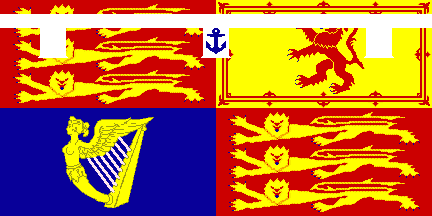 Duke of York (1986)
 Duke of Edinburgh (1947)
 Duke of Kent (1934)
Duke of Gloucester (1928)
Duke of Kent (1934)
Duke of Gloucester (1928)
Duke of Fife (1900)
Duke of Argyll (1892)
Duke of Gordon (1876)
Duke of Westminster (1874)
Duke of Abercorn (1868)
Duke of Sutherland (1833)
Duke of Wellington (1814)
Duke of Leinster (1766)
Duke of Northumberland (1766)
Duke of Manchester (1719)
Duke of Brandon (1711)
Duke of Montrose (1707)
Duke of Roxburghe (1707)
Duke of Atholl (1703)
Duke of Rutland (1703)
Duke of Marlborough (1702)
Duke of Argyll (1701)
Duke of Bedford (1694)
Duke of Devonshire (1694)
Duke of St Albans (1684)
Duke of Queensberry (1684)
Duke of Beaufort (1682)
Duke of Richmond (1675)
Duke of Grafton (1675)
Duke of Buccleuch (1663)
Duke of Hamilton (1643)
Duke of Lennox (1581)
Duke of Somerset (1547)
Duke of Norfolk (1483)
Duke of Rothesay (1398)
Duke of Cornwall (1337)
Nobility is a graceful ornament to the civil order. It is the Corinthian capital of polished society. - Edmund Burke
Barons of the Press
ROYAL INSIGHT
Majesty Magazine
The Salisbury Review
The New Criterion
The Scotsman
The Times
The Australian
The Telegraph...Blogs
National Review...Corner
The Spectator...CoffeeHouse
The Chap Magazine NEW!
Savile Row Style
Arts & Letters Daily
Burke's Peerage and Gentry
The American Conservative
New English Review
Kingston Whig-Standard
Victoria Times Colonist
Chronicles Magazine
Punch
Baronage
The Herald
Marlborough Express
Western Standard RIP
Taki's Magazine
The Brussels Journal
VDARE.COM
Globe and Mail
STUFF.CO.NZ
New York Sun RIP
Dominion Post
National Post
Quadrant Magazine
Macleans Magazine
Nelson Mail
Defence News
Gilbert Magazine
The subject who is truly loyal to the Chief Magistrate will neither advise nor submit to arbitrary measures. - Junius
(motto of the Globe and Mail)
Blogs of the Order
An Englishman's Castle
Albion's Seedlings
The Blogging Tories
Tory Diary
Kiwi Blog
A Pint of Unionist Lite
Irish Elk
Tory Heaven
Bring Back The British Empire
The Daily Bayonet
The Dominion Institute Blog
Adam Smith Institute Blog
The Witanagemot Club
Very British Subjects
Occam's Carbuncle
The Liberty Papers
The Commonwealth Realm
The Prince of Darkness
Kiwi Examiner
Our Kingdom
England Expects
Captain's Quarters
Tory Historian
Lord Kitchener's Own
The English Crusade
The British North America Blog
In the name of God, go!
100 Years Ago Today
The Anglo Saxon Chronicle
Wilson Revolution Unplugged
The Salisbury Pages
The Lord Protector
Canterbury Tales
Geoffrey Chaucer Hath a Blog
Sir Robert Bond Papers
Kiwi Pundit
My Flanders Fields
Veritas
Brit Blog
The Crusader
Burkean Canuck
Arthur's Seat
Chesterton and Friends
Lord Feverstone
Freedom and Whisky
Old Whig's Brain Dump
The Torch
Officer's Club
Guy Fawkes' Blog
Armavirumque
Mild Colonial Boy
Tommy English
Kingdom of Chaos
Alfred the OK
Postmodern Conservative
This royal throne of kings, this sceptr'd isle/This earth of majesty, this seat of Mars/This other Eden, demi-paradise...This blessed plot, this earth, this realm, this England... - William Shakespeare
Lords of the Manor
BUCKINGHAM PALACE
England's Windsor Castle
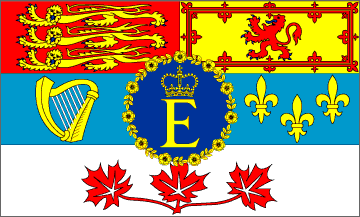 Canada's Rideau Hall
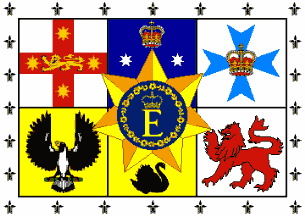 Australia's Yarralumla
Scotland's Holyroodhouse
Sandringham House
Frogmore House
Kensington Palace
Clarence House
St. James's Palace
 Balmoral Castle
COUNTRY HOUSE
Guild of Professional Butlers
The National Trust
The National Trust for Scotland
Arundel Castle (Norfolk)
Edinburgh Castle
Hatley Castle (Dunsmuir)
Harewood House
Inveraray Castle (Argyll)
Castle Howard
CASA LOMA
Chatsworth House (Devonshire)
Glamis Castle (Strathmore)
Blenheim Palace (Marlborough)
Leeds Castle (Tudor)
Spencer House
Dundurn Castle
Longleat House (Bath)
Wollaton Hall
Hardwick Hall (Devonshire)
Hatfield House (Salisbury)
Burghley House
Craigdarroch Castle
Woburn Abbey
Warwick Castle
Wilton House
Beaulieu Abbey
Bowood House
Chiswick House
Holkham Hall
Lost Heritage
A man's home is his castle.
- Sir Edward Coke, 1581
- THE GENTLEMAN -

By the by, if the English race had done nothing else, yet if they left the world the notion of a gentleman, they would have done a great service to mankind. - Gerard Hopkins
Gentlemen Clubs
White's/Brooks's/Boodle's
 Royal Air Force Club
The Caledonian Club
 Naval and Military Club
Naval and Military Club
Cavalry and Guards Club
Metropolitan Club
The Rideau Club
The Travellers Club
Oxford and Cambridge Club
Leander Rowing Club
Yale Club of New York
Harvard Club of New York
Princeton Club of New York
The Garrick Club
The Australian Club
Athenaeum Club
The National Club
The Carlton Club
The Commonwealth Club
The Bullingdon Club
Conservative Monday Club
The Albany Club
Union Jack Club
Victory Services Club
The Union Club
The Commonwealth Club
The Savage Club
The California Club
The Weld Club
The Reform Club
Royal Military Colleges Club
The Handlebar Club
The Pipe Club of London
Boisdale Jazz & Cigar Club
It would be better that ten unobjectionable men be excluded than one terrible bore be admitted. - Garrick Club's motto
Gentlemen Spirits
 BRANDY AND PORT:
 French Cognac
Thomas Hine Cognac
Hennessy Cognac
French Cognac
Thomas Hine Cognac
Hennessy Cognac
 Jerez Sherry Xeres
Porto Port Oporto
Grand Marnier
Jerez Sherry Xeres
Porto Port Oporto
Grand Marnier
Drambuie Scotch Liqueur
Armagnac
Anyone for Pimm's?
CHAMPAGNE:
Dom Pérignon
Moët et Chandon
Pol Roger Champagne
Lanson Pére et Fils
Armand de Brignac
Laurent Perrier
Korbel California
Louis Roederer
 Sovetskoye Shampanskoye
Krug Champagne
Sovetskoye Shampanskoye
Krug Champagne
LONDON DRY GIN:
Gin & Tonic
Ready to Tanqueray?
Bombay Sapphire
Boodle's British Gin
Gordon's Dry Gin
New Amsterdam Straight Gin
Hendrick's Gin
Broker's Gin
Juniper Green Organic Gin
London Beefeater Gin
Bulldog
SCOTCH & WHISKY:
Johnnie Walker
Crown Royal
"Gentleman Jack"
The Famous Grouse
Glenfiddich Single Malt
Canadian Club ...Queen Vicky's
Balvenie Single Malt
Wiser's Canadian Whisky
Chivas Regal Blended
Jim Beam Kentucky Bourbon
Cutty Sark Blended
Jack Daniel's Tennessee Whiskey
Drambuie Scotch Liqueur
John Dewar & Sons
I have taken more out of alcohol than alcohol has taken out of me. - Winston Churchill
Gentlemen-at-Arms
Gerald Warner
Roger Scruton
Mark Steyn
Daniel Larison
Simon Heffer
Andrew Bolt
Andrew Roberts
Kevin Myers
Daniel Hannan, M.E.P.
Lew Rockwell
John Derbyshire
John Fox
Peter Brimelow
Andrew Cusack
Kathy Shaidle
Peggy Noonan
John O'Sullivan
David Flint
Theodore Dalrymple
David Warren
Boris Johnson, Lord Mayor
Taki Theodoracopulos
Michael Gove, M.P.
Tim Blair
Nigel Farage, M.E.P.
Rex Murphy
George Will
Jim Hopkins
Peter Hitchens
Andrew Coyne
Tim Worstall
George Jonas
William Rees-Mogg
Tom Utley son of Peter Utley
William Gairdner
Keith Windschuttle
Roger Kimball
Iain Dale
James Bowman
Colby Cosh
John Redwood, M.P.
There is a natural aristocracy among men. The grounds of this are virtue and talents.
- Thomas Jefferson
- RICHARD THE THIRD -

Richard III Societies
Richard III Society
The Wars of the Roses
Richard III Foundation
Richard III Society Canada
Richard III New Zealand
Richard III New South Wales
Richard III Yorkshire
Richard III Western Australia
Richard III Worcestershire
Richard III America
Richard III Society of Friends
Richard III Queensland
RICHARDIII.ORG
England's Medieval Festival
Honourary Patron of the English-Speaking Peoples

Brave Old Lion, British Prime Minister, Statesman, Soldier and Author, Knight of the Most Noble Order of the Garter, Stalwart Defender of the Sacred Crown, Heroic Leader of the Free World, Honourary Citizen of the United States, Magnanimous Victor of the English-Speaking Peoples, so on and so forth.
Gentlemen-at-Arms
Sir Winston Churchill
Churchill Online
Churchill Great Republic
THE CHURCHILL CENTRE
Churchill for Democracy
The Churchill Society, London
English-Speaking Peoples
International Churchill Society
International Churchill Society
Battle of Britain Society
Last Romantic Zionist Gentile
USS Winston S. Churchill
Their Finest Hour
The Last of the Few
Sunlit Uplands
Churchill Books
Society of British Columbia
Chartwell House
Chartwell and Churchill
 Romeo Y Julieta
Blenheim Palace
The Duke of Marlborough
Cuvée Sir Winston Churchill
Churchill College, Cambridge
Churchill Archives Centre
Churchill Memorial Trust
Buried in Bladon
He mobilised the English language, and sent it into battle. - John F. Kennedy
Burke: The Father of Anglo-American Conservatism

Manners are of more importance than laws
- Edmund Burke (1729-1797)
Anglos of the Sphere
Conservative Home
Conservative Central
Conservative Union
Edmund Burke Society
Samuel Johnson Society
Johnson Society of London
Sir Walter Scott Club
Sir Robert Peel
Baldwin and Lafontaine
MacDonald and Cartier
Benjamin Disraeli
Christopher Dawson Archives
The Salisbury Review
Marquess of Salisbury
Taki's Magazine
The Freedom Association
Sir Robert Menzies
The Churchill Society
T.S. Eliot Society
George Grant
Russell Kirk Center
 Erik von Kuehnelt-Leddihn
Alexander Solzhenitsyn
Erik von Kuehnelt-Leddihn
Alexander Solzhenitsyn
William F. Buckley, RIP
Roger Scruton Page
Right Reason
CIVITAS
Samuel Francis Index
Malcolm Muggeridge Society
Michael Oakshott Association
G.K. Chesterton Society
Why I became a conservative
The Conservative Mind
The Meaning of Conservatism
Liberty or Equality
Reflections on French Revolution
Good order is the foundation of all things.
- Edmund Burke, 1790
The only thing necessary for the triumph of evil is for good men to do nothing.
- Edmund Burke
Anglos of the Sphere
Anglos of the Sphere
The Rhodes Trust
The Oxford Union
English Heritage
 The Anglosphere
An Anglosphere Primer
The 3rd Anglosphere Century
Anglo-Australian
The Churchill Centre
Splendid Isolation
English-Speaking Peoples
The Anglosphere Institute
Adam Smith Institute
The Manhattan Institute
The Dominion Institute
The Maxim Institute
The Acton Institute
The Claremont Institute
Ludwig von Mises Institute
The Round Table
Arts & Letters Daily
MOTHER ENGLAND
Anthem 4 England
Albion's Seedlings
Kingdom of England
Britain and America
Margaret Thatcher Foundation
Free Dominion
Silent Running
The Anglosphere Challenge
What England Means to Me
The Atlantic Bridge
Anglosphere Union Now!
England Your England
There is a forgotten, nay almost forbidden word, which means more to me than any other. That word is ENGLAND.
- Sir Winston Churchill
- ROYAL STANDARDS -
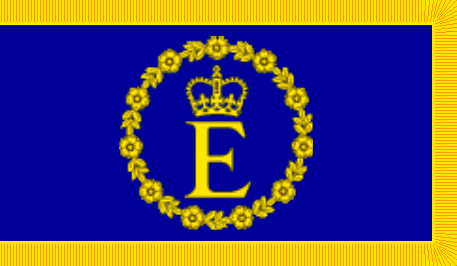
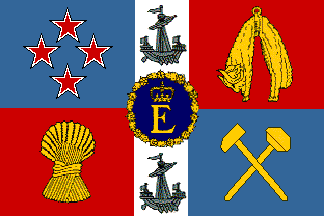
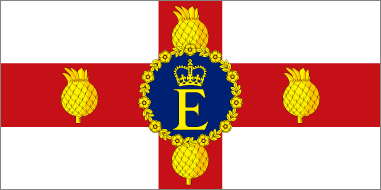
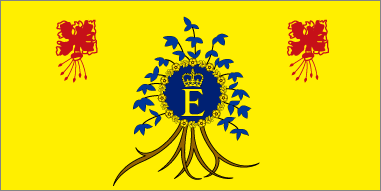
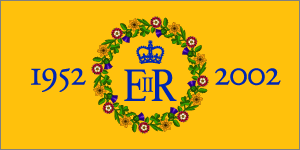


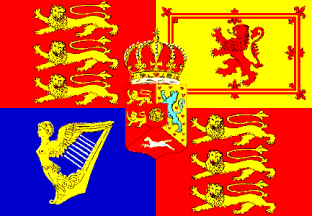
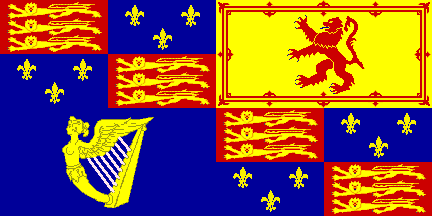
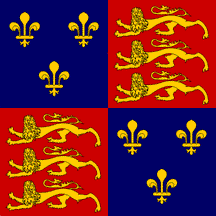
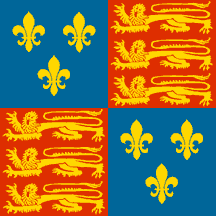
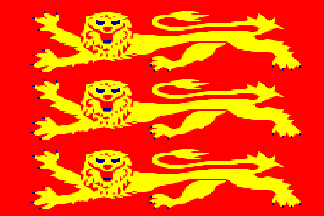
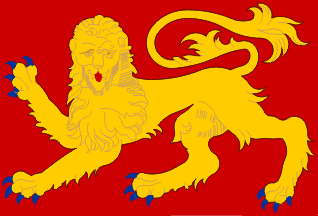
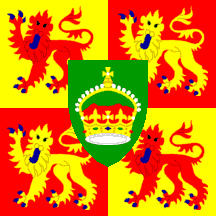
- ROYAL FAMILY -
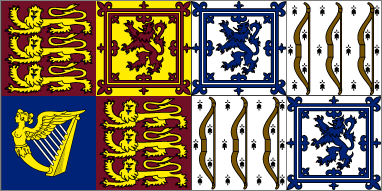
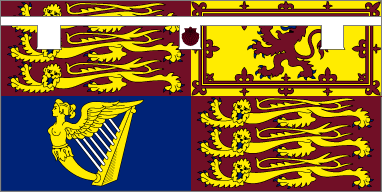
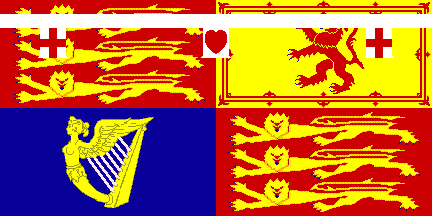
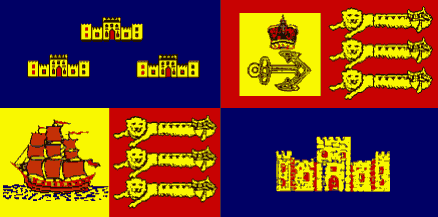
FREE MOVEMENT BETWEEN THE REALMS?
 COMMONWEALTH FREE MOVEMENT: SIGN THE PETITION!
British Borders Bill: Common Entry For Her Majesty's Realms
ROYAL SUCCESSION: The Succession to the Crown Bill
Gloriana for our times: A Diamond Jubilee Tribute
Queen's Message: The Queen's Diamond Jubilee Message
The Queen's Accession: The Accession Feb 6 - 8, 1952
Monarchy at its Finest: The Queen prospered in her role
Majestic Success: In an age of turmoil
Elizabeth-the-Dutiful: A Vintage Year for the Royal Family
Reign Maker: Restoring the Power of the Monarchy
YES MA'AM How the Queen defined her role
ROYALSALUTE.CA Fall In! The RCN & RCAF have been restored!
Now on Twitter! Defending the Crown one tweet at a time
Fade Britannia: Vichy Tories commit treason in HM's docks
Anglo-Irish Visit?: Will the Queen go to Ireland?
Crown & Country: The Royal Republic of Britain?
Royal Portraits: David Starkey reveals the power of portrait
New Vice-Regal: David Johnston takes reins as GG of Canada
Loyal Opposition: The Marxist brothers take over UK opposition
On Democracy and Kings: Why I am a monarchist.
Queen and Pope: A Glorious Day for Scotland
Kingdom of Bhutan: The Greatest Nation on Earth
Saturday, October 31, 2009
Beaverado

Thursday, October 29, 2009
Republicans Put Foot in Mouth
Some people's desperation to defame the monarchy knows no bounds:
Prince Philip reportedly made one of his notorious gaffes by joking with a British-Indian business leader about his name. During a reception at Buckingham Palace for 400 influential British Indians, Prince Philip, pictured, greeted Atul Patel by glancing at his name tag and saying, "There's a lot of your family in tonight."
My guess is that the Duke had probably greeted several Patels by that point in the evening, thus the joke. How on earth is that even remotely racist? Patel is an extremely common Indians surname. It's a small talk joke. He could easily have made the same one about people named Smith. The gentleman in question was not offended. Being modern Britain others are offended on his behalf. We used to call these people busybodies. Naturally, the usual suspects are trying to get as much mileage out of this as possible.
But Republic, a group campaigning to abolish the monarchy, said it was "deeply embarrassing." "Making a joke about people called Patel is deeply embarrassing.... At best it's a comment that shows he's out of touch and out of date," said its spokesman, Graham Smith.
Sorry. Not buying it. Embarrassing it is not. What is embarrassing is the existence, in Britain, of a group that makes political hay out of small talk. It's not the sort of thing gentlemen and ladies do, distorting chat into character assassination. In the unlikely event that Graham Smith is interested in how actual ladies and gentlemen conduct themselves, we ask that Mr Smith pay attention to the life and manners of Her Majesty and her consort. At times I wonder what the Duke makes of all this. A sailor from the days when so much of the world was still pink. Decency and sense, England hath need of thee.
Read More »»
Tuesday, October 27, 2009
Lord Warden of the Cinque Ports
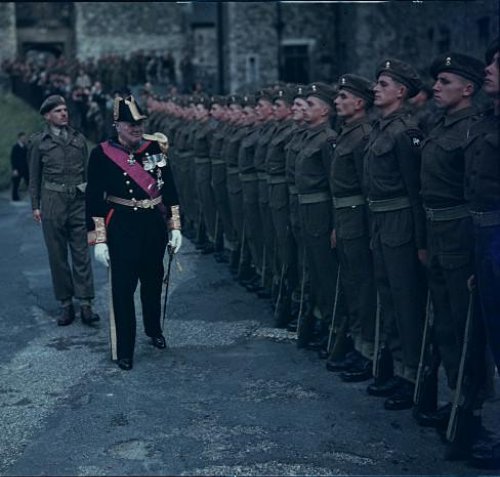
On 14 August 1946 King George conferred upon Sir Winston Churchill the ancient honor of appointment as Lord Warden and Admiral of the Cinque Ports. Above Churchill inspects a line of soldiers at his installation ceremony as the new Lord Warden and Constable of Dover Castle at Dover Kent. Read More »»
Monday, October 26, 2009
"I am writing a very beautiful book..."
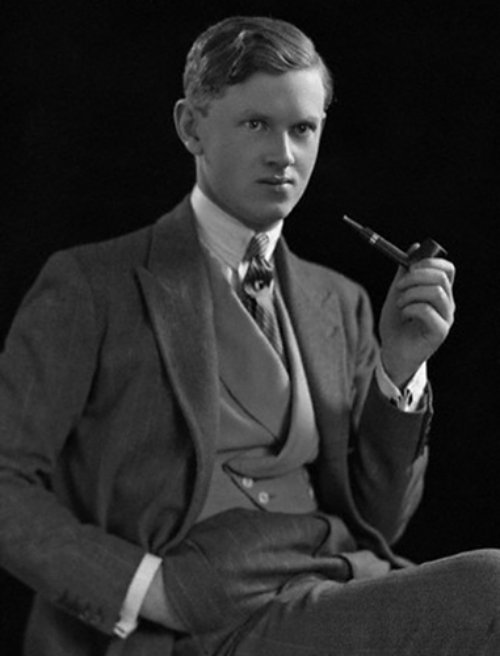
Knowing Waugh, he was probably being a wee bit ironic. Yet he did write "a very beautiful book."
Read More »»
On March 13, 1944, Evelyn Waugh informed his friend Lady Dorothy Lygon: “I am writing a very beautiful book, to bring tears, about very rich people, beautiful, high born people who live in palaces and have no troubles except what they make themselves and those are mainly the demons of sex and drink which after all are easy to bear as troubles go nowadays”. This book would be published the following year as Brideshead Revisited, and would portray a family not unlike the Lygons of Madresfield Court in Worcestershire, who were indeed rich, (mostly) beautiful, high born and had more than their fair share of troubles with sex and drink, which they in fact found quite hard to bear. Paula Byrne’s object in writing Mad World was “to find the hidden key to Waugh’s great novel, to unlock for the first time the full extent to which Brideshead encodes and subtly transforms the author’s own experience”.
Wither the Lords
Labels: Crown-in-ParliamentTen years ago today, the House of Lords passed the abominable House of Lords Act 1999, altering the upper chamber beyond recognition. The Act provides firstly that "No-one shall be a member of the House of Lords by virtue of a hereditary peerage."
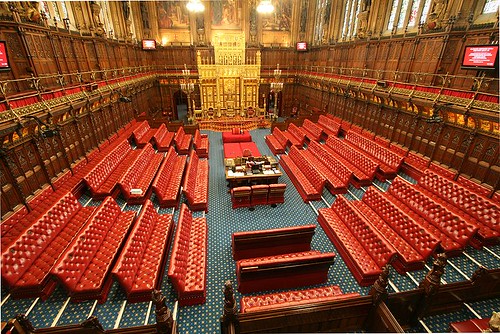
There are over seven hundred peers who hold titles that may be inherited; only ninety-two are now permitted (surely a temporary measure) to sit in the House of Lords, although this reduction has been challenged in the — ahem — European Court of Human Rights.
Hat tip: Wilson Revolution Unplugged. Read More »»
Saturday, October 24, 2009
Friday, October 23, 2009
As the Good Lordship Put It...
The recent Head of State nonsense, in what was once known as the Elder Dominion, has smoked Canadian republicans out of the wood work. There are not many Canadian republicans, they are a small and rather predictable breed whose central criticism is that the monarchy is old and British derived. So are habeas corpus and free speech, the latter of which allows many republicans - who are overwhelmingly journalists - to earn a living. Even if only a scribblers living. While reading one of these screeds I was mentally preparing a rebuttal, then I struck gold. The author pointed to a recently declassified report by Lord Moran, Britain's High Commissioner to Ottawa in the early 1980s. The reference is a ham fisted attempt to portray Lord Moran, whose father was Winston Churchill's personal physician, as a condescending British toff.
Back in 1982 when I was the Star's bureau chief in Ottawa, I met Lord Moran, who then was the British high commissioner to Canada.Heavens. I wouldn't be surprised that Lord Moran was bored stiff talking to Bob Hepburn (which I guess is not his full name). I've never met his lordship, he might very well be a pompous toff, though I rather doubt it. After nearly four decades in the British Foreign Service, it's unlikely anyone lacking in tact and some measure of humility would have been posted to some of the most sensitive areas of world, notably Africa in the wake of decolonisation. Britishers often come off as condescending and superior by virtue of their accent and bearing. Posture is still insisted upon in the betters schools (Moran attended Eton), so is the Queen's English. Victims of our proletarianized North America culture - not that Britain is so far behind now - might very well mistake manners and education as pomposity. Bobby Hepburn (since we are not to stand on formality and call him Robert) goes to some trouble to destroy the monarchy on the basis of one meeting.
Our meeting was cordial, but I got the distinct impression that Lord Moran, whose real name is John Wilson, was completely bored with our session, as well as with Ottawa, Canada and Canadians as a whole.
From his pompous attitude, which stuffy Brits like Lord Moran carry off so well, it was clear he saw most Canadians as inferior colonials with limited talents and even less curiosity.
Turns out my first impression was right, as evidenced by a 1984 dispatch that Lord Moran, who was high commissioner from 1981 to 1984, sent to London on his departure from Ottawa.
The letter, obtained by the BBC from the British Foreign Office under Freedom of Information legislation and made public earlier this week, trashes Canadians in general, our politicians, especially the late Pierre Trudeau, our writers, actors and even our skiers.
Reading the six-page letter, titled "Final Impressions of Canada," reminded me of that meeting with Lord Moran.
It also made me wonder why, if top British diplomats like him hold us in such low esteem, Canada continues to cling to its British colonial roots, complete with having us acknowledge Queen Elizabeth as "the Queen of Canada."
I'm exaggerating only slightly. I'm sure anything involving hierarchy, formality and restraint are an anathema to Bobby. Which is why the living embodiment of such traits is obnoxious to him. The victim of this drive-by smearing, Lord Moran, has not commented and is unlikely to do so. The article does perform one invaluable service, it points us to the former High Commissioner's report. Rather than being condescending, it is a frank and honest assessment of Canada's virtues and faults. I've read very few professional hand-wringers of Canadian identity, a modestly profitable cottage industry here, that capture Canada so well as Lord Moran. Thin skinned nationalists can complain, the honest patriot should make time to review the report here. Ironically the report describes Bobby Hepburn without citing him.
One of Lord Moran's complaints, though he does not say it explicitly, is that Canadians are quite provincial in their attitudes. One of the symptoms of provincialism is overacting to criticism from the metropolis. The Big Time calls you Small Time and you jump up and down about how Big Time you really are. There's a reason people like Michael Ignatieff, whom I do not like, spent so much of their career in London. The former Imperial Capital is a much bigger stage than Toronto or Montreal. An honest man can admit that, a pompous old scribbler will find it harder. Read More »»
Wednesday, October 21, 2009
Have you news of my Boy Jack?
Hat tip: The Gods of the Copybook Headings Read More »»“Have you news of my boy Jack?”
Not this tide.
“When d’you think that he’ll come back?”
Not with this wind blowing, and this tide.
“Has any one else had word of him?”
Not this tide.
For what is sunk will hardly swim,
Not with this wind blowing, and this tide.
“Oh, dear, what comfort can I find?”
None this tide,
Nor any tide,
Except he did not shame his kind —
Not even with that wind blowing, and that tide.
Then hold your head up all the more,
This tide,
And every tide;
Because he was the son you bore,
And gave to that wind blowing and that tide!
Anglican Catholic Reconciliation? Old Fat King Henry must be rolling in his enormous grave
Labels:
Church of England
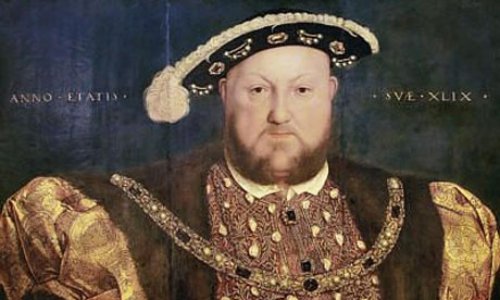
So this is how long schisms last. It's the 500th anniversary of King Henry's accession to the throne (1509-2009), and Pope Benedict is saying all is forgiven.
Forgetting for just a moment the troubles the Church of England is currently embroiled (lack of leadership, lack of unity, lack of orthodoxy), here are three historical reasons why traditional Anglicans might welcome His Holiness's extremely generous "a church within a church" offering of Anglo-Catholic reunification:
1. The chronically adulterous wife-murderer Henry VIII has never been a very compelling religious leader;
2. Parliament's illegal dethroning of James II for his Catholicism and religious tolerance was a shabby pretext for a so-called 'Glorious Revolution', and;
3. Anglicanism has been more a measure of well-placed cultural faith in the English-speaking upper classes, institutions and work ethic, than a worldly portal to the kingdom of God.
Lord Black, a once nominal Anglican, explains why he finally became a Catholic:
I had always had some problems with Henry VIII as a religious leader. That he apostacised to facilitate marriage with a woman whom he soon beheaded on false charges of adultery, seized the monasteries to finance his wars in France, and required his puppet parliament to give him back the title "Defender of the Faith", (still on the Canadian coinage in honour of the present Queen), that the pope had given him in recognition of a canonical paper Erasmus had ghost-written for him, never filled me with confidence in the legitimacy of the Church of England. More and Wolsey were more morally compelling figures than the Henricians, and many of Britain's great pre-Wren Anglican churches were seized from Rome.Yes, my Lord, how true. That "we-don't-Pope" thing is wavering yet again today. Read More »»
Nor was I convinced that the replacement of the Stuarts with the House of Orange was the "Glorious Revolution" that MacAulay and the Trevelyans and other talented Whig myth-makers have claimed. James II was a blundering monarch, but his Toleration Act, promising religious freedom for Jews, Roman Catholics, disestablished Protestants and non-believers, was not subversive or ignoble, and was a shabby pretext for a revolution.
The Anglicans, as Newman had written, had an impressive lower clergy, but it seemed more (to me) a measure of well-placed cultural and ethnic faith in the British and American upper classes and institutions, and a contingent, sectarian insurance policy, than the earthly portal to the kingdom of God. The Anglicans have never really decided whether they are Protestant or Catholic, only that they "don't Pope", though even that wavers from time to time.
Tuesday, October 20, 2009
Britain's new Supreme Court? My grandmother had better looking china than this
Here is the crest of the new Supreme Court of the United Kingdom, a circular floral emblem that looks more like a decorative dinner plate, than the usual royal coat of arms represented in courts across the country.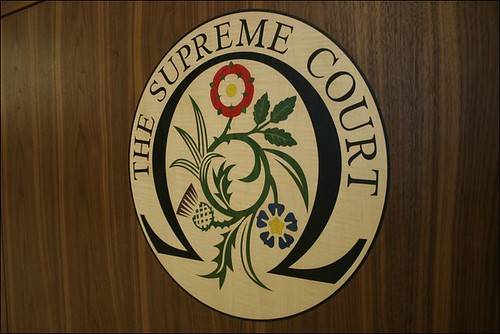
So this is suppose to imbue people with a sense of awe and terror over the might, justice and antiquity of The Law. You call this heraldry?
Even the court's own formal logo, which carries an image of the royal crown, has been relegated to the front entrance and official documents and communications.Read More »»Instead a less formal emblem, which only contains national flowers and vegetables representing each of the home nations, features throughout the building and in the three court rooms – in a bid to be more accessible to the public.
Officials at the court, which began work on Monday, insisted the move "in now way" undermines the relationship with the Crown and the presence of the royal crown and coat of arms emphasised that the Monarch is the source of the court's authority.
It is the latest in a series of rows over the down grading of royal symbols and allegiance under Labour.

Queen awards Chrétien Order of Merit
Labels: Fountain of Honour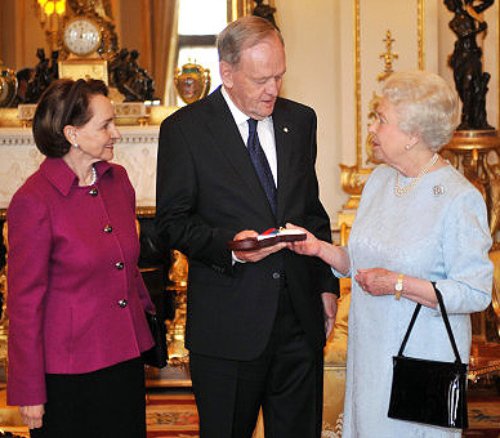
Former Canadian Prime Minister Jean Chretien, accompanied by Mrs. Chretien, is presented with the Order of Merit by The Queen at Buckingham Palace, 20 October 2009. "It is a big honour because there are very few of us — 24, including Prince Philip and Prince Charles — and very few people from political background," Chrétien told CBC News.
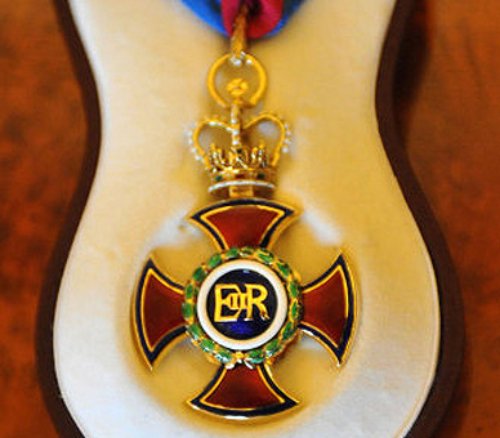
The honour, created by King Edward VII in 1902 and awarded in the sole gift of the Sovereign, is bestowed on "individuals of exceptional distinction in the arts, learning, sciences and other areas such as public service". Above is the Insignia of the Order of Merit awarded by The Queen to the former Canadian Prime Minister today at an audience at Buckingham Palace.
Photos © Press Association Read More »»
Thoughts on the Human Development Index
Labels:
Whig and Tory
I have long admired the Scandinavian kingdoms of Norway and Sweden for being both constitutional monarchies and socialist, two things I think every country should be. Doubtlessly, you fine gentlemen-scholars reading this are gasping with shock and amazement at my positive comment on socialism. Surely someone who goes by the name of that grand old Classical Liberal William Gladstone would not make a positive comment on STATISM of all things.
Well, you're right, because I'm not making a positive comment on statism. However, we must remember that one can be socialist without being statist. Statism, as I understand it, is a system in which the Government controls most or all aspects of a person's life. Fascism is statist, as are most models of communism. I wholeheartedy disapprove of such stuff. Social democracy, on the other hand, in combination with constitutional monarchy, that I wholeheartedly approve of, and with good reason.
Consider the Human Development Index, which I have recently been reading over. For the uninitiated, the HDI is an index of countries, listed from 1 to 182, based on various statistics such as life expectancy, education, literacy, GDP, and other factors. The number 1 spot, according to this index, is the best place in the world to live in. That place is Norway, a fact I'm rather proud of, considering my Grandfather's Norwegian heritage. As you may or may not know, Norway is a notably socialist country, using the highly successful Scandinavian welfare model. With it's constitutional monarchy, Norway maintains continuity and the glorious traditions of the past. And with it's various social programs, Norway has improved the lives of King Harald's citizens in the areas of healthcare, education and social security to the point where Norway is now considered the best country in the world to live in. Not only that, but Norway is also the richest country in the world , and in this ongoing financial crisis, the Norwegian krone is one of the most solid and dependable currencies in the world.
Norway and Sweden (both in the top 10 of the HDI's list, Norway of course at 1, Sweden at 7) represent the great success that a country can enjoy when constitutional monarchy is combined with democratic socialism. Canada and Australia, both social democracies as well, also enjoy high rankings on the HDI. Canada, I'm proud to say, sits at 4, while Australia is at 2. The whole purpose for a country's existence is to provide a better life for the people that live within it. Clearly something is working well in the combination of constitutional monarchy and social democracy.
So, I know the opinions on socialism here at The Monarchist are quite complex, so I would like to open the comments section of this post for discussion: What do you fine gentlemen think of socialism when combined with constitutional monarchy, such as the Norwegians have?
Monday, October 19, 2009
Lord Clark of Civilisation
Old Kenneth Clark was such a towering intellect and man of basic decency and conviction, I weep at the thought and realisation that men like him are now gone. Here are Lord Clark's first ("The Skin of Our Teeth") and final ("Heroic Materialism") episodes of his superb 1969 BBC documentary, Civilisation.
Above, Kenneth Clark opens Civilisation with a quote from Ruskin, who said that the manuscript of a nation is found in a book of their deeds, a book of their words and a book of their art, but mostly in a book of their art. We may not be able to define civilisation in abstract terms, but we sure in the heck know what it is when we see it. The great man explains how European civilisation got through by the skin of its teeth.
In the final episode, Lord Clark re-emphasises his central theme of why civilisations require confidence to survive, and how cynicism and disillusion can do us in as easily as bombs and barbarism. We are not at the end, but we are in trouble because there is no longer a (Christian) Center holding it all together. Heroic materialism is no substitute for the moral and intellectual failure of Marxism. "One may be optimistic, but one can't exactly be joyful at the prospect before us."
A big hat tip to Sunlit Uplands.
Sunday, October 18, 2009
The Lord's Day (Feast of St Luke the Evangelist)
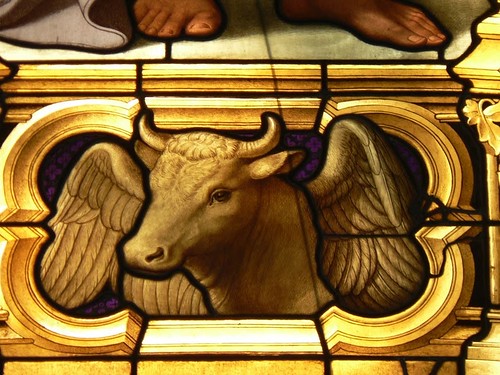
As oft as thou fallest through frailty repent and come again and thou art safe and welcome, as thou mayest see by the similitude of the riotous son (Luke 15). If thou be lopen out of sanctuary come in again. If thou be fallen from the way of truth come thereto again and thou art safe, if thou be gone astray come to the fold again and the shepherd Christ shall save thee, yea and the angels of heaven shall rejoice at thy coming, so far it is off that any man shall beat thee or chide thee."
— From The Obedience of a Christian Man, William Tyndale
Read More »»
Saturday, October 17, 2009
The Rogue's March
Spin is the porn of politics. Dave, you and your useless Tories are headed for a presidential superstate with His Tonyness the Emperor soon calling the shots unless you unequivocally act now. If you are not the Heir to Blair, then bloody well prove it. No less than the sovereignty of Her Majesty's Kingdom is at stake.
And all for what? This? So Blair can pretend he's a superpower and smile alongside Obama as equals. Humility has never been one of Tony's core strengths, the man will stop at nothing, even attempting to make a Blairite out of the Pope, so aggressive is the charlatan's certainty. Only you have the power to stop him, Dave, and to give the people what they want. In the name of God, do the King's duty here, or we'll play The Rogue's March and drum you out of the regiment.
The Gentleman's Motor Car
Labels: English GentlemanAnyone who has visited or lived in Los Angeles or Toronto, the two most hideously sprawling megaloposis's in North America (where car ownership exceeds 600 per 1000 people), will agree with Russell Kirk that the automobile is a village destroying mechanical Jacobin.
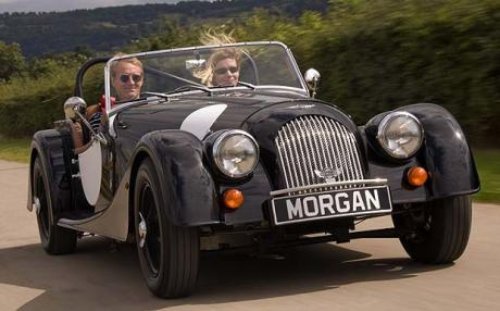
I don't own one myself (they don't make me happy), because I find it more convenient to rent. However, if I were in the market to buy, I would keep my eye open for a vintage marques, something Morgan, Bentley or Aston Martin, not so much a car as a frame of mind.
Worthy of a Monarch's telegram, the Morgan Motor Company is celebrating its hundredth birthday this year, incredibly still running as a family-owned business by Mr. Morgan himself, whose paternal grandfather founded the company in 1909. The company employs only 163 people, still assembles their cars by hand, and fills orders on a two year waiting list.
Incidentally, the Royal Automobile Club, which received its royal patronage by King Edward VII (Old Bertie was a motor car enthusiast), is arguably the grandest of all the gentlemen clubs in London. With Victorian Turkish baths, Italian marble swimming pools, I think I will stop by next time I'm in old Londontown. Read More »»
I am a British subject
Labels: British EmpireMy apologies to the Gods for stealing their Quote of the Day:
As the Roman, in days of old, held himself free from indignity, when he could say, Civis Romanus sum [I am a Roman citizen], so also a British subject, in whatever land he may be, shall feel confident that the watchful eye and the strong arm of England will protect him from injustice and wrong.
— Lord Palmerston, 1850
(Speaking in the House of Lords on the Don Pacifico Affair).
Save the Dukes
Labels: AristocracyOnly Gerald Warner could write this:
The now extra-Parliamentary hereditary peerage should be returned to the exclusive jurisdiction of Her Majesty the Queen, as the Orders of the Garter and the Thistle have been. In future, instead of awarding a Most Noble Marquess who has done sterling service in the community a Knighthood of the Garter, the Queen should consider offering him promotion to a dukedom. None of this should have anything to do with the Prime Minister of the day: let him hand out life peerages to any scallywags he wishes; but the hereditary peerage should continue as a body of true nobility under the Queen. Dukes and other hereditary peers are living heritage: we should be more concerned to conserve them than nasty creatures such as the Natterjack toad.Read More »»
Her Majesty as Commander-in-Chief
Labels: Commander-in-Chief, King and Country, RemembranceThe Queen and The Duke of Edinburgh leave St Paul's Cathedral following a service to mark the end of combat operations in Iraq which was attended by Iraq veterans, bereaved families, Prime Minister Gordon Brown, former PM Tony Blair and senior military leaders, 9 October 2009.
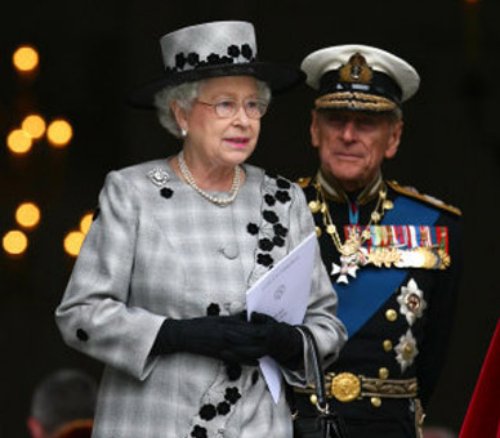
The service was also attended by The Prince of Wales and The Duchess of Cornwall, Prince William, The Earl and Countess of Wessex, The Princess Royal and Vice Admiral Timothy Laurence.
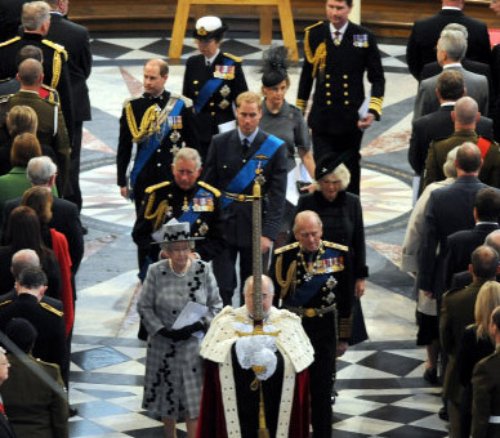
Photos © Press Association Read More »»
Friday, October 16, 2009
The Death of Marie Antoinette, October 16th, 1793.
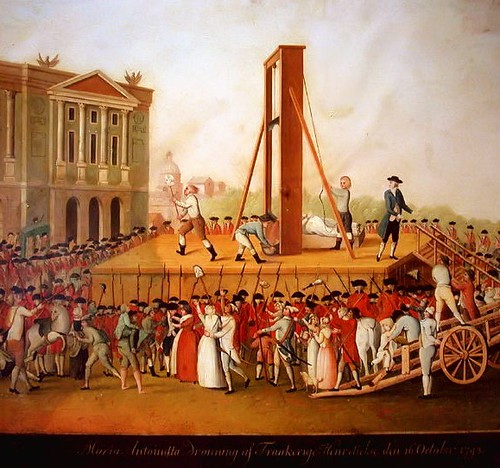
Two-hundred and sixteen years ago to the hour (I hope), the Queen of France, Marie Antoinette, was murdered by Jacobin criminals in the Place de la Revolution.
Vive la Reine! Read More »»
Thursday, October 15, 2009
Don't confuse a dandy with a metrosexual
I have long believed that there is a strong symbiosis between monarchy and manners. It is why when one looks at the prevailing negative attitude towards the monarchy in contemporary society, one notices a corresponding lack of gentlemanly virtue and refinement.
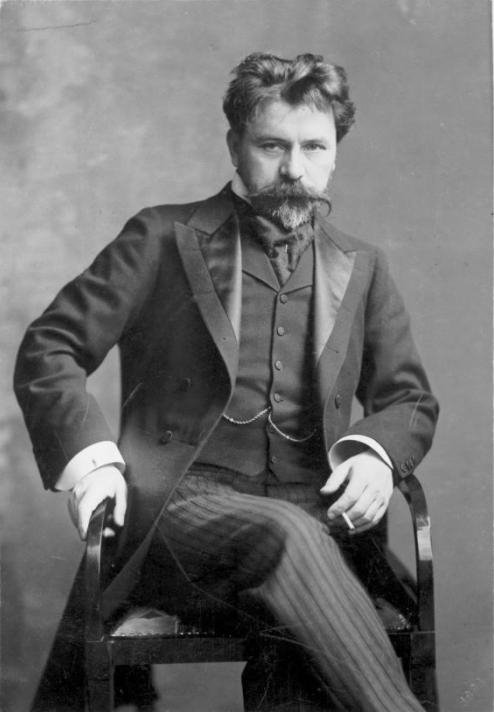
Portrait of a Dandy: Considered an outstanding conductor and interpreter of the music of Bruckner, Tchaikovsky, Beethoven and Liszt, Arthur Nikisch (1855-1922) knew a thing or two about classical and masculine refinement.
Consider the difference between the dandy of yesterday and the metrosexual of today:
Today, metrosexual is used to describe an urban heterosexual male in touch with his inner Carrie Bradshaw. But don't confuse him with a dandy. Created by advertising execs, consumed by consumption, he is a gay stereotype trapped in a straight cliché, sipping crantinis in between shopping, the gym, and laser hair-removal appointments. Contrary to popular belief, not all gay men were born with the Manolo-detection gene any more than all straight men were born scratching their crotches."Dandy isn't a fashion slave but a well-dressed philosopher. I don't think too many metrosexuals can quote Alexander Pope." Read on about the difference between dandies and metrosexuals.
Once upon a time, after the fops and before the metrosexuals, dandy referred to a well-mannered fellow who dressed with flair and knew a thing or two about art, literature, gentlemanly sports, and the finer things in life. He was just as likely to fancy the ladies as the lads. The dandy did not follow trends; he set standards. The metrosexual is his flickering holograph.
At a cocktail party, you'd be well-advised to skirt around the metrosexual and sidle up to the dandy, if you can find one. The metrosexual would be the clotheshorse checking out his freshly dermabraded complexion in the mirror over the mantelpiece. A dandy never consults the looking glass in public because he is confident. This frees him up to show off the dandy's must-have accessory: a keen, sly wit.
Read More »»
"The Head of State Debate"
Labels: Vice-Regals
Is the Governor General the head of state? Well, Slick Willy must be the new Canadian viceroy because according to Rideau Hall, it depends on what the definition of is is.
Needless to say, the Dominion Chairman of the Monarchist League of Canada and the Governor General are no longer working on the same team. Robert Finch says he doesn't have a choice, he's gotta tell it like it is:
The significance of last week, though, is not the fact that our Governor General referred to herself as head of state. Nor is it the fact that Rideau Hall so foolishly tried to justify using the term... And, nor is it the fact that the Prime Minister issued a rare public rebuke.Here is only a sampling of articles from the mainstream media on the whole "Head of State Debate":
Rather, the importance of last week is that years of constitutional vandalism was suddenly exposed. Last week, the general public learned what many of us reluctantly suspected was on the agenda: a carefully calculated plan to elevate the office of the Governor General, to purposely downplay the role of The Queen herself, to "Canadianize" the Crown into a monarchy without a monarch.
Finally, the story was being told. The head-of-stateism-by-stealth campaign was blown wide open for all to see. Yes, that's what is important...
I believe that years from now we will look back and realise that last week was indeed a turning point. The hidden agenda to turn the Governor General into the head of state now public and causing tremendous backlash, the steps are now being taken to reverse the trend and to restore the vice-regal office to what it truly should be: a representative of our Queen, a woman who has dutifully and selflessly served us for almost 60 years.
Queen is our head of state, Prime Minister reminds GG
The Gazette (Montreal) - Randy Boswell - Oct 13, 2009
Stephen Harper has sent a clear message to Michaelle Jean, the Governor-General, that she should not ...
Governor General's new website adds fuel to head-of-state debate
The Gazette (Montreal) - Randy Boswell - Oct 13, 2009
Prime Minister Stephen Harper and Governor General Michaelle Jean in the senate chambers in Ottawa. ...
Queen keeps distance from 'head of state' flap
National Post - Oct 13, 2009
Andy Clark/Reuters Queen Elizabeth II during a visit to an RCMP training facility in Ottawa on Oct. 14, 2002. News of Canada's "head of state" uproar has ...
1 or 24: Which comes first?
Ottawa Citizen - Randy Boswell - Oct 13, 2009
Ottawa's two most prestigious addresses are locked in a polite -- but firm -- battle over exactly who is the head of state, writes Randy Boswell. ...
A viceroy is a viceroy
Globe and Mail - Oct 12, 2009
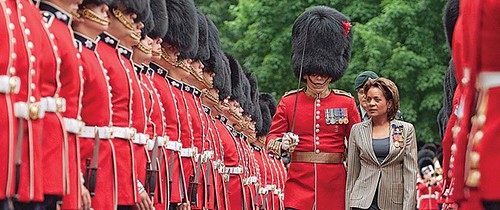
Governor-General Michaelle Jean is inspects the Ceremonial Guard at Rideau Hall on June 18, 2009. The Canadian Press From Tuesday's Globe and Mail Published ...
Citizenship and the Governor-General
The Suburban - Jim Wilson - 12 hours ago
We all know that on one side of Canadian coinage is an image that we recognize as the Queen, who is the country's head of state. ...
L. Ian MacDonald: Uneasy lies the Governor General that wears the crown
National Post - 10 hours ago
A hot debate about head of state
The Globe and Mail - Saturday, Oct. 10, 2009 12:19AM EDT
Douglas Bell: Steve and Betty
The Globe and Mail - Saturday, Oct. 10, 2009 02:35PM EDT
Norman Spector: Fixing a constitutional grey area
The Globe and Mail - Saturday, Oct. 10, 2009 08:55AM EDT Read More »»
Wednesday, October 14, 2009
Referendum on the way?
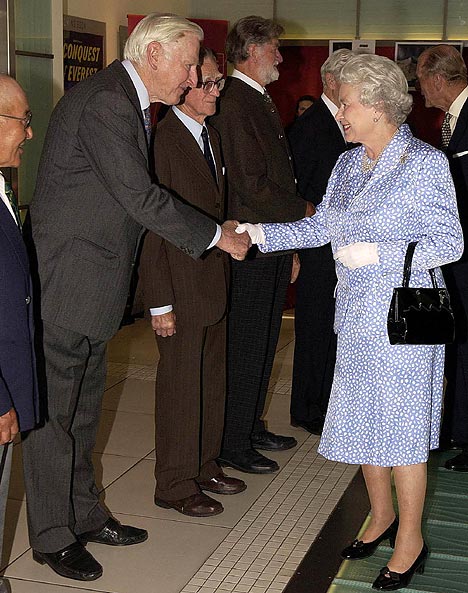
Her Majesty the Queen of New Zealand (and some other places)
Green MP Keith Locke's Head of State Referenda Bill has been drawn from today's members ballot. If New Zealand's Parliament passes the bill into law, it would trigger a referendum on the monarchy, with three options:
1. The status quo, with Her Majesty continuing as Head of State
2. A directly elected President
3. A President appointed by a three quarters vote in Parliament.
If the majority voted for a change, then the two most popular options would have a run-off.
We are inspired to remark on a couple of things.
First, we hope that this Bill will spark some useful constitutional debate about our nationhood and constitutional arrangements.
But there is, that we can see, no appetite for change in our constitution, and there is no appetite for a republic.
There might be one among the elite and the politicians (some of whom have always resented the Monarchy as a colonial overhang), and there are republicans of conviction as well — Mr. Locke is from a well-known socialist family, and doubtless he is one such.
But where are the pressing reasons for change?
We are not opposed to debate on the constitution, and we think that if the monarchy was put to a vote, the status quo would win.
But we are suspicious of the idea that a republic is "inevitable" which is what our politicians and opinion-makers say. And we are opposed to the seeming Australian (and Irish) idea which is "ask until you get the answer you want, (and then, we're betting, never ask again)"
A republic is not the inevitable outcome of constitutional and national maturity (like our constitution needs an extra decade or two on top of the eight hundred we've had already). The march of Progress (dear, outdated, Victorian idea) does not necessarily lead to dreary Presidential democracy.
We think Constitutional reform should not come from a push by the snarkerati, however legitimate it is to put in a private member's Bill. It should come from a substantial public groundswell, leading to popular pressure, and backed by public support.
So here's the question:
Where is it?
Where are the mobs demanding a republic?
Where's the Republican Movement with a hundred thousand members? (In fact, like its Monarchist counterpart, the Movement is fairly small)
Where are the petitions calling for change?
The demands for a New Zealand Head of State?
What is it that necessitates Mr. Locke's referendum?
Where's the fire?
Of course, we would vote No. And, as we said, we think New Zealand would join us.
But why should Parliament indulge one Green MP's excercise in vanity, on his say-so alone?
Here's Hayley Westenra:
Hat Tip: Kiwiblog Read More »»
Tuesday, October 13, 2009
Handel's Messiah
"George Frideric Handel was in his person fat and slovenly, gluttonous, bowlegged, bovine of expression, often to be seen lurching about the streets of London muttering to himself in German like some rummy ship-jumper. He was generally perceived to be mad in some degree; modern observers note evidence of manic depression, one sympton of which was his bizarre creative frenzies. All the same, by the end of a career of extravagant ups and precipitous downs, he had come to represent to his own time just about what he represents to ours: one of those angel-smitten geniuses who are the glories of our species."
"Then as now, that reputation was founded primarily on a single work of unprecedented popularity, Messiah. So magnificent and nearly ubiquitous is this oratoria that it has long threatened to crowd the rest of his work out of the public ear. That masterpiece was no fluke, however, but simply the most consistently inspired work of an artist who depended more than most on the inspiration of his muse. His contemporary, Bach, was the period's great architect in sound; Handel was its great improviser."
— Jan Swafford
Read More »»
Republican rigour in the face of appalling apathy and constitutional ignorance
Labels: Vice-RegalsHere: "If you do all the head-of-state stuff, aren’t you the head of state?"
I don't know, John, if a man squats on your property, isn't it his property?
Dan Gardner (somebody sane) takes a decidedly less casual view:But then John, and others, point to the fact that the GG has taken over more and more roles of the head of state. Doesn't that prove that she is, in fact, the head of state? No, it doesn't. What it proves is that we critics were right to worry about this stuff when we did.
Remember how Adrienne Clarkson stopped Ralph Klein from having the Queen personally sign legislation? The GG said it was contrary to the policy of "Canadianization." At the time, those who got upset were told this was too trivial to worry about. It meant nothing! Then Clarkson had foreign diplomats stop addressing their letters of introduction to the Queen and address them to her instead. Again, this annoyed some of us but, hey, it's meaningless, right? Wrong. As I and others said, Rideau Hall was attempting to build up precedents which would turn the monarch into a constitutional dead letter. Then, when they felt their position was strong enough, they would seek to formally elevate the GG to head of state.
And look what's happening now: Rideau Hall is attempting to elevate the GG to head of state, and it's making its case by pointing to those "trivial" precedents. And suddenly, John Geddes and others find those precedents to be not so trivial. Suddenly, they're compelling evidence.
Look, I know most people think this is all about toasts at Rideau Hall and whose face goes on the coins. But it's much more than that. This is about Canadian history and heritage, yes, but fundamentally it's about the constitution: The Crown is the cornerstone of our legal order and the head of state is its guarantor, possessing emergency powers in the event of impasse or breakdown. Even the staunchest republican should agree that it is absurd that these changes can be made without the slightest popular discussion or consent.
If Michaelle Jean wants to be Queen, let her say so and put it to a vote. That at least would have the virtue of honesty, which is considerably better than what she is doing now.
Monday, October 12, 2009
The Harmonious Blacksmith
Sunday, October 11, 2009
"De facto head of state"
Your Excellency,
Having just vigorously denied that we have a "head of state", I would like to now beat up on "de facto". Feel free to chime in, Piddingworth.
I know, Madam, that you are fond of insisting that "As the representative of the Crown in Canada, the Governor General carries out the duties of head of state, and therefore is de facto head of state."
But I'm afraid that is not what Letters Patent 1947, in fact, state or intend. So far as I can tell, you are lawfully authorized and empowered to carry out certain duties as representative of the Queen in right of Canada, that is it. It is simply a delegation of duties and responsibilities to the governor general, not a transfer of the monarch's authority or sovereignty. De jure or de facto nothing.
Madam, "de facto head of state" would mean that "for all intents and purposes", you are, in practice or actuality, head of state, as you have deliberately pretended in recent days, weeks, months and years. By doing so, you and your modern predecessors have thus managed to reduce Her Majesty — the Queen of Canada, after all — to a mere technicality.
Ah, I see. Her Majesty, that bothersome nuisance, may technically be the Queen, but really, effectively, truthfully — loyally! — it is the Governor General. Honestly, now.
Let us not split hairs, Madam, look at what the papers are saying about your office. The Ottawa Citizen on your self-promotion:
Carrying out the Queen's duties -- on the Queen's behalf, and in her absence -- does not turn the Governor General into a Queen herself. It's true that the Governor General performs more duties now than did governors general in the past, but that doesn't change the fact that she derives her power from the Crown. There can only be one head of state. Canada's Constitution Act is pretty clear about who that is: The Queen.It is embarrassing that the prime minister as head of government should feel the need to clarify such a fundamental constitutional fact as: "The Governor General represents the Crown in Canada." As the editorial begins, "this is akin to issuing a statement reminding everyone that the sky is blue. The Queen's position as head of state is fact."
Not de facto fact, your Excellency, fact fact.
I have the honour to be Her Majesty's humble and obedient servant. Read More »»
Saturday, October 10, 2009
"Head of State"?
The head of Her Majesty's Canadian government reminds the Governor General of who really is the boss:
Prime Minister Stephen Harper has sent a clear message to Gov. Gen. Michaelle Jean that she should not call herself Canada's head of state.
"Queen Elizabeth II is Queen of Canada and Head of State," the Prime Minister's Office said in a statement issued to Canwest News Service on Thursday. "The Governor General represents the Crown in Canada."
The extraordinary reminder from the country's head of government to its top viceregal representative follows an uproar over Jean's use of the phrase "head of state" when referring to herself during a speech in Paris on Monday.
Twice during the Governor General's address at an executive meeting of UNESCO — the United Nations Educational, Scientific and Cultural Organization — she called herself Canada's head of state.
I was rather surprised by the comment myself, the current Canadian GG has generally done a good job. A more correct description is that the Governor General carries out most of the tasks of the Head of State, without actually being Head of State.
The link to A Crown of Maples can be found here. Read More »»A Rideau Hall spokesperson had stated Wednesday that Jean's reference to being head of state was justified: "As the representative of the Crown in Canada, the Governor General carries out the duties of head of state, and therefore is de facto head of state."
Rideau Hall had also said the "head of state" reference was acceptable because of a 1947 agreement in which the "letters patent of King George VI" — Queen Elizabeth's father — "transferred all the duties of head of state of Canada to the Governor General."
But the assertion that the Governor General can be correctly described as Canada's head of state directly contradicts some of the federal government's own published references to the position.
In A Crown of Maples, an online guide to Canada's constitutional monarchy published by the Department of Canadian Heritage, a section titled "The Queen as head of state: Personifying the Country" states: "As Queen of Canada, Her Majesty Queen Elizabeth II is our head of state and a powerful symbol of Canada and Canadian sovereignty."
Friday, October 9, 2009
"The GG's self-promotion"
The Ottawa Citizen is onto Rideau Hall. Like Tommy Paine, the little American Taylor taking a measure of the Crown for his own head, the vice-regal's taylors in Canada have been hard at work for more than 40 years.
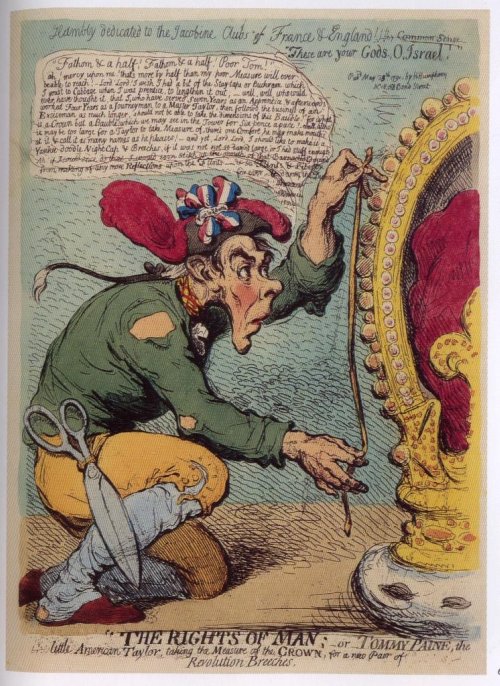
Gilray's Rights of Man, 1791
Thursday, October 8, 2009
The Crown and Beaver
If I were a proud owner of an English public house, that, gentlemen, would be its name. In obeyance to King Richard II, who enacted in 1393 legislation stating "Whosoever shall brew ale in the town with intention of selling it must hang out a sign, otherwise he shall forfeit his ale", I would happily hang my heart and soul, The Crown and Beaver.
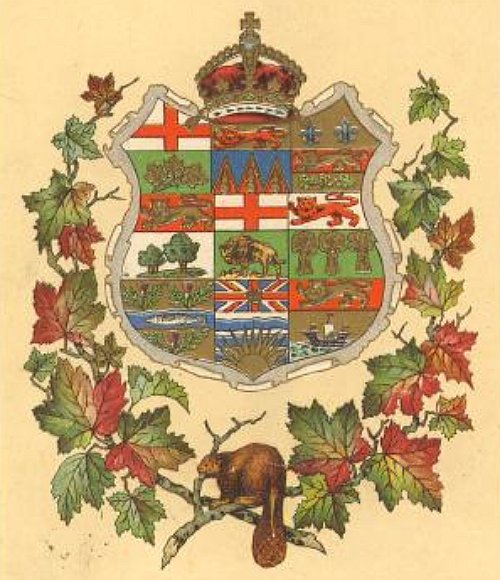
The Dominion Coat of Arms, 1908
The pub is a central part of English-speaking life and culture, and one of the glories of good living with good food and drink and a jovial social atmosphere. Regulars at my pub would regularly toast the Queen, test the loyalty of new visitors and expose clandestine republicans through jokes, puns, teasing, wit, banter and backchat. They would quickly learn how to celebrate the Crown in the spirit of a good time was had by all. Read More »»
Wednesday, October 7, 2009
The Prince of Paradox

happens in history is this: the old man is always wrong; and the young people are always wrong about what is wrong with him. The practical form it takes is this: that, while the old man may stand by some stupid custom, the young man always attacks it with some theory that turns out to be equally stupid.
— G.K. Chesterton
Read More »»
Tuesday, October 6, 2009
Her Majesty "appalled"
 A report this morning, and not for the first time, that Her Majesty the Queen is "appalled" at the current direction of the Church of England.
Inasmuch as most people with functional cerebral cortexes are appalled at the current direction of the Church of England (downwards in a death spiral), this should be a suprise to no-one.
However, it remains to be seen whether Her Majesty will exert her considerable personal influence over the Church in order to halt said spiral.
We recommend the apocryphal words of the first Elizabeth, to the bishop of Ely:
Proud Prelate, you know what you were before I made you what you are. Comply with my request, or I'll unfrock you, by God!
Cross posted at Kiwi Examiner.
Monday, October 5, 2009
Her Majesty reflects on the Monarchy
From the 1970's documentary Elizabeth R, Her Majesty talks for a rare ten minutes about her own conception of Monarchy: what it is for, and her job.
Shining through is the woman; decent, conservative with a small c, impartial and conscientious — Our Sovereign continues to rock my socks.
Sunday, October 4, 2009
Westminster Abbey Choir
Anglican boys in their ruffled necks sing the Old Testament words to Psalm 67: May God be gracious to us and bless us, and make his face shine upon us.
Friday, October 2, 2009
Handel's Sarabande
One of the earliest compositions of monarchy's favourite friend, George Frideric Handel, is the solo Keyboard suite in D minor (harpsichord), which was created between 1703 and 1706 and first published in 1733. Below is an orchestrated version adapted for Stanley Kubrick's 1975 feature film, Barry Lyndon.
- Dieu et mon Droit -

Britain, Canada, Australia, New Zealand, Jamaica, Barbados, Bahamas, Grenada, Papua New Guinea, Solomon Islands, Tuvalu, St.Lucia, St.Vincent & Grenadines, Antigua & Barbuda, Belize, Kitts & Nevis
DEFENDER OF THE FAITH
[+] The Lord God Almighty
[+] God Save the Queen
[+] The Sacred Crown
[+] Church of England
[+] Saint George
[+] Throne and Altar
[+] The Stone of Destiny
[+] The Divine Right of Kings
Honour all men. Love the brotherhood.
Fear God. Honour the king. - 1 Peter 2:17
 KING AND COUNTRY
[+] The Queen's English
[+] Sovereign of the Realms
[+] Fount of Justice
[+] Constitution of Liberty
[+] Crown-in-Parliament
[+] Queen's Prime Ministers
[+] Fountain of Honour
[+] Commander-in-Chief
[+] Her Majesty's Ships
[+] The Queen's Regiments
[+] Patron of the Arts
[+] Philosophy of Loyalty
[+] Head of the Commonwealth
Every subject’s duty is the king’s; but every subject’s soul is his own.
- William Shakespeare
 LORD OF THE BLOG
[+] Lords of the Blog
[+] Guild of Butlers
[+] Debrett's Online
[+] Burke's Peerage and Gentry
[+] The Duke of Edinburgh
[+] The House of Lords
[+] Peers of the Realm
[+] Barons of the Press
[+] Blogs of the Order
[+] Lord Stanley's Cup
[+] Great Officers of State
[+] Lord of the Manor
[+] Brideshead Revisited
[+] Downton Abbey
Lords are lordliest in their wine.
- John Milton
 THE WEEPING CAVALIER
[+] Sir Winston Churchill
[+] Most Noble Order of the Garter
[+] Knights of the Round Table
[+] Society of Knights Bachelor
[+] Military Knights of Windsor
[+] Orders of Chivalry
[+] In Defence of Pomp
[+] The Joy of Order
[+] Equality Be Damned
[+] The Decline of Reverence
[+] Roundhd Values, Cavalier Tastes
[+] The Decent Draperies of Life
[+] Fade Britannia
But what are kings, when regiment is gone, But perfect shadows in a sunshine day?
- Christopher Marlowe
 THE GENTLEMAN
[+] Mr. Gentleman
[+] The Chap Manifesto
[+] The Queen's Bankers
[+] The Black Tie Guide
[+] "Gentlemen's Champagne"
[+] Anyone for Pimm's?
[+] Gentlemen-at-Arms
[+] The Landed Gentry
[+] Master of Foxhounds
[+] Calcutta Polo Club
[+] Traditional Gentlemen's Club
[+] For Liberty and Livelihood!
[+] The Military Gentleman
[+] The Art of Manliness
[+] The Last Edwardian
All men are equal. All men, that is, who possess umbrellas. - E.M. Forster
 THE PROUD TOWER
[+} Defending the Crown since 2005
[+] The Monarchist on Twitter
[+] The Monarchist Interview
[+] The Monarchist Spectrum
[+] Number One on Google!
[+] One of Taki's Favorite Blogs!
[+] List with Kiwi Blogs
[+] Member, Blogging Tories
[+] Member, English Free Press
[+] The Anglosphere Consortium
[+] Enlist in the Red Ensign Brigade
[+] Monarchist Message Board
[+] Email The Monarchist

The blog that brought back the
Royal Canadian Navy (R.C.N.) and the Royal Canadian Air Force (R.C.A.F.)
The reward of a thing well done is to have done it. - Ralph Emerson
From the proud tower in town, death looks gigantically down. - Edgar Allen Poe
If I have seen further than others, it is because I have stood on the shoulders of giants. - Sir Isaac Newton
 QUEEN ELIZABETH II (1952 -)
King George VI (1936-52)
King Edward VIII (1936)
King George V (Windsor)
King Edward VII (Saxe-Coburg)
Queen Victoria (1837-1901)
King William IV (1830-37)
King George IV (1820-30)
QUEEN ELIZABETH II (1952 -)
King George VI (1936-52)
King Edward VIII (1936)
King George V (Windsor)
King Edward VII (Saxe-Coburg)
Queen Victoria (1837-1901)
King William IV (1830-37)
King George IV (1820-30)
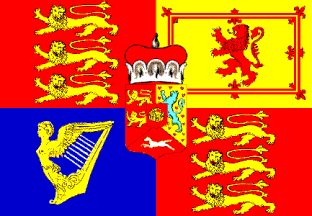 King George III (1760-1820)
King George II (1727-60)
King George I (Hanover)
Queen Anne (1702-14)
King William III (Orange)
King James II (1685-88)
King Charles II (1660-85)
King George III (1760-1820)
King George II (1727-60)
King George I (Hanover)
Queen Anne (1702-14)
King William III (Orange)
King James II (1685-88)
King Charles II (1660-85)
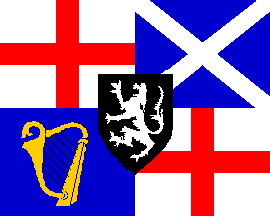 Richard Cromwell (1658-59)
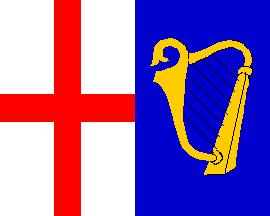 Oliver Cromwell ("Protector")
King Charles I ("Martyr")
King James I (Stuart)
Queen Elizabeth I ("Gloriana")
Queen Mary ("Bloody Mary")
Lady Jane Grey (Regent)
King Edward VI (1547-53)
King Henry VIII ("Majesty")
King Henry VII (Tudor)
King Richard III (1483-85)
King Edward V (1483)
King Edward IV (York)
King Henry VI (1422-61)
King Henry V (1413-22)
King Henry IV (Lancaster)
King Richard II (1377-99)
King Edward III (1327-77)
King Edward II (1307-27)
King Edward I ("Longshanks")
King Henry III (1216-72)
King John (Magna Carta)
King Richard I ("Lionheart")
King Henry II (Plantagenet)
King Stephen (House of Blois)
King Henry I (Charter Liberties)
King William II ("Rufus")
King William I ("Conqueror")
King Harold II (Godwinson)
King Edward ("Confessor")
Oliver Cromwell ("Protector")
King Charles I ("Martyr")
King James I (Stuart)
Queen Elizabeth I ("Gloriana")
Queen Mary ("Bloody Mary")
Lady Jane Grey (Regent)
King Edward VI (1547-53)
King Henry VIII ("Majesty")
King Henry VII (Tudor)
King Richard III (1483-85)
King Edward V (1483)
King Edward IV (York)
King Henry VI (1422-61)
King Henry V (1413-22)
King Henry IV (Lancaster)
King Richard II (1377-99)
King Edward III (1327-77)
King Edward II (1307-27)
King Edward I ("Longshanks")
King Henry III (1216-72)
King John (Magna Carta)
King Richard I ("Lionheart")
King Henry II (Plantagenet)
King Stephen (House of Blois)
King Henry I (Charter Liberties)
King William II ("Rufus")
King William I ("Conqueror")
King Harold II (Godwinson)
King Edward ("Confessor")
Monarchy can easily be debunked, but watch the faces, mark well the debunkers. These are the men whose taproot in Eden has been cut: whom no rumour of the polyphony, the dance, can reach - men to whom pebbles laid in a row are more beautiful than an arch. Yet even if they desire mere equality they cannot reach it. Where men are forbidden to honour a king they honour millionaires, athletes or film stars instead: even famous prostitutes or gangsters. For spiritual nature, like bodily nature, will be served; deny it food and it will gobble poison - C.S. Lewis
- GOD SAVE THE QUEEN -

I declare before you that my whole life, whether it be long or short, shall be devoted to your service and the service of the great Imperial Commonwealth to which we all belong. - Princess Elizabeth, 1947
British Monarchy
HER MAJESTY
Queen of Canada
Queen of Australia
Queen of New Zealand
Queen of Jamaica
Queen of Barbados
Commonwealth Realms
Style of the British Sovereign
The Prince Consort
The Prince of Wales
The Duke of York.Org
The Monarchy Today
Monarchy Media Centre
History of the Monarchy
Royal Art and Residences
Royal Society Portrait Painters
The Royal Collection
The Queen's Images
The Royal YouTube Channel
Official Royal Image Library
LOYAL PROCLAMATION
Uneasy lies the head that wears a crown.
- William Shakespeare
Royal Family
HOUSE OF WINDSOR
British Royal Family
Her Majesty The Queen
HRH The Duke of Edinburgh
HRH Prince Charles of Wales
HRH The Duchess of Cornwall
HRH Prince William of Wales
HRH Prince Henry of Wales
HRH The Princess Royal
HRH The Duke of York
HRH The Earl of Wessex
HRH The Countess of Wessex
HRH The Duke of Gloucester
HRH The Duchess of Gloucester
HRH The Duke of Kent
HRH The Duchess of Kent
HRH Prince Michael of Kent
HRH Princess Michael of Kent
HRH Princess Alexandra
Lord Mountbatten of Burma
They would never leave without me, I would never leave without the King, and the King would never leave. - Queen Mother, 1940
Monarchist Leagues
Canadian Royal Heritage Trust
Diamond Jubilee Trust Australia
British Monarchist League
Monarchist League of Canada
Australian Monarchist League
Monarchy New Zealand
British Monarchist Society
SA Monarchist Society
Monarchy Wales
American Monarchist League
Orange Lodge of Ireland
Orange Lodge of Canada
Orange Lodge of England
Orange Lodge of Australia
Loyal Orange Institution
Orange Historical Site
For Constitutional Monarchy
Junior Lodge of Ireland
Society of United Royalists
Monarchist Society of America
Royal Over-Seas League
The Victoria League
There is something behind the throne greater than the King himself.
- William Pitt the Elder
- DEFENDER OF THE FAITH -

The character of Kings is sacred; their persons are inviolable; they are the anointed of the Lord, if not with sacred oil, at least by virtue of their office. Their power is broad - based upon the Will of God, and not on the shifting sands of the people's will. They will be spoken of with becoming reverence, instead of being in public estimation fitting butts for all foul tongues. It becomes a sacrilege to violate their persons, and every indignity offered to them in word or act, becomes an indignity offered to God Himself. - Archbishop John Healy
The Sacred Crown
CROWN JEWELS
Jewel House, Tower of London
The Stone of Scone (847 A.D.)
King Edward's Chair (1296)
Crown of Scotland (1540)
St. Edward's Crown (1661)
Mary Modena's Crown (1661)
Sceptre with the Cross (1661)
Sceptre with the Dove (1661)
The Sovereign's Orb (1661)
Sword of Mercy (Curtana)
Sword of Offering (1820)
George IV State Diadem (1820)
Coronation Ring (1831)
Imperial Crown of India (1911)
Imperial State Crown (1937)
Gold Armills and Royal Robe
Colobium Sindonis
Royal Regalia
The Sleeping King
Here lies an anachronism, in the vague expectation of eternity. - 'Lord Peter'
Queen's Coronation
DIEU ET MON DROIT
The Devine Right of Kings
House of God, House of Kings
Throne and Altar
Order of Succession
Royal Line of Succession
King is Dead. Long Live the King!
The Interregnum
Accession Proclamation
QUEEN'S CORONATION:
Swearing of the Oath
Presenting of the Holy Bible
Anointing with Holy Oil
Presenting of Spurs and Sword
Investing with the Armills
Delivery of the Orb
Investiture and Crowning
"God Save the Queen!"
The Benediction
Enthroning and Homage
Holy Communion and the Recess
Archbishop: Will you solemnly promise and swear to govern the Peoples of the United Kingdom of Great Britain and Northern Ireland, Canada, Australia, New Zealand, ...and of your Possessions and other Territories to any of them belonging or pertaining, according to their respective laws and customs?
Queen: I solemnly promise so to do.
- SOVEREIGN OF REALM -

To be a king and wear a crown is more glorious to them that see it than it is a pleasure to them that bear it.
- Queen Elizabeth the First
Pomp and State
ELIZABETH REGINA
The Royal Yacht Britannia
In Defence of Pomp
Coronation of Elizabeth II
Reserve Powers of the Crown
Her Majesty's Privy Council
Queen's Privy Council
Great Officers of State
Queen's Golden Jubilee
Diamond Wedding Anniversary
Queen's Silver Jubilee
Trooping the Colour
Changing of the Guard
Sovereign's Fleet Review
Battle of Britain Memorial Flight
Accession Day (Feb 2)
Commonwealth Day (Mar 13)
Victoria Day (May 24)
Coronation Day (Jun 2)
Queen's Official B'day (Jun 6)
Remembrance Day (Nov 11)
Royal Xmas Message (Dec 25)
State Opening of Parliament
Sovereign's Ceremonial Mace
THE ROYAL TOURNAMENT
Edinburgh Military Tattoo
 Royal Nova Scotia Tattoo
Royal International Air Tattoo
Royal Nova Scotia Tattoo
Royal International Air Tattoo
Canadian Military Tattoo
Australian Federation Tattoo
Virginia International Tattoo
Birmingham Military Tattoo
 Quebec City Military Tattoo
Windsor Castle Royal Tattoo
SPEECH FROM THE THRONE
Quebec City Military Tattoo
Windsor Castle Royal Tattoo
SPEECH FROM THE THRONE
If your job is to leaven ordinary lives with elevating spectacle, be elevating or be gone. - George F. Will
- FOUNT OF JUSTICE -

And in choosing to leave the selection of their head of state to this most common denominator in the world - the accident of birth - Canadians implicitly proclaim their faith in human equality; their hope for the triumph of nature over political manoeuvre, over financial and social interest; for the victory of the human person.
- Jacques Monet
The Queen's Bench
QUEEN AND THE LAW
At Her Majesty's Pleasure
The Queen's Peace
Justices of the Peace
King's Court (Curia Regis)
Her Majesty's Courts Service
Royal Courts of Justice
Magna Carta Society
Constitution Society
English Common Law
Unwritten Constitution
The Liberty Papers
British House of Lords
Supreme Court of Canada
High Court of Australia
High Court of New Zealand
King's Bench Prison
Queen's Bench Bar Assn.
Crown Attorney
Crown Prosecutor
Tower of London
The Old Bailey
Without authority there is no liberty. Freedom is doomed to destruction at every turn, unless there is a recognized right to freedom. And if there are rights, there is an authority to which we appeal for them.
- G. K. Chesterton
King's Colleges
KING'S COLLEGE
University of Oxford (1167)
Westminster School (1179)
University of Cambridge (1209)
Winchester College (1382)
University St. Andrews (1410)
ETON COLLEGE (1440)
University of Glasgow (1451)
King's College, Aberdeen (1495)
Saint Paul's School (1509)
Shrewsbury School (1552)
Merchant Taylors' School (1561)
Rugby School (1567)
Harrow School (1572)
Trinity College, Dublin (1592)
Charterhouse School (1611)
Harvard University (1636)
College William & Mary (1693)
Yale University (1701)
Princeton University (1746)
King's College, Columbia (1754)
University King's College (1789)
McGill University (1821)
King's College, Toronto (1827)
King's College London (1829)
Upper Canada College (1829)
King's College School (1829)
Queen's University (1841)
Queensland University (1909)
Gordonstoun (1933)
KING'S SCHOLAR
Oxford gave the world marmalade and a manner, Cambridge science and a sausage
- CROWN-IN-PARLIAMENT -

Above the ebb and flow of party strife, the rise and fall of ministries, and individuals, the changes of public opinion or public fortune, the British Monarchy presides, ancient, calm and supreme within its function, over all the treasures that have been saved from the past and all the glories we write in the annals of our country. - Winston Churchill
Her Majesty's Government
"MY GOVERNMENT"
The Royal Prerogative
Her Majesty's Privy Council
Queen's Privy Council
Federal Executive Council
Executive Council of N.Z.
Her Majesty's Government
Westminster Cabinet
Rt. Hon. Prime Minister
Minister of the Crown
Her Majesty's Loyal Opposition
Her Majesty's Loyal Opposition
Order-in-Council
Chief Government Whip
Letters Patent
Petition of Right (1628)
The King-Byng Affair (1926)
The Dismissal of 1975
Dropping the Writ
The attitude of successive governments towards the monarchy is that of the urchin, secretly urinating on some shrub in the hope that it will die. - Peter Brimelow
Westminster Parliaments
QUEEN-IN-PARLIAMENT
Palace of Westminster
The Westminster System
Granting of Royal Assent
Act of Parliament
Parliamentary Privilege
Unparliamentary Language
Prorogation of Parliament
Anglo-Saxon Witenagemot (650)
The Model Parliament (1295)
U.K. Parliament (1801)
New Zealand Parliament (1852)
Parliament of Canada (1867)
Parliament of Australia (1901)
British House of Lords
Gentleman Usher of Black Rod
British House of Commons
Speaker of the House (1377)
Sergeant-at-Arms
(Let's Not) Elect The Lords
For an English Parliament
Scottish Parliament
National Assembly for Wales
As nature’s ties decay
As duty, love, and honour fail to sway,
Fictitious bonds, the bonds of wealth and law,
Still gather strength, and force unwilling awe.
- Oliver Goldsmith
Hansard Societies
 HANSARD
U.K. Hansard
CAN Hansard
AUS Hansard
NZ Hansard
Ireland Hansard
Wales Hansard
Scotland Hansard
 Northern Ireland Hansard
Isle of Man Hansard
Jersey Hansard
British Columbia Hansard
A nation of sheep will beget a government of wolves. - Edward R. Murrow

Orders of Chivalry
KNIGHTS AND CHIVALRY
Military Knights of Windsor
Noble Order of the Garter
Ancient Order of the Thistle
Illustrious Order of St. Patrick
Honourable Order of the Bath
Order of the Star of India
Order of St. Michael & St. George
The Order of Canada
The Order of Australia
The Order of New Zealand
Order of the Crown of India
The Order of Merit
New Zealand Order of Merit
Order of Military Merit
Royal Victorian Order
Order of the British Empire
Order of the Indian Empire
Order of Australia Association
Distinguished Service Order
Merit of the Police Forces
Companions of Honour
Society of Knights Bachelor
Knight Bachelor
Venerable Order of St. John
...in a nation of gallant men, in a nation of men of honour, and of cavaliers! I thought ten thousand swords must have leaped from their scabbards, to avenge even a look that threatened her with insult. But the age of chivalry is gone; that of sophisters, economists, and calculators has succeeded, and the glory of Europe is extinguished forever. - Edmund Burke
Victoria Cross
 For Valour: The Monarchist
Canadian Victoria Cross
Anzac Victoria Cross
The Victoria Cross Society
History of the Victoria Cross
Canadian Recipients of the VC
Australian Winners of the VC
New Zealand Recipients
Victoria Cross at Sea
Imperial War Museum VCs
Victoria Cross Heroes
BRITISH MEDALS
Canadian Victoria Cross
New Zealand Cross (Civilian)
George Cross (Civilian)
Cross of Valour (Civilian)
Cross of Valour (Civilian)
Conspicuous Gallantry Cross
Star of Military Valour
Distinguished Service Cross
Distinguished Service Cross
Military Cross
Distinguished Flying Cross
Star of Courage (Civilian)
Star of Courage (Civilian)
Medal of Military Valour
New Zealand Cross (Civilian)
Meritorious Service Cross
Medal of Bravery
The Sacrifice Medal
The King feels so strongly that, no matter the crime committed by anyone on whom the VC has been conferred, the decoration should not be forfeited. Even were a VC to be sentenced to be hanged for murder, he should be allowed to wear his VC on the gallows. - Lord Stamfordham, 1920
- COMMANDER-IN-CHIEF -

In war, resolution; in defeat, defiance; in victory, magnanimity; in peace, goodwill.
- Sir Winston Churchill, K.G. (1874-1965)
Queen and Armed Forces
QUEEN AND ARMED FORCES
Land Forces of the Empire
 The British Army
HM Canadian Armed Forces
The Australian Army
The New Zealand Army
Royal Armouries
The Royal Air Force
Royal Australian Air Force
Royal New Zealand Air Force
THE ROYAL NAVY
My Royal Canadian Navy
Royal Australian Navy
Royal New Zealand Navy
Her Majesty's Canadian Navy
Her Majesty's Royal Marines
Royal Canadian Mounted Police
Digger History (ANZAC)
Wellington's Dispatches
REGIMENTS.ORG
Never in the field of human conflict was so much owed by so many to so few.
- Winston Churchill
- HER MAJESTY'S SHIPS -

England expects that every man will do his duty. - Admiral Lord Horatio Nelson, 1805
The Admiralty
 LORD HIGH ADMIRAL
First Lord of the Admiralty
The First Sea Lord
LORD HIGH ADMIRAL
First Lord of the Admiralty
The First Sea Lord
The Nelson Society
Nelson's Dispatches
The 1805 Club
Vice-Admiral United Kingdom
Rear-Admiral United Kingdom
Nelson and His Navy
THE ROYAL NAVY
Royal Canadian Navy
Royal Australian Navy
Royal New Zealand Navy
The Great White Fleet
Her Majesty's Canadian Navy
Her Majesty's Royal Marines
Britannia Royal Naval College
Annapolis Naval Academy
Royal Naval College Greenwich
Royal Roads Military College
Royal Naval College Osborne
Trafalgar 200th
Admiral Cod
Nelson's Victory
Duty is the great business of a sea officer; all private considerations must give way to it, however painful it may be. - Lord Nelson
Royal Yachts
HMY BRITANNIA
Royal Yacht Squadron
The Royal Yacht Britannia
 Royal Thames Yacht Club
 Royal Canadian Yacht Club
 Royal Sydney Yacht Squadron
Royal Nova Scotia Yacht Sqn.
Royal Cork Yacht Club
Royal Perth Yacht Club
Royal Ulster Yacht Club
Royal Sydney Yacht Squadron
Royal Nova Scotia Yacht Sqn.
Royal Cork Yacht Club
Royal Perth Yacht Club
Royal Ulster Yacht Club
 The New York Yacht Club
Royal Brighton Yacht Club
Royal Irish Yacht Club
Royal Southampton Yacht Club
Royal Yacht Club of Tasmania
The New York Yacht Club
Royal Brighton Yacht Club
Royal Irish Yacht Club
Royal Southampton Yacht Club
Royal Yacht Club of Tasmania
It takes 3 years to build a ship, but 300 years to build a tradition.
- Admiral Cunningham, 1941
- QUEEN'S REGIMENTS -

The Battle of Waterloo was won on the playing fields of Eton. - Arthur Wellesley
- The Duke of Wellington, 1815
Ceremonial Guards
THE QUEEN'S GUARD
Yeomen of the Guard
Gentlemen at Arms
Royal Company of Archers
Yeomen Warders
Warden of the Cinque Ports
Royal Canadian Mounted Police
Military Knights of Windsor
HOUSEHOLD DIVISION
The King's Troops
The Life Guards
The Blues and Royals
The G-G's Horse Guards
Australia's Federation Guard
The Grenadier Guards
The Canadian Grenadier Guards
The Coldstream Guards
The Scots Guards
The Irish Guards
The Welsh Guards
The G-G's Foot Guards
We few, we happy few, we band of brothers; For he to-day that sheds his blood with me Shall be my brother; be he ne'er so vile, This day shall gentle his condition: And gentlemen in England now a-bed Shall think themselves accursed they were not here, And hold their manhoods cheap whiles any speaks That fought with us upon Saint Crispin's day. - William Shakespeare
Cavalry Regiments
HOUSEHOLD CAVALRY
The Life Guards
The Blues and Royals
The G-G's Horse Guards
DRAGOON REGIMENTS:
1st The Queen's Dragoon Guards
Royal Scots Dragoon Guards
Royal Dragoon Guards
Royal Canadian Dragoons
The British Columbia Dragoons
The Saskatchewan Dragoons
HUSSAR REGIMENTS:
Queen's Royal Hussars
Prince of Wales's Royal Lancers
King's Royal Hussars
Royal Canadian Hussars
The Light Dragoons
1st Hussars
The Sherbrooke Hussars
Princess Louise's Hussars
LANCER REGIMENTS:
The Queen's Royal Lancers
Lord Strathcona's Horse
Hunter River Lancers
Royal New South Wales Lancers
LIGHT HORSE REGIMENTS:
Queensland Mounted Infantry
Queen Alexandra's Mounted
South Australia Mounted Rifles
South Alberta Light Horse
Prince of Wales' Light Horse
The Light Horse Regiment
The Fort Garry Horse
Le Regiment blinde du Canada
TANK REGIMENTS:
1st Royal Tank Regiment
2nd Royal Tank Regiment
1st Armoured Regiment
2nd Cavalry Regiment
3rd/4th Cavalry Regiment
The Ontario Regiment
Queen's York Rangers
Prince Edward Island Regiment
Duke of Connaught's Own
King's Own Calgary Regiment
Le Regiment de Hull
The Windsor Regiment
From time to time, the tree of liberty must be watered with the blood of tyrants and patriots. - Thomas Jefferson
- REMEMBRANCE -

We are the dead. Short days ago We lived, felt dawn, saw sunset glow...If ye break faith with us who die We shall not sleep, though poppies grow In Flanders fields.
- Lt.Col. John McCrae (1872-1918)
War Veterans
REMEMBRANCE DAY
War Graves Commission
British Ex-Services League
For King and Empire
Queen's Book of the Red Cross
THE POPPY APPEAL
Royal British Legion
Royal British Legion Scotland
Royal Canadian Legion
Returned Services League
Returned Services Association
The American Legion
Land Forces of the Empire
Grand Army of the Republic
The Earl Haig Fund Scotland
Veterans Affairs Canada
Anzac Day Dawn Service
Western Front Association
Surviving WW1Veterans
They shall grow not old, as we that are left grow old. Age shall not weary them, nor the years condemn. At the going down of the sun and in the morning We will remember them.
- Laurence Binyon, For the Fallen
Lest We Forget
O VALIANT HEARTS (mp3)
Menin Gate Memorial
The Verdun Memorial
National Vimy Memorial
Thiepval War Memorial
ANZAC War Memorial
The Unknown Warrior
Tomb of the Unknown Soldier
Tomb of the Unknown Warrior
The Cenotaph at Whitehall
Arlington National Cemetary
Tyne Cot War Graves Cemetary
Scottish War Memorial
Ireland War Memorial
Canadian War Memorial
Australian War Memorial
 Nfld National War Memorial
New Zealand War Memorial
Shot at Dawn Memorial
Saint Julien Memorial
Shrine of Remembrance (*)
The Armed Forces Memorial
Douaumont Ossuary Verdun
National Memorial Arboretum
The Welsh Memorial
British Commando Memorial
Lewis War Memorial
 Old City Hall Cenotaph
Ottawa Memorial
Old City Hall Cenotaph
Ottawa Memorial
Korean War Memorial Wall
South African War Memorial
Vancouver Victory Square
The Hobart Cenotaph
 Next of Kin Memorial Avenue
Auckland War Memorial
Saskatchewan Memorial Gates
Beaumont-Hamel Memorial
Notre Dame de Lorette
The Normandy Memorial
Groesbeek War Cemetery
Garden of Remembrance
The Hong Kong Cenotaph
Juno Beach Centre
Women of World War II
Peacekeeping Monument
LAST POST ASSOCIATION
Their name liveth forevermore.
- Rudyard Kipling, from Ecclesiasticus
Commonwealth Premiers
YES, PRIME MINISTER
 David Thompson (2008-)
Kevin Rudd (2007-)
David Thompson (2008-)
Kevin Rudd (2007-)
 Bruce Golding (2007-)
Gordon Brown (2007-)
Bruce Golding (2007-)
Gordon Brown (2007-)
 Hubert Ingraham (2007-)
Stephen Harper (2006-)
P. Simpson-Miller (2006-07)
Hubert Ingraham (2007-)
Stephen Harper (2006-)
P. Simpson-Miller (2006-07)
 Michael Somare (2002-)
Perry Christie (2002-07)
Paul Martin (2003-06)
Mekere Morauta (1999-2002)
Michael Somare (2002-)
Perry Christie (2002-07)
Paul Martin (2003-06)
Mekere Morauta (1999-2002)
 Helen Clark (1999-)
Bill Skate (1997-99)
Tony Blair (1997-2007)
Jenny Shipley (1997-99)
John Howard (1996-2007)
Helen Clark (1999-)
Bill Skate (1997-99)
Tony Blair (1997-2007)
Jenny Shipley (1997-99)
John Howard (1996-2007)
 Keith Mitchell (1995-)
Julius Chan (1994-97)
Owen Arthur (1994-2008)
Jean Chretien (1993-2003)
Kim Campbell (1993)
Paias Wingti (1992-94)
Hubert Ingraham (1992-2002)
P.J. Patterson (1992-2006)
Paul Keating (1991-96)
Nicholas Brathwaite (1990-95)
Jim Bolger (1990-97)
John Major (1990-97)
Mike Moore (1990)
Geoffrey Palmer (1989-90)
Ben Jones (1989-90)
Michael Manley (1989-92)
Rabbie Namaliu (1988-92)
Paias Wingti (1985-88)
Brian Mulroney (1984-93)
Erskine Sandiford (1987-94)
Errol Barrow (1986-87)
Bernard St. John (1985-86)
David Lange (1984-89)
Herbert Blaize (1984-89)
John Turner (1984)
Nicholas Brathwaite (1983-84)
Bob Hawke (1983-91)
Michael Somare (1982-85)
Edward Seaga (1980-89)
Julius Chan (1980-82)
Pierre Trudeau (1980-84)
Margaret Thatcher (1979-90)
Joe Clark (1979-80)
Tom Adams (1976-85)
James Callaghan (1976-79)
Michael Somare (1975-80)
Robert Muldoon (1975-84)
Malcolm Fraser (1975-83)
Bill Rowling (1974-75)
Harold Wilson (1974-76)
Lynden Pindling (1973-92)
Gough Whitlam (1972-75)
Norman Kirk (1972-74)
Michael Manley (1972-80)
Jack Marshall (1972)
William McMahon (1971-72)
Edward Heath (1970-74)
John Gorton (1968-71)
Pierre Trudeau (1968-79)
Hugh Shearer (1967-72)
John McEwen (1967-68)
Errol Barrow (1966-76)
Harold Holt (1966-67)
Donald Sangster (1967)
Harold Wilson (1964-70)
Lester Pearson (1963-68)
Alec Douglas-Home (1963-64)
Alex Bustamante (1962-67)
Keith Holyoake (1957-72)
John Diefenbaker (1957-63)
Harold Macmillan (1957-63)
Walter Nash (1957-60)
Anthony Eden (1955-57)
Louis St. Laurent (1948-57)
Sidney Holland (1949-57)
Keith Mitchell (1995-)
Julius Chan (1994-97)
Owen Arthur (1994-2008)
Jean Chretien (1993-2003)
Kim Campbell (1993)
Paias Wingti (1992-94)
Hubert Ingraham (1992-2002)
P.J. Patterson (1992-2006)
Paul Keating (1991-96)
Nicholas Brathwaite (1990-95)
Jim Bolger (1990-97)
John Major (1990-97)
Mike Moore (1990)
Geoffrey Palmer (1989-90)
Ben Jones (1989-90)
Michael Manley (1989-92)
Rabbie Namaliu (1988-92)
Paias Wingti (1985-88)
Brian Mulroney (1984-93)
Erskine Sandiford (1987-94)
Errol Barrow (1986-87)
Bernard St. John (1985-86)
David Lange (1984-89)
Herbert Blaize (1984-89)
John Turner (1984)
Nicholas Brathwaite (1983-84)
Bob Hawke (1983-91)
Michael Somare (1982-85)
Edward Seaga (1980-89)
Julius Chan (1980-82)
Pierre Trudeau (1980-84)
Margaret Thatcher (1979-90)
Joe Clark (1979-80)
Tom Adams (1976-85)
James Callaghan (1976-79)
Michael Somare (1975-80)
Robert Muldoon (1975-84)
Malcolm Fraser (1975-83)
Bill Rowling (1974-75)
Harold Wilson (1974-76)
Lynden Pindling (1973-92)
Gough Whitlam (1972-75)
Norman Kirk (1972-74)
Michael Manley (1972-80)
Jack Marshall (1972)
William McMahon (1971-72)
Edward Heath (1970-74)
John Gorton (1968-71)
Pierre Trudeau (1968-79)
Hugh Shearer (1967-72)
John McEwen (1967-68)
Errol Barrow (1966-76)
Harold Holt (1966-67)
Donald Sangster (1967)
Harold Wilson (1964-70)
Lester Pearson (1963-68)
Alec Douglas-Home (1963-64)
Alex Bustamante (1962-67)
Keith Holyoake (1957-72)
John Diefenbaker (1957-63)
Harold Macmillan (1957-63)
Walter Nash (1957-60)
Anthony Eden (1955-57)
Louis St. Laurent (1948-57)
Sidney Holland (1949-57)
 Robert Menzies (1949-66)
Winston Churchill (1951-55)
Robert Menzies (1949-66)
Winston Churchill (1951-55)
Thereupon the people picked a leader nearer to their mood, Churchill, who was at any rate able to grasp that wars are not won without fighting. - George Orwell
Imperial Prime Ministers
Ben Chifley (1945-49)
Frank Forde (1945)
Clement Attlee (1945-51)
John Curtin (1941-45)
Arthur Fadden (1941)
Winston Churchill (1940-45)
Peter Fraser (1940-49)
Robert Menzies (1939-41)
Earle Page (1939)
Neville Chamberlain (1937-40)
MacKenzie King (1935-48)
Michael Savage (1935-40)
Stanley Baldwin (1935-37)
Joseph Lyons (1932-39)
Richard Bennett (1930-35)
George Forbes (1930-35)
James Scullin (1929-32)
Ramsay MacDonald (1929-35)
Joseph Ward (1928-30)
MacKenzie King (1926-30)
Arthur Meighen (1926)
Gordon Coates (1925-28)
Francis Bell (1925)
Stanley Baldwin (1924-29)
Stanley Bruce (1923-29)
MacKenzie King (1921-26)
Andrew Bonar Law (1922-23)
Arthur Meighen (1920-21)
David Lloyd George (1916-22)
Billy Hughes (1915-23)
Andrew Fisher (1914-15)
Joseph Cook (1913-14)
William Massey (1912-25)
Thomas Mackenzie (1912)
Robert Borden (1911-20)
Andrew Fisher (1910-13)
Alfred Deakin (1909-10)
Herbert Asquith (1908-16)
Andrew Fisher (1908-09)
Joseph Ward (1906-12)
William Hall-Jones (1906)
Alfred Deakin (1905-08)
Campbell-Bannerman (1905-8)
George Reid (1904-05)
Chris Watson (1904)
Alfred Deakin (1903-04)
Arthur Balfour (1902-05)
Edmund Barton (1901-03)
Wilfred Laurier (1896-1911)
Charles Tupper (1896)
Marquess of Salisbury (1895-02)
Mackenzie Bowell (1894-96)
Earl of Rosebery (1894-95)
Richard Seddon (1893-1906)
John Thompson (1892-94)
William Gladstone (1892-94)
John Ballance (1891-93)
John Caldwell Abbott (1891-92)
Marq. of Salisbury (1886-92)
William Gladstone (1886)
Marquess of Salisbury (1885-86)
Robert Stout (1884-87)
Frederick Whitaker (1882-83)
John Hall (1879-82)
John A. MacDonald (1878-91)
George Edward Grey (1877-79)
Julius Vogel (1876)
Daniel Pollen (1875-76)
William Gladstone (1880-85)
Benjamin Disraeli (1874-80)
Julius Vogel (1873-75)
Alexander Mackenzie (1873-78)
George Waterhouse (1872-73)
William Fox (1869-72)
William Gladstone (1868-74)
Benjamin Disraeli (1868)
John A. MacDonald (1867-73)
Earl of Derby (1866-68)
Edward Stafford (1865-69)
Earl Russell (1865-66)
Frederick Weld (1864-65)
Frederick Whitaker (1863-64)
Alfred Domett (1862-63)
William Fox (1861-62)
Viscount Palmerston (1859-65)
Earl of Derby (1858-59)
Edward Stafford (1856-61)
Henry Sewell (1856)
Viscount Palmerston (1855-58)
Earl of Aberdeen (1852-55)
Earl of Derby (1852)
Earl Russell (1846-52)
Robert Peel (1841-46)
Viscount Melbourne (1835-41)
Robert Peel (1834-35)
Duke of Wellington (1834)
Earl Grey (1830-34)
Duke of Wellington (1828-30)
Viscount Goderich (1827-28)
George Canning (1827)
Earl of Liverpool (1812-27)
Spencer Perceval (1809-12)
Duke of Portland (1807-09)
Lord Grenville (1806-07)
William Pitt (1804-06)
Henry Addington (1801-04)
William Pitt (1783-1801)
Duke of Portland (1783)
Earl of Shelburne (1782-83)
Marquess of Rockingham (1782)
Lord North (1770-82)
Duke of Grafton (1768-70)
Earl of Chatham (1766-68)
Marq. of Rockingham (1765-66)
George Grenville (1763-65)
Earl of Bute (1762-63)
Duke of Newcastle (1757-62)
Duke of Devonshire (1756-57)
Duke of Newcastle (1754-56)
Henry Pelham (1743-54)
Earl of Wilmington (1742-43)
Robert Walpole (1721-42)
RIGHT HONOURABLE
Primus Inter Pares. First Among Equals.