Friday, July 30, 2010

The Triumph of Lord Black?

. Friday, July 30, 2010
4 comments

Let me tell you a story, 'bout man named Conrad...


In the lead up to Conrad Black’s 2007 criminal trial, a Toronto designer created some t-shirts with the slogan “Conrad will win” printed under a cartoon of Black’s face. As a backer of Black’s from the beginning, I arranged to get myself one. The shirt symbolized what Conrad’s friends and supporters thought was destiny at the time.

But despite being cleared of the majority of criminal charges against him, its wasn’t to be — and Black has been in jail for more than two years. Like many of his “foul-weather friends,” to borrow George Jonas’ term, I held out hope for as long as I could, but I packed away my t-shirt when George W. Bush left the White House. When Bush declined to give Black a pardon, it appeared the war was lost and no plausible battlefields remained. Others I spoke to privately felt the same way.


It's not just National Post hacks who think like that. No, ordinary people, well ordinary readers of the Post, have also chimed in:


If his bail conditions permit him to leave the United States, we should all welcome Conrad Black home. Other exploits notwithstanding, his accomplishments as a newspaperman and writer are prodigious and unusual. And, if he sometimes got profligately confused about what he was entitled to, that is an understandable by-product of being a very prodigious, and ridiculously talented, individual. As long as he doesn’t insist on being addressed as “Lord”, I’ll be happy to buy him a welcome-back beer at any time. Bring him home now.

I am fine with referring to Mr Black as His Lordship. But I'm a Whig Monarchist Reactionary, so my position may not be reflective of prevailing trends. The motto of my life. Still Conrad Black has had a kind of cult following for years, especially among conservatives.


They are not quite fans, by their nature they are a reticent lot, but certainly admirers. Black is scarcely the Horatio Alger type of figure the free market minded tend to admire. A scion of a wealthy WASP Montreal family (originally from Winnipeg), Black was famously kicked out of Upper Canada College for selling test answers. His first major success was a corporate coup, seizing control of the legendary Argus holding company in the late 1970s, with a measure of personal charm and strategic acuity that would have impressed Talleyrand.


A documentary on Black's takeover, based on Peter C Newman's book, transformed the thirty-something into a national celebrity. Brilliant, erudite and conservative, Black exuded a charm that was perfectly in step with the age of Reagan, Thatcher and Alex P Keaton, who might have been a younger American cousin. He was not, despite the haranguing of the Canadian Left, a hard-core free marketer. An admirer of Franklin Roosevelt and Richard Nixon (both grand villains in libertarian cosmology), Black is really a sort of moderate British Tory, somewhere to the right of Harold Macmillan and the left of Geoffrey Howe.


To the Canadian media of the era, he was a gift. Canadian businessmen, by instinct and training, are a grey lot who shun public attention. They seek to blend effortless into the soft leather cushions of their limos, being driven at moderate speeds down Bay and King. Black was nothing of the sort. He was flamboyant, albeit by conservative Canadian standards, and like Pierre Trudeau in politics he was accorded points for style. Being so, by the meek standards of the day, militant in his defense of capitalism, he was immediately branded a modern day robber baron. A slag that became more plausible when he became an actual baron in 2001, and was convicted in 2007.


Despite the steady stream of sneers, Black spent the 1980s and 1990s acquiring a reputation as a formidable reorganizer of ailing corporate giants. His passion for newsprint lead him to revitalize Canadian journalism, an effort which met with the typical ingratitude of the hacking class. When he was offered a peerage, a traditional prerogative of owners of the Telegraph, he accepted.


To the fur traders back in Toronto and Montreal, it was further proof that the boy-wonder had delusions of grander. For an anglophile history-nut, the temptation of sitting in the house of Beaconsfield and Liverpool was too much. Jean Chretien, annoyed by the Post's dogged tracking of his Prime Ministerial excesses, decided to block the peerage. He was on the shakiest of constitutional ground, citing the Nickel Resolution of 1919 which allegedly barred Canadians from accepting honours from the Crown.


Yet it was simply a resolution passed by the House of Commons, it was never agreed to by the Senate and no formal request was ever made to the sovereign. The successor government of R.B. Bennett ignored the resolution, and Bennett himself accepted the title of Viscount after leaving office (a step above baron). Frederick Banting and William Stephenson were both made Knights after the passage of the Nickel Resolution. Chretien was playing the vindictive ward heeler.


In his rapid ascent, wide learning and powerful style, Black accumulated a small but dedicated following. Few of these people had ever met Black. They were not friends or allies, but ordinary Canadians, professionals, small business people and conservative fellow travellers. He was a larger than life character, born in a country that in a deep and powerful way was still essentially provincial. The old Canadian joke about the lobsters applies to Lord Black.


How can you tell a pot is full of Canadian lobsters?

When one tries to escape the others hold him down.


He was too bright, too interesting, too grand a figure for the people who believed in Little Canada, a smug colonial outpost that alternately hated and envied its mother and older brother. To those whose vision of Canada is wide and free, who imagine it capable of great things, if only its talents were unleashed, to many of those Lord Black was a prophet in pinstripes. For all his faults he remains prophet. From his ordeal at the hands of a vindictive American government, he has acquired a sort of strange martyrdom, endured with the stoicism of his class and generation. He is a powerful reproach to the worst of modern Canada, especially the cults of envy and greyness. For this alone he deserves to be welcomed back to the land of his birth.

Read More »»

Wednesday, July 28, 2010

Old dukes never die, they don't even fade away

. Wednesday, July 28, 2010
4 comments

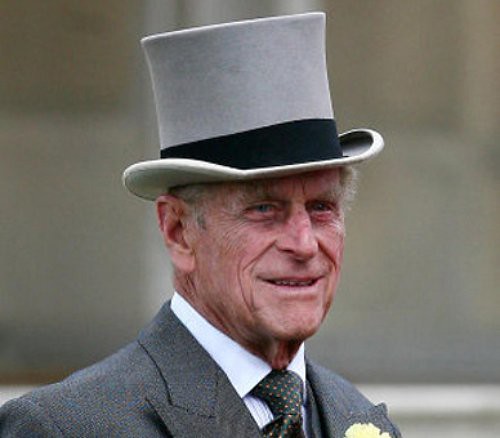
Here is a recent photo of our elegant Grand Old Duke entering his 90th year and still going about his duties as vigorously as ever. I read somewhere - perhaps quoting from the duke himself - that Prince Philip, now the longest serving royal consort in British history, has the kind of vitality and freshness of spirit that refuses to diminish with time and will never show signs of depletion - one day he will just drop, and that will be that. Of course here's hoping that is a long way away. It is gratifying to see His Royal Highness in very fine form indeed.

untitled

The Duke of Edinburgh during the Garden Party at Buckingham Palace, 22 July 2010. © Press Association

Read More »»

Tuesday, July 27, 2010

The English Fleet in the Age of Sail

. Tuesday, July 27, 2010
2 comments

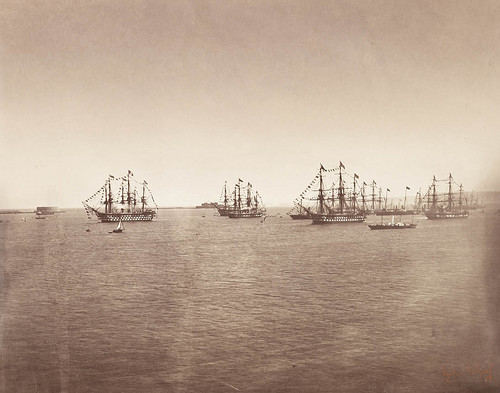
Being a navy man, I was fascinated by this end of era photograph. Here is a real life glimpse of sailing warships as it would have looked in the time of Nelson. Only two years after this photo was taken, the French Navy would commission the first fighting ironclad, which would revolutionize naval warfare in the 19th century. The Grand Imperial Fleet is clearly showing off some its muscle and technology outside of a French Bay here, because if you look closely some if not all of Her Majesty's ships have been fitted out with steam propulsion. Steam propelled wooden sailing ships could get up to speeds of 12 knots regardless of wind conditions, which could play a decisive factor in naval tactics. However, wooden ships quickly became obsolete with the invention of explosive shells (which replaced traditional cannon shot) and the corresponding need for naval armour.

4682254418_ab265c8217_b

The English Fleet at Cherbourg, 5 August 1858, by Gustave le Gray

This photograph is included in the exhibition Victoria & Albert: Art & Love at The Queen's Gallery, Buckingham Palace, until 31 October 2010.

The Royal Collection © 2010, Her Majesty Queen Elizabeth II

Read More »»

Monday, July 26, 2010

The Prince of Wales, 1852

. Monday, July 26, 2010
1 comments

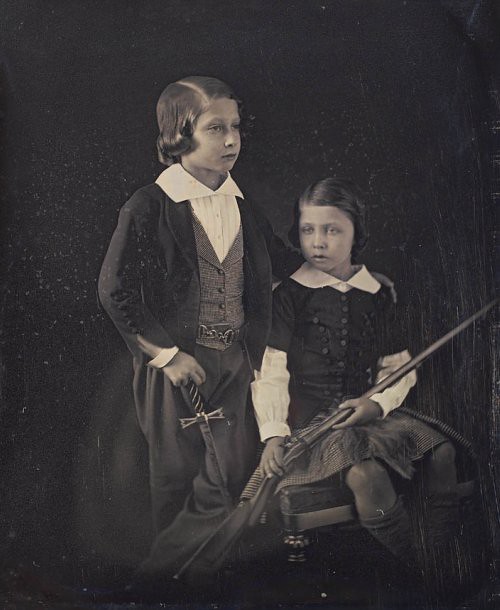
The young boy whom some 50 years later would become King Edward VII. This and more at the fascinating collection now on Flickr: Queen Victoria, Prince Albert and Early British Photography

4681603585_91a36d46a8_b

The Prince of Wales and Prince Alfred, 1852, by Theodore Brunell

This photograph is included in the exhibition Victoria & Albert: Art & Love at The Queen's Gallery, Buckingham Palace, until 31 October 2010.

The Royal Collection © 2010, Her Majesty Queen Elizabeth II

Read More »»

Saturday, July 24, 2010

A Brideshead Saturday

. Saturday, July 24, 2010
2 comments


Read More »»

Thursday, July 22, 2010

Return to Chivalry

. Thursday, July 22, 2010
5 comments

A big tip of the hat to Admiral Cod for this Argentinian find. Go over and read what he has to say about it too, it will swell your heart.

Read More »»

Roses for the Rose Queen

.
1 comments

Read More »»

Wednesday, July 21, 2010

Heartbreaking Contrast

. Wednesday, July 21, 2010
9 comments

I was reading Wikipedia's article on East Prussia and was struck by two adjacent photos that I think when juxtaposed together illustrate as starkly as possible the difference between traditional Christian monarchical Europe and modern secular republican Europe, all the more so because the hideous "House of the Soviets" stands on the very site of Königsberg Castle, tragically destroyed along with so much else in World War II. Whatever its flaws, the Europe of Kings and Princes cared about Beauty and left an unparalleled legacy of magnificence, of which Königsberg Castle was but one of countless examples. The Europe of Presidents and Bureaucrats is ugly to the core, and is fittingly represented by the House of the Soviets. The French writer Anatole France (1844-1924) perhaps foreshadowed the lesson of these two buildings when he wrote, "For every monarchy overthrown the sky becomes less brilliant, because it loses a star. A republic is ugliness set free."

(Originally posted at RoyalWorld; requested here by Beaverbrook)

Read More »»

Tuesday, July 20, 2010

Canada has a longer continuous monarchy than even England

. Tuesday, July 20, 2010
6 comments

A fascinating column by Andrew Coyne (Canada is a French country) about how Harper is subverting Quebec nationalists by reminding French-Canadians that Francis I was the first sovereign over Canada, and that Canadian history did not begin with the British Conquest under George II.

The nationalists’ conquêtisme, of course, was but a mirror to that of an earlier tradition of Anglo triumphalists, who also emphasized the Conquest (“Wolfe the dauntless hero came”) as the locus generis of the British ascendancy. As, in their own way, did a later generation of Canadian nationalists, for whom the British connection was a yoke to be thrown off, together with such colonial “relics” as the Crown, not merely to mollify Quebec but for the sake of our own psychological maturation as a people. You still hear a lot of that.

But if the history of Canada is an unbroken chain of sovereignty, Francis to Elizabeth, Champlain to Johnston; if what is important about it is not the change from French to British rule but the continuity between them—if we are not a British monarchy, or even a French monarchy and then a British one, but simply a monarchy, throughout—then the Conquest is not the pivotal event in our history: it is just an event. The effect, in turn, is to deracinate the British inheritance. What is valuable is the inheritance—Crown, Parliament, the common law, the Constitution—not its Britishness.
Of course John Cabot landed in Newfoundland in 1497 in the name of Henry VII, which predates the landing by Jacques Cartier in 1534, so is not Canada originally an English country? Or are we to believe that because Newfoundland did not join Confederation until 1949, Newfoundland is therefore not really part of old Canada. The unbroken chain of sovereignty over Canadian territory began in 1497, a fact that was not even interrupted by the brief Cromwellian republic since a French king still ruled over most of Canada at the time.

Does Canada therefore have a longer continuous monarchy than even England?

Read More »»

Sunday, July 18, 2010

"A Despotic Lieutenant Governor"

. Sunday, July 18, 2010
4 comments

Meddle no more thou busy imposers for we now have it in our power to make you curse the hour when you dared interfere with the Constitution.

Thomas Robert McInnes, the 6th Lieutenant Governor of British Columbia, was one of the most controversial vice-regals in British imperial history. After reading his turbulent biography, one wonders if his former position as superintendent of the provincial Lunatic Asylum (what they called institutions for the mentally disabled in the politically incorrect year of 1878) had any impact on his subsequent political career, especially his time as Lieutenant Governor.

While the political situation in BC at the time of his governship was turbulent (the Legislative Assembly of British Columbia was made up of factions rather than organized political parties), McInnes believed it to be his role to arbitrarily dismiss and appoint premiers without the support of the legislature or the people. The Dominion Government warned McInnes not to meddle in provincial politics, but "the Governor was not a man who cared to be dictated to by eastern capitalists concerning western political situations."

The first premier to experience the swing of McInnes' axe was John H. Turner, whom McInnes removed from office 8 August 1898. Although Turner was having difficulties forming a government amidst all the political turmoil, his dismissal was widely criticized. McInnes appointed Robert Beaven to replace Turner, but as Beaven did not even have a seat in the House, McInnes was forced to appoint his second choice, Charles Semlin as the new premier on 15 August 1898. However, when Semlin began to have problems in the House, McInnes demanded he call elections. When Semlin refused, McInnes abruptly dismissed him, and appointed his opponent, the unpopular Joseph Martin. Martin's term as premier was the shortest in BC history and he was ousted with a vote of non-confidence, which overwhelmingly passed 30-1 on 14 June 1900.

Wide public discontent with McInnes was apparent. After Martin's appointment as premier, McInnes arrived to prorogue the assembly and every MLA, aside from Martin and the speaker, walked out. The next premier, James Dunsmuir wrote to Sir Wilfred Laurier, the Dominion Prime Minister, condemning McInnes' actions as "contrary to the principles, usages, and customs of constitutional government." The Provincial Rights Association published a decree (it is worth reading the entire complaint) in which they wrote:

The People's complaints to the Provincial Rights Association

Decree No. 37
Published for the information of the People

The council of the Provincial Rights Association of British Columbia by virtue of the power vested in it by the constitution, has presented to the world a strong case against Thomas R. McInnes, Lieutenant Governor of the Province, and the Association has already been instrumental in calling the attention of the Dominion Government to the devious methods of government adopted by the said Thomas R. McInnes and his paid personal representatives.

Thomas R. McInnes has committed a series of outrages on the constitution of this Province, and therefore, on the people, beginning in 1898 and not having ended at the present hour. The man that has been his chief adviser for some time past, how long it has not yet been ascertained, is Joseph Martin a hare brained political conspirator, a modern Macduff who claims to be the Premier of this province, but who is not Premier, since this a position that belongs to the legislative assembly to confer, and no man, under responsible constitutional government, can be declared such by any autocrat, but must be so declared by the voice of the people through a majority of the legislature in session assembled. It is perfectly true that some time ago, the time not yet being a known quantity, Thomas R. McInnes selected Joseph Martin to be his chief adviser, but Joseph Martin was unable to get any members of the then existing Legislature to join his political menagerie, and he was compelled to go into the highways and the by-ways for timber, with the result that he has formed a museum of political curiosities that are in no way responsible to the people of whom the said Joseph Martin is alleged to be great friend. Thus by the royal mandate of Thomas R. McInnes, illegally and unconstitutionally exercised, Joseph Martin and his irresponsible and incapable associates are in no way the choice of the people of the great questions affecting the welfare of the Province, but are a cabal set above the heads of people who are now asked to acquiesce in a proceeding which was taken and carried out without their consent.

No man who is the subservient tool of a despotic Lieutenant Governor, who is not responsible to the people, can be a true or sincere friend of the people. The people's rights have been grossly invaded and trampled upon by Thomas R. McInnes, Lieutenant Governor of this Province and by his co-conspirators.

The Prime Minister of the Dominion, Sir Wilfred Laurier has refused to assist Thomas R. McInnes, the head, and Joseph Martin, the tail of this rump creation, and the Provincial Rights Association which steadfastly opposes all tyrants, be they representatives of the Crown, or of the people, will hunt them from post to pillar until avenging justice shall have secured their political strangulation.

Never since the days of Sir Francis Bond Head, since the later perverse folly of Sir Charles Metcalf in 1843, has there been in Canada such a bold, desperate and shame faced attempt to trample on the rights and liberties of the people as there is presented at the present hour, and each hour adds darkness to the fraud, and new attempts are being made to purchase entire constituencies wholesale by these usurpers and pretenders.

It has now, indeed, "become necessary to instruct the throne in the language of truth, "and we must if possible, dispel the delusion and the darkness that envelope it and display in its full danger and genuine colors the ruin which it has brought to our doors."

Certainly, "the people are not so dead to their dignity and duty as to acquiesce in men and measures that have thus been obtruded and forced upon them, men and measures that have reduced this fine Province to the scorn and contempt of the intelligent world. The people are asked to support men on whose records are written despotism, madness, tyranny, mis-government, misrepresentation, fraud, deception, demagoguism, ex post facto legislation, bigotry, usurpation and wrong. The horrifying banner is a fragment torn from midnight and the voices are not those of patriots and liberators, but the appeals of irresponsible adventurers skilled in the smoothness of flattery and deception and proficient in the art of political jugglery. Their legislative enactments will be a series of infamous contributions to the "statutes of fraud," while the ultimate result of their political chicanery will be certain death to Provincial credit and prosperity already on the verge of ruin, unless checked by the voice of reason and of patriotism which let us sincerely hope will receive the approval of Him, who created a system out of a "spacious void, and whose blessing we sincerely believe will not be bestowed on a tyrant like Thomas R. McInnes or a professional wrecker like Joseph Martin, assisted by Smith Curtis, the Oily Gammon of this Comedy of Errors.

We warn these three men especially, in the immortal language of Junius- "meddle no more thou busy imposers for we now have it in our power to make you curse the hour when you dared interfere with the Constitution."

HORACE F. EVANS Executive officer

Rossland, B.C., April 26th, 1900.


In response, Laurier advised McInnes to resign on 19 June 1900 and when McInnes refused, Laurier unprecedentedly advised the governor general to dismiss him from office the following day and appointed the fascinating French-Canadian from Quebec, Henri-Gustave Joly de Lotbinière as his replacement.

Read More »»

Friday, July 16, 2010

Elizabeth, Queen of Scots

. Friday, July 16, 2010
1 comments

9179984

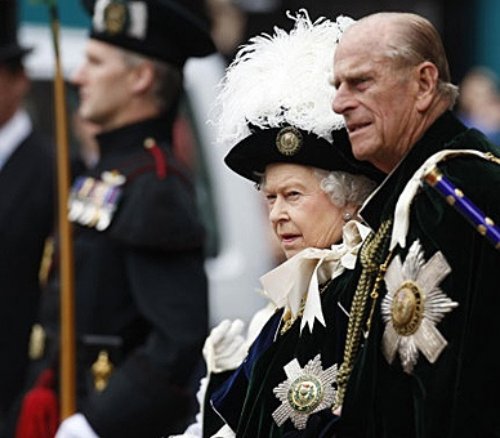
The Queen and The Duke of Edinburgh attend a Service for the Most Ancient and Most Noble Order of the Thistle in St. Giles' Cathedral, Edinburgh, 15 July 2010. The Order represents the highest honour in Scotland and is awarded to Scottish men and women who have held public office or who have contributed in a particular way to national life.
© Press Association

Read More »»

Thursday, July 15, 2010

Prime Minister of Australia admits republican agenda is elitist

. Thursday, July 15, 2010
6 comments

Julia Gillard, Australia's new prime minister, may be no monarchist, but she's no Chardonnay republican either:

"Where the republic debate went wrong was that it became too much about what people like me think and not enough about what Australian community thinks," she told the National Press Club in Canberra during her first address as prime minister.

"This has to be about a community consensus and I don't believe we are there yet."
This is a very telling statement, isn't it. It is a startling admission from the Prime Minister of Australia no less, that the whole republican agenda has been an elitist-driven project from the get-go, which did not adequately take into account the people's views. We, of course, have known this for years, but it is refreshing to hear it come directly from the Queen's first minister Down Under.

Win or lose the next election, it appears the whole matter has been safely punted into the long grass. By then Tony Abbott might be prime minister, who is perhaps the most monarchist Australian leader since Sir Robert Menzies. Rest assured, Australian republicans are eating defeat today.

Read More »»

Wednesday, July 14, 2010

Gentlemen Scholars

. Wednesday, July 14, 2010
4 comments

Pipe_scholars
Hat Tip: Admiral Cod

Read More »»

Tuesday, July 13, 2010

Australia's new Prime Minister

. Tuesday, July 13, 2010
3 comments

I would like to make three statements about the seemless transition of power from Prime Minister Kevin Rudd to Prime Minister Julia Gillard a couple of weeks ago.


1. It is wonderful to see that Cabinet Government is alive and well in Australia! I'm politically indifferent between Rudd and Gillard, but the fact that a sitting prime minister can be unseated by his peers is a good thing, and demonstrates the needed flexibility, stability and maturity of our parliamentary democracy in doing so.

2. The swearing-in ceremony was a highly dignified proceeding, and there is no doubt in watching the video who is in charge. Quentin Bryce, the Governor-General doesn't come across as merely a ceremonial rubber stamp, but as a chief of state handing over executive power to the next government in the name of Her Majesty.

3. The Oath of Office is a republican abomination. It is a shame that Julia Gillard has followed the example of Kevin Rudd in making no mention of the Queen in promising only to "well and truly serve the Commonwealth of Australia, her land and her people."

Read More »»

Prince Harry on Afghanistan

.
1 comments

Prince Harry is evidence that duty and service is still the stuff of monarchies, and a far cry from the draft dodging ways of modern republican presidents.

Read More »»

Monday, July 12, 2010

Historians find Camelot?

. Monday, July 12, 2010
1 comments

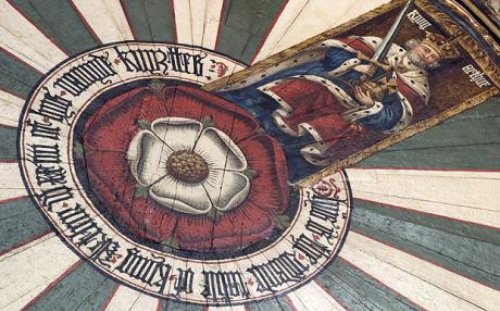
Historians claim to have found the site of King Arthur’s Round Table – and believe it could have seated 1,000 people.

VB-00017227-001

Researchers exploring the legend of Britain’s most famous Knight believe his stronghold of Camelot was built on the site of a recently discovered Roman amphitheatre in Chester.

Legend has it that his Knights would gather before battle at a round table where they would receive instructions from their King.

But rather than it being a piece of furniture, historians believe it would have been a vast wood and stone structure which would have allowed more than 1,000 of his followers to gather.

Read More »»

Where do you lie on the monarchist spectrum?

.
27 comments

On a scale of one to ten, one being the least supportive (fanatically against) and ten being the most supportive (fanatically for), what following statement best summarizes your attitude and belief in the monarchy? (Note to readers that I have personally assigned myself a score of 8.7, somewhere between devout Anglophile and High Church Tory.)

1.0 Latent Anti-Monarchist: The British Crown is an intolerable relic and an embarrassing reminder of our colonial past. The institution offends me deeply because it is racist, undemocratic and historically oppressive, having subjugated or killed millions of people at the height of its imperial crime. I have an instinctive and reflexive hatred for the monarchy and would like nothing better than to send Mrs. Windsor packing. I need the monarchy like I need a hole in the head.

2.0 Carping Republican: The monarchy is a ludicrously outdated genetic lottery and a colossal waste of my taxes. It is a completely ridiculous, cringe-inducing soap opera about a family of rich dullards who look like horses. All arguments in support of this colonial hangover can be boiled down to sentimental traditionalism or self-justifying poppycock. When are we going to ditch the foreign Queen and finally grow up?!!

3.0 Levelling Modernist: I have a profound distaste for snobbery and all forms of hierarchy. The monarchy goes against equality and runs counter to modern values such as democracy, diversity and human rights. I feel sorry for the Queen and her family for the unnatural, fish bowl life that they are forced to endure to satisfy the parading appetite of pompous monarchists. The royals are victims. I want to free them from the hell of monarchy.

3.5 Radical Whig: Hereditary monarchy is anachronistic and the Queen is constitutionally and politically useless. I'm an enlightened republican who fervently believes we need an elected president who can legitimately check the legislative and executive power of the prime minister. I also believe we need a head of state who truly represents the citizens of our country and the nation abroad. The Queen is not above politics and cannot be the focus of national unity because the monarchy itself is a divisive political issue.

4.0 Chardonnay Republican: I am basically a morally superior elitist with ironic resentment and contempt towards the monarchy. Even though the whole institution runs contrary to my philosophical goals, Her Majesty is a lovely lady and I crave the spotlight of her company over a glass of Chablis. I make the common mistake of evaluating the monarchy against my own little world, but if I can portray my base instincts and republican agenda as moral superiority and be exalted as a commoner's demigod in the process, my social and intellectual needs are met.

4.5 Crypto-Republican: I am the eternal optimist who believes a republic is inevitable. I have to be coy about revealing my true intentions when attempting to provoke a public debate about the monarchy because I often work in the media. But you can usually spot my mischief as I like to wrap my bias in a cloak of fairminded evenhandenness by asking the neverending question: Is the monarchy still relevant?

4.9 Ignoramus: We have a Queen? If that is true, then I support getting rid of it.

5.0 Couch Potato: Who cares, the monarchy is irrelevant. Royal visits intoxicate me with boredom. I wouldn't lift a finger to defend it, nor would I agitate to replace it. When it comes right down to it, the monarchy just doesn't matter.

5.5 Milquetoast Monarchist: I know the monarchy is good for tourism, but I don't really follow it all that much. To me, the monarchy is just a symbol and essentially harmless. I suppose if it ain't broke, don't fix it.

6.0 Royal Watcher: I am not a monarchist per se, just fascinated by royalty. The Queen is the single-best argument for keeping the monarchy alive. I love the fabulous hats she wears, and I can't wait for the next royal wedding. I have a crush on Prince Harry.

6.5 Crypto-Monarchist: I am uncomfortable to admit as much, but I am a monarchist. I have serious misgivings about dumping the monarchy, but because there is something inherently silly in defending the fantasy of being ruled by kings and queens, I either remain quiet or meekly conform with republican assumptions. Sorry, but I have a day job and must maintain appearances.

7.0 Traditionalist: The monarchy is part of our tradition and I strongly support keeping it, much as I would an old vintage wine. If we were a republic, then I would probably support that, but we have never been a republic. Every nation and every people must subscribe to a history which collectively defines its substance. We stand at the end of a proud tradition, stretching back into the mists of time. You could no more remove the monarchy from Britain than you could remove winter from Canada. Blessed are those societies whose institutions endure long enough to become "anachronistic."

7.5 Constitutionalist: We are the proud legal heirs to centuries of peaceful constitutional evolution. I declare my allegiance to custom, convention and continuity, even in reform, and joyfully receive the rights of free Englishmen guaranteed us by Her Majesty our Queen, under Magna Carta and the Act of Settlement. I affirm that the civil and religious rights guaranteed by them lie at the heart of our national life. I uphold the role of the pillars of social order; that is, Her Majesty the Queen, the Police, the Armed Forces, and the other agents of the civil government in its proper, limited sphere. I further affirm that the great duty of a nation is to preserve its unique identity as defined by its culture, its traditions, and its heritage.

8.0 Fervent Loyalist: In an era of self-involved celebrities spewing mind-numbing moral relativism, the Queen is a true icon – one who hails from a time before radical individualism took over as the guiding principle of our age. Stoic, tactful, duty-bound and utterly self-contained, she is the human embodiment of an absolutist ideal. In a world without manners, the monarchy represents style, grace, virtue, honourable tradition and loyalty to noble values. God Save the Queen!

8.5 Devout Anglophile: I'm a Churchillian, a supporter of the British Commonwealth and a loyal subject of Her Majesty. I believe sincerely that the binding, defining and inspiring power of the monarchy is indissolubly linked with the pomp and ceremony of the institutions of Great Britain, its Crown, and their associated grandeur. If these British Royal associations are removed or alienated, our institutions will cease to have the same fundamental meaning, merit, prestige, gravitas and intrinsic power. The British Monarchy is the link between the Motherland and her many outposts, independent, yet always united, in culture, law, language, sport and love of our collective Queen.

9.0 High Church Tory: I am the archetypal aristocratic conservative with the manners and style of a true gentleman. As a classically-educated believer in high culture, I am suspicious and cool towards democracy and have an entrenched dislike of contemporary popular culture. My whole ethos can be summed up with the phrase God, King and Country. Although fiercely loyal to Her Majesty who is a Christian Prince, I strongly sympathize with Jacobitism and divine monarchist ideals. The monarchy is more than an ancient glory, it is a sacred trust.

9.5 Staunch Jacobite: The House of Windsor are German usurpers and not the rightful kings of Britain. The Revolution of 1688 was not glorious, it was a Whig heresy, an Orange conspiracy and a Dutch invasion of Britain with the consent of a treacherous, anti-Catholic Parliament. By deposing the legitimate hereditary sovereign through a coup d'etat and unlawfully circumscribing the monarch's power, Parliament has steadily increased its influence at the expense of the Crown and the natural equilibrium between monarchy, aristocracy and democracy has been irretrievably lost. Thanks to mass democracy, we now live in a collective dictatorship. Long live the memory of Bonnie Prince Charlie!

10. Royal Absolutist: I believe in divine right and the natural power of kings. The character of Kings is sacred; their persons are inviolable; they are the anointed of the Lord, if not with sacred oil, at least by virtue of their office. Their power is broad - based upon the Will of God, and not on the shifting sands of the people's will. They will be spoken of with becoming reverence, instead of being in public estimation fitting butts for all foul tongues. It becomes a sacrilege to violate their persons, and every indignity offered to them in word or act, becomes an indignity offered to God Himself.

Read More »»

Sunday, July 11, 2010

"conspicuously towards barbarism"

. Sunday, July 11, 2010
2 comments

From the estimable Mr Warren:

Good manners, and at the apex of the state even grand manners, are unquestionably an expression of "homo ludens," of man at play. But as those who have thought with some patience about the human condition have observed, the rules of such "games" are very important. They are the outward expression of a nation of laws not men; of men who serve offices and not vice versa. To behave informally, where formality is required, is to exhibit narcissism.

It should also be said that the office of the Canadian viceroy is an exemplary one. The uniform of the governor general was not only an outward symbol of monarchy (and therefore a reminder of our whole inheritance of British freedom). It was, too, the key to an order in which even the butcher wore a tie, under his apron, as the mark of his respect, including self-respect; in which the bus driver wore his cap and blazer; in which the housewife and mother dressed in vivid awareness of the tone she was setting for her own children, and for all children.

That Canada has passed away, not because it did not work but because it was methodically done in; and the trend since has been conspicuously towards barbarism.

To which I can only say, Amen.


Read More »»

"Bring Back the Act"

.
0 comments

The British have it, and we want it:

The act, printed on vellum and held with thousands of other parliamentary records in a document repository in London, was adopted by British lawmakers and signed by Queen Victoria several months before Canada's birth on July 1, 1867.

While Library and Archives Canada possesses paper copies of the document, the animal-skin originals have remained in British hands for the past 143 years.

British officials have, in the past, rejected requests to surrender the historic legislation.


Well, look at it from the Brits' perspective. How would you like a bunch of foreigners, even if they are family, removing bits and pieces of your national records? The British North America Act (officially renamed Constitution Act, 1867 by the anglophobic Trudeau government at the time of patriation) is just another act of the Mother Parliament, one among many thousands. It's our birth certificate, but Westminster issued quite a few of these over the centuries. What happens when all the old colonies come rummaging through the archives, grabbing this old vellum and that?


With the backing of some historiographical heavyweights, including Jack Granatstein, a "Bring Back the Act" campaign has been started. The marketing boys must have outvoted the nitpickers on that slogan, the Act was never in Canada. We are not bringing it back, we are taking it for the first time. It's been gathering dust in that archive, with fishing legislation and assorted treaties with long defunct states, for the better part of a century and a half.


My own sentiments are divided on this one. Yes, there is an inherent coolness - well for me anyway - of having the BNA on Canadian soil. On another level the whole campaign smacks of a pinning for an American-style veneration of our constitution. But therein lies the rub. We are a constitutional monarchy not a constitutional republic. The U.S Constitution and Declaration of Independence are the fountainhead of America, and Americanism. We have different origins and a different history.


The BNA didn't create Canada, it was an administrative reorganization which created the federal government. While some of the Fathers of Confederation did hint, that at some point in the distant future, we would become independent, that wasn't in the cards then. Indeed, one of the major goals of Confederation was to prevent Canada from becoming independent. Many of the leading Fathers - Macdonald, Brown and Galt among them - were terrified that Britain was getting fed up with its quarrelsome North American possessions.


Why risk a war with the emerging United States over Canada? Why risk the lucrative trade and commercial links between Britain and America? All for a "few acres of snow," as Voltaire had called us? "We must make ourselves powerful," said John A. If Canada looked like something big and important, Britain would think twice about cutting us loose. When John A was given an audience with Queen of Victoria, after Confederation was a done deal, he told Her Majesty that the whole point of the exercise was to ensure that Canada remained loyal to her, and her descendants, "forever."


The BNA was just a piece of legislation, subject to the traditions of the British constitution, and future revisions as deemed necessary by the relevant parties. The Act simply does not play the same role in Canadian history as the American constitution does in their history. The attempt to "Bring Back" the BNA seems to be another example of imported Americanism with a Maple Leaf slapped on the side. I like America, I like Americans, the Fathers of the American republic are personal heroes, but I'm not American. I'm Canadian. In Canada the fountainhead of our constitutional traditions is the Crown.


Read More »»

Never Tickle a Sleeping Dragon

.
5 comments

Mr. John Key has been in China lately, talking up New Zealand's Chinese future.


New Zealand know-how, Chinese capital.
New Zealand businesses, Chinese partners.
New Zealand lamb and butter for Chinese T-shirts.

Free trade, and a truce with Coca-Cola Communism.

I studied Mandarin for two years, and have many Chinese friends. There is no Yellow Peril ick factor here. Free trade with India, Thailand, Singapore and Japan doesn't bother me a jot.

But China?

China imprisons priests and nuns, Falun Gong members and political dissents.
China continues the oppression of Tibet.
China is a huge, militaristic, Communist dictatorship.

China does things like this:


What partnership is there between a dragon and a mouse?
What power equality is there between tyrants and the people they victimise?
What influence do we really have with the Chinese?

Apparently not much.

Read More »»

Friday, July 9, 2010

A Gentleman for Governor General and a Stalwart Defender of the Canadian Crown

. Friday, July 9, 2010
4 comments

20100708_PM_GG_Subpage

Prime Minister Harper's team of "ardent monarchists" has chosen well. David Lloyd Johnston, who will become the Queen's next vice-regal representative in Canada, is a highly respected political moderator, legal scholar, university president and constitutional monarchist who vows to be "a stalwart defender of our Canadian heritage, of Canadian institutions and of the Canadian people". Above all, and having followed him for many years as a non-partisan moderator of political debate on television, he is an impeccable gentleman with a distinguished record of public service. I am sure he will perform brilliantly in his new role as Governor General. This is a fine choice indeed!

Read: Incoming governor general proud to serve Canadians - CTV News

Read More »»

Wednesday, July 7, 2010

The Queen in New York

. Wednesday, July 7, 2010
0 comments


Read More »»

Tuesday, July 6, 2010

The Queen in Toronto

. Tuesday, July 6, 2010
0 comments


Read More »»

Monday, July 5, 2010

The Queen in Winnipeg

. Monday, July 5, 2010
0 comments

Read More »»

"Ardent monarchists"

.
4 comments

Advising the Prime Minister?

4751074780_d8d33f526e

Ardent monarchists close to Stephen Harper are helping to pick the next Governor General, who is likely to be more of a Buckingham booster than recent representatives of the Queen, insiders say.

Conservative sources say Ray Novak, the prime minister's principal secretary, and Kevin MacLeod, Canadian secretary to the Queen, have been involved in the search. They say both men are strong supporters of Canada's links to the monarchy.

"Only a few people in government care about it, but they care about it fiercely," said one source.

At least someone in government does! A determined minority can accomplish quite a lot. Including keeping the monarchy alive in the years ahead. It's true that from a purely constitutional perspective the Queen's position in Canada is impregnable. All ten provinces and the federal government couldn't agree on the entree at a restaurant, much less dramatic constitutional change (last week we marked the 20th anniversary of the death of Meech). Still, Ottawa's caste of determined crypto-republicans, some of whom are working at Rideau Hall, continue to plot.


One of the most frequently mooted approaches would be to fail to proclaim the next monarch. That would leave a constitutional vacuum to be filled by an appointed or elected head of state. Canadian republicans know that the current sovereign is too popular to be overthrown, and denying her grandson the throne is likely to raise strong objections as well. They have zeroed in on Prince Charles as the weak link in the line of succession. Who succeeds to the throne, of course, is of secondary importance. It is the institution of the monarchy which needs to be preserved. Personally, I believe the Prince will turn out rather well. Yet the principle remains, we should not confuse individuals with institutions. We don't junk Parliament because the Prime Minister of the day is a fool or coward - otherwise parliament would have been done away with centuries ago.


Talk, sometimes even from confused monarchists, of skipping Charles and going straight to William is very dangerous. The second you transform the succession into a popularity contest, the monarchy is done and finished. It becomes American Idol or Britain's Got Talent with better scenery. Either you have a hereditary monarch or you don't. By continuing to remind the public of this basic idea these "ardent monarchists" are doing their country a great service.


If Canada were to lose the monarchy, either from direct constitutional challenge or simple neglect, we would lose far more than its pomp and circumstance. The ordinary person - who is ignorant of the Crown's role in our history, and indeed of that history itself - might not care much if Canada became a Republic. This is all the more worrisome. A nation without a sense of its own history and traditions (the later being an embodiment and reminder of history) is a nation of amnesiacs. The amnesiac does not know what he lost, so in a limited sense he feels little pain, regret or longing. Yet imagine his state. Without memory he is without identity, susceptible to suggestion and temporary impulses. All the days of his life filled with a nagging doubt he can't quite define. The question of monarchy vs republic in this country is one over the soul of Canada. Are we a nation with roots and tradition, or a nation of insecure juveniles constantly reinventing itself?


Read More »»

Sunday, July 4, 2010

The Lost America

. Sunday, July 4, 2010
4 comments

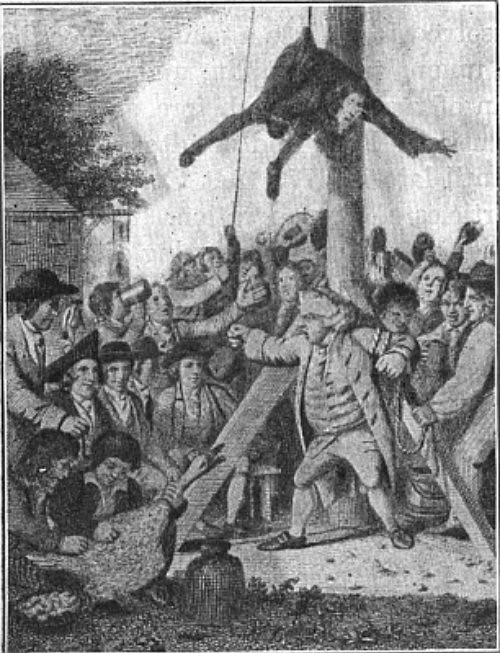
Burke's Corner on The Lost America. He reminds us of a more settled, ordered and peaceable polity prior to the runup to 1776, which was less aggressive and less populist than the tradition that ensued after the revolution.

Lynching
The lynching of an American Tory

James Hall on a previous diatribe against present day American Tories, proves this point with this statement:

A real conservative is a revolutionary in the pursuit of individual rights and an advocate of constitutional protections and limited government.

In the American tradition, this anti-Burkean statement is probably on the mark as it relates to so many of today's "conservative" talk shows in the United States. The voice of Russell Kirk is of an older American tradition that doesn't see the country's starting point in the year 1776, but it is a small minority and cannot be heard under the thunderclap of Republican America.

We continuously hear what was gained by America on Independence Day. We rarely hear what was lost when about a quarter of the colonist population was persecuted for their American loyalist beliefs. But heh, Happy Independence Day all the same to our American (who represent the majority of our readers) friends.

Read More »»

British Crown Dependencies seek new
Lieutenant Governors

.
0 comments

The three British Crown Dependencies are Guernsey, Jersey & the Isle of Man. Apply here if you wish to be considered for Lieutenant Governor of the Isle of Mann. The application deadline is July 30th.

Commonwealth or Irish citizens are equally eligible to apply, as the Crown dependencies are not in political union with either the United Kingdom or the European Union. However, "a distinguished military service background at the highest level" is specified.

The post of Guernsey's lieutenant governor, which comes with a tax-free salary of £105,000, has been advertised.

The post, which would be taken up in April, has been advertised in the Times newspaper by the Ministry of Justice.

Applicants have been told they must have a full and distinguished military career.

Candidates need to apply to Guernsey's Bailiff's chambers for an application pack.

The advert said the island's authorities would decide the appointment, a move away from past appointments, which were made by the Queen from recommendations drawn up by the Ministry of Justice.

Vice Admiral Sir Fabian Malbon (photo right), the current lieutenant governor, is due to continue in his post until his successor takes up the role.

The lieutenant governor's main duties are primarily diplomatic and ceremonial.

Read More »»

Saturday, July 3, 2010

So Her Majesty comes to town and the Prime Minister dispatches the Governor General to China

. Saturday, July 3, 2010
1 comments

Is this not an abuse of protocol, should not the country's vice-regal accompany the Queen throughout her entire tour while she is here? No, it is not. It is well and proper for the Governor General to be the first to greet Her Majesty on her arrival and the last to say goodbye, but beyond that you might as well call the monarch's representative woefully unemployed for the nine days that the Monarch is in the country. If the vice-regal's job is to represent the Queen while she is out of the country, then when she is in the country it is just as well that the Governor General disappear altogether.

2199182
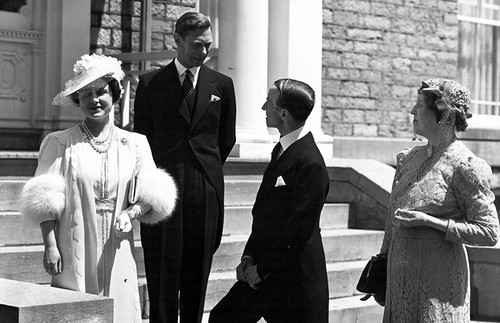
The King and Queen with Lord Tweedsmuir, Governor General of Canada

In 1939 this protocol question was wrongfully resolved. The Governor General of the day, Lord Tweedsmuir, rightfully considered it his role to greet the King and Queen on their arrival in Canada, and escort them to Ottawa, thereafter Prime Minister Mackenzie King would then accompany them for the rest of their journey. Mackenzie King, however, wanted to be the one to welcome the royal couple when their ship arrived, and so forced his way. The staff at Laurier House and Rideau Hall debated this point furiously in the weeks leading up to the royal visit. In the end, the Governor General's role was diminished even further than he had anticipated. He did not greet the King and Queen until they reached Ottawa some days later. There they stayed with him and his wife at Government House, and he joined them for the farewell in Halifax. Tweedsmuir was scandalously denied the right to greet the royals upon their arrival, and to his credit understood that once the royal standard is firmly planted on native soil, it was his job to assume a significantly diminished role.

Read More »»

Friday, July 2, 2010

The Queen embodies Canadian Identity

. Friday, July 2, 2010
1 comments

Our previous post on the possible benefits of patriating the monarchy insinuated that the royals do not embody our national identity because they are British. This is not really correct, since the Queen does embody other national identities, as Her Majesty has effortlessly demonstrated in her current visit to Canada.

2010-07-01-2

While the Queen is in Canada she comes across as Canadian as maple syrup, as tens of thousands of Canadians celebrate her presence as the very focal point of our national identity. We lose sight of this fact because Her Majesty is mostly out of residence, and mostly a product of her British environment. But there is an unmistakable bond and human attachment between Queen and Country while she is here. All that genuine cheering is evidence that Canadians are not welcoming a foreign Queen at all, but one of them.

Read More »»

Thursday, July 1, 2010

Happy Dominion Day

. Thursday, July 1, 2010
2 comments

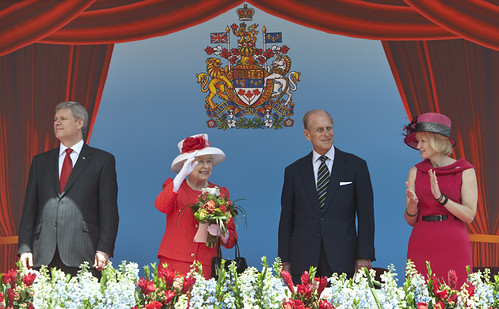
Hats off to this government and prime minister for once again prominently displaying the Royal Arms of Canada. Previous governments would have merely festooned the place with national flags, whether the Queen was present or not. Harper's restorative incrementalism is once again on full display.

1028_20100701_PM_CanadaDay_photoalbum_37


(By the way, even though the Royal designation has not formally been restored to the Navy yet, notice how ministers seem to use every opportunity to say Royal Canadian Navy. I sense that the government feels that a simple proclamation from the Queen is not sufficient, that the motion currently before the Senate needs to proceed first.)

Read More »»

Some Comments on the Royal Visit

.
7 comments


Her Majesty has once again returned to the Elder Dominion!

This has, sadly, led to the usual republican carping. You've heard it all before.


The monarchy is obsolete they say. But style, grace, virtue, honourable tradition and loyalty to noble values is never obsolete.


The monarchy is unrepresentative. Life is not representative. It is only the jacobin and utopian who wishes to mangle all our institution into statistical conformity.


The monarchy is unCanadian. Canada has never been a republic. The very thought was considered absurd until only a few years ago. The Crown is as Canadian as maple syrup. Canadians revered the monarchy long before they started playing hockey.


The monarchy is British. Even if this is so, why is that a problem? With the exception of the classical civilizations of Greece and Rome, who laid the foundations of Western Civilization, no other political force in history has done more good that the British Empire. Reminding Canadians of that fact is a wise exercise at any time. In remembering out past we affirm to ourselves the wellspring of our prosperity, peace and freedom.


The monarchy is unpopular. We hear continually that Canadians are apathetic toward it. This is not surprising. People are often apathetic to that which they do not understand. For forty years educators, civil servants and politicians have striven mightily to erase the monarchy from Canadian history and civics classes. Teach and they will understand.


The monarchy is elitist. We are born with equal rights, not with equal talents or gifts. The law is the same for all - the Queen's law incidentally. Some are born handsome, others plain. A few can run fast or speak well, others stagger in foot and tongue. There are few things more pernicious than a levelling belief. Behind the leveller is not a noble aspiration but something quite dark, the sin of envy.


The monarchy is undemocratic. The most common objection. Democracy is useful for somethings, such as choosing certain public officials. It would be absurd to imagine - sadly a common absurdity in our era - that a mere political mechanism has some sort of inherent moral value. Beauty, truth, virtue, compassion, justice and reason are not the products of majority votes. Old King Canute could not command the waves, neither can a democratic Leviathan. It's no use saying you didn't vote for who sits on the throne, you also didn't vote for your parents. Are your parents therefore illegitimate? Experience shows that somethings are best left to the accidents of nature.


The monarchy is foreign. Canada is not alone in the world. We are part of a great family of free nations, stretching across the globe. The monarchy is a living link to that family. Why would we wish to abandon our kith and kin? For what? A lonely nationalism? Parochialism is not a virtue.


The monarchy is a reminder of old values that have fallen out of fashion. The Queen and her Consort are living reminders of those values in their speech and deed. They are not perfect, for no human thing ever is. The monarch is an exemplar and does not pander. The monarchy is traditional, and tradition is accidental, as is wisdom. It does not matter how we learned, we have learned this and should keep it. Why must so many strive to forget? Amnesia is not a state to be desired, the jacobins be damned.


Over the last weekend violence erupted in Toronto, as so-called protestors ran havoc through the streets of the downtown area. Their malignant energies directed at an international conference, whose protection required the expenditure of a billion dollars. This is far more than has ever been spent defending Her Majesty's person.


As she makes her progress through Canada we can be assured of certain things:


Gangs of monarchists will not start smashing windows and attacking police officers.


Neither Her Majesty, nor her many admirers, will resort to using profanity to express themselves.


The highlight of her visit will be commemorating the 100th anniversary of the founding our navy. On show will be Canada's finest, who have dedicated themselves to the service of Crown and Country. They use violence as a last resort in the defense of life and liberty. Not as a method of "communicating," as do some small children and most barbarians.


Her Majesty will cast a light upon the best of Canada.

Read More »»

Hatfield and the Crown

.
0 comments

How the Premier of New Brunswick secured the future of the Crown:

Every time the queen comes to Canada, and this is her 24th visit, polls show Canadians indifferent to the crown, with many favouring its abolition. Tell us something we don't know.

It isn't going to happen. And proponents of our constitutional monarchy have Richard Hatfield to thank for it.

"I got the queen in there," Hatfield, then premier of New Brunswick, said delightedly at his hotel suite in Ottawa in November 1981, following the conclusion of the talks that led to the patriation of the Constitution from Westminster with the Charter of Rights.

Rene Levesque and Quebec went home empty-handed, but Hatfield got the queen entrenched in the constitutional amending formula, requiring unanimous consent of Ottawa and the provinces for any change to her role and status.

Much to the chagrin of Canada's then Prime Minister, a crypto-republican, Pierre Trudeau. Sometimes the good guys do win.


Read More »»